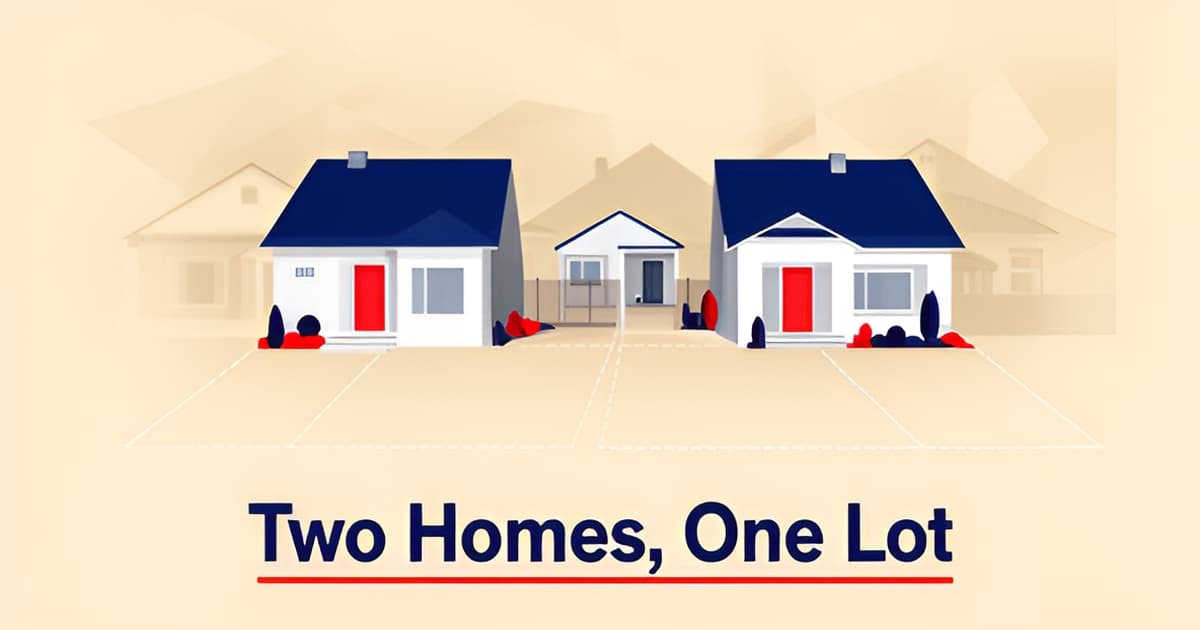
Two Homes on One Lot in California: Duplex vs SB 9 vs ADU Paths
Key Facts
- Only an SB 9 lot split creates a separately sellable lot — ADUs and duplexes keep both homes on one title, per practitioner comparisons.
- ADUs grew to nearly a fifth of all new housing units permitted statewide in six years, Terner Center research shows.
- Los Angeles led SB 9 activity with 28 lot split applications — zero approved — and 211 unit applications with only 38 approved, per Terner Center data.
- A Terner Center co-author called SB 9's first-year housing impact negligible, citing low awareness and overworked planning departments.
- Each SB 9 lot split parcel must be at least 1,200 square feet with a roughly 40–60 size split, per LA County Planning.
- Practitioners report SB 9 lot splits cost $50,000–$70,000 in fixed fees, take 10–18 months, and add $250,000 to $1 million in value, per WIRE Associates.
- An SB 9 split doesn't trigger Prop 13 reassessment — only per-parcel fees of roughly $200–$1,000 yearly, practitioners report.
Three Legal Paths, One Confusing Landscape
You own a single-family lot in Altadena — maybe a hillside parcel your family has held for decades, maybe a rebuild site after the Eaton Fire — and you keep circling the same question: can I put a second home here? The answer is yes, potentially, but California gives you three different legal routes to get there, and homeowners routinely confuse them.
The three paths look similar on the surface but diverge sharply underneath. Design and permitting guides consistently separate them: an SB 9 two-unit development (two primary residences on one parcel), an SB 9 urban lot split (subdividing into two independently owned lots), and an ADU or JADU (a second dwelling subordinate to your primary home, all under one title).
- SB 9 two-unit development: two equal primary residences on one lot — neither subordinate to the other, unlike an ADU.
- SB 9 urban lot split: divides the parcel into two lots, each generally at least 1,200 square feet, in a roughly 40–60 size split per LA County Planning.
- ADU/JADU: a second home that stays on your existing lot and title — a JADU maxes out at 500 square feet inside the existing house, per practitioner guidance.
Here is the distinction that matters most, and the one most homeowners miss: only a lot split creates a separately sellable lot. An ADU and an SB 9 duplex both leave everything on one title — you can rent them, live in them, or leave them to family, but you cannot sell the second home on its own. A recorded lot split, by contrast, is permanent and hard to undo, which is why practitioners frame the choice as a decision tree: ADU for least friction, duplex as the middle option, split only when a sellable lot or maximum density is the goal.
The rules on owner-occupancy differ too. Lot splits require an owner-occupancy affidavit, and JADUs require owner occupancy, while standard ADUs and the SB 9 two-unit right often do not — a meaningful difference if you are weighing a future sale or a move.
Adoption patterns tell their own story. Terner Center research found most large California cities received only a handful of SB 9 applications in the law's first year — some reported none — while ADUs grew to nearly a fifth of all new units permitted statewide. For Altadena homeowners, eligibility screening comes first: LA County applies fire, earthquake, and flood hazard constraints that matter enormously on hillside and rebuild parcels. At Altadena Custom Home Builder, we start every conversation with that feasibility question — which path your lot actually qualifies for — before anyone sketches a floor plan.
The Data: Why ADUs Dominate While SB 9 Moves Slowly
If you want proof that California's "two homes on one lot" laws work very differently in practice, look at the numbers. ADUs have grown to nearly a fifth of all new housing units permitted statewide in just six years, while SB 9 — the law that promised duplexes and lot splits on single-family parcels — has barely moved the needle.
Terner Center research tracking SB 9's first year found that most large California cities received only a handful of applications — some reported none at all, even as homeowner inquiries ran high. Los Angeles led the state in activity, yet the raw counts were striking:
- 28 lot split applications filed — 0 approved
- 211 SB 9 unit applications — only 38 approved
- San Diego, which permitted 871 ADUs in 2021, saw just 3 lot split applications and 7 unit applications, with none approved
A Terner Center co-author called SB 9's first-year impact on housing supply "negligible," citing low public awareness and overworked planning departments across the state. The math is sobering given the 2021 Terner estimate that over 700,000 new homes became newly feasible under the law.
Planners interviewed by Terner hypothesize that California's more prescriptive ADU laws — limited impact fees, larger allowed units, and no owner-occupancy requirement for standard ADUs — are pulling homeowners away from SB 9 entirely. ADU approval is also ministerial in most cities, a faster, by-the-rules review with far less discretion.
SB 9 also carries friction ADUs don't. Some cities impose requirements on SB 9 projects that state law prohibits for ADUs, and local design rules and unit-size caps can quietly make projects infeasible. Geometry matters too: homes centered on smaller lots make adding a second house "geometrically difficult," while larger-lot suburbs like Saratoga and Danville overperformed big cities.
Still, the SB 9 lot split offers something no ADU can — a separately sellable lot. Practitioner-reported figures show net value increases of $250,000 to over $1,000,000 from the split alone, with all-in fixed fees of $50,000–$70,000 and timelines averaging 10–18 months. One reported client sold a newly recorded lot for $1,000,000 within two weeks of recording.
Those figures come from promotional industry sources and haven't been independently verified, so treat them as directional, not guaranteed. For Altadena homeowners weighing these paths on hillside or rebuild parcels, a feasibility-first conversation beats starting with design — Altadena Custom Home Builder offers a free build consultation to sort out which path your parcel actually supports.
Altadena Reality Check: Hazard Zones, Slopes, and Lot Geometry
Altadena's hillsides, canyons, and fire-scarred parcels make SB 9 eligibility screening anything but a formality. Before sketching a single floor plan, you need to know whether your lot can legally split at all.
LA County Planning — which governs Altadena's unincorporated parcels — confirms that SB 9 projects face fire, earthquake, and flood hazard constraints on top of the standard state rules. For a community still rebuilding after the Eaton Fire, that screening layer matters as much as lot size. Hillside lots with steep slopes and constrained access often fail before design questions even begin.
The geometry rules are strict. Each resulting parcel from an urban lot split must be at least 1,200 square feet, and the two lots must be roughly equal in size — no more than a 40–60 split of the original lot area, per statewide SB 9 guidance. An irregular flag lot or a parcel whose buildable area sits on one slope may satisfy the square footage on paper yet still be geometrically impractical.
Two more constraints deserve early attention:
- One-time-only splits. A parcel created through an SB 9 lot split can never be split again — the decision is essentially permanent.
- Tenant demolition cap. If the home was tenanted in the last 3 years, no more than 25% of the residential structure may be demolished (garages are generally exempt).
- Hazard-zone overlays — fire, seismic, and flood — can disqualify a parcel outright in unincorporated LA County.
This is why the most common homeowner mistake is starting design before confirming the permitting pathway. As planning practitioners note, lot shape, slope, access, and existing improvements matter as much as raw lot size — and assuming a backyard is automatically buildable leads to expensive dead ends.
For Eaton Fire rebuild parcels, the calculus shifts again: a teardown-and-rebuild scenario interacts differently with the tenant demolition rules, and slope conditions may push an ADU ahead of a duplex or split in feasibility. The right answer depends on your parcel's specific geometry and hazard mapping — which is why Altadena Custom Home Builder recommends confirming the pathway first, then designing to it. If you're weighing a duplex, SB 9 split, or ADU on a hillside or rebuild lot, JMB Builders LLC (CSLB #1103479) offers a free build consultation to assess what your parcel can actually support.
Choosing Your Path: Costs, Timelines, and Reversibility
The best path depends less on what your lot allows and more on what you actually want: rent, a second home, or a saleable asset you can cash out.
If your goal is rental income or family space, the ADU is the least-friction route. ADU approval is ministerial in most cities — a by-the-rules review rather than a discretionary hearing — and state ADU law limits impact fees and imposes no owner-occupancy requirement on standard units, per the same practitioner comparison. The market reflects this: ADUs grew to nearly a fifth of all new units permitted statewide, while most large cities saw only a handful of SB 9 applications, Terner Center research shows.
If you want two primary residences on one lot, the SB 9 duplex is what one practitioner calls "a strong middle option." Unlike an ADU, the second unit isn't legally subordinate to the first — you get two full dwellings under one title. The trade-off is that some cities attach requirements to SB 9 projects that state law prohibits for ADUs, and local design rules can quietly make a project infeasible, as design-firm guidance warns.
If your goal is selling land or maximum density, the lot split is the only route that creates a separately sellable lot. Practitioner-reported numbers from WIRE Associates put the all-in fixed cost at $50,000–$70,000 (fees, surveys, legal, recording), with a 10–18 month contract-to-recording timeline — LA City running longest. Their rule of thumb: the economics generally pencil when the pre-split property is worth around $600,000 or more, with reported net value gains from $250,000 up to $1 million. Treat these as practitioner figures, not neutral data.
Three facts soften the lot split's risks and sharpen its limits:
- A split does not trigger Prop 13 reassessment — only per-parcel assessments (~$200–$1,000/year extra); reassessment happens only when a parcel changes title.
- Lot splits require an owner-occupancy affidavit; standard ADUs and the SB 9 two-unit right generally do not.
- A recorded split is hard to undo, and the new parcel can never be split again.
That last point deserves weight. As the comparison puts it: an ADU rarely closes doors, while a recorded lot split is hard to undo. You can add an ADU now and pursue a split later — but not the reverse. And in Altadena, where hillside slope, access, and fire-hazard constraints shape what's buildable at all, lot geometry matters as much as lot size. LA County Planning confirms fire, earthquake, and flood hazards are additional SB 9 constraints in unincorporated areas.
If you're weighing these paths on a hillside or rebuild parcel, Altadena Custom Home Builder offers a free build consultation to sort feasibility before you spend on design or applications.
Your Next Step: Feasibility Before Blueprints
The most expensive mistake in a two-homes-on-one-lot project isn't construction — it's designing the wrong project for the parcel. Practitioners consistently see homeowners start design work before confirming the permitting pathway, assuming a backyard is automatically buildable or that SB 9 applies to every single-family lot (design-firm guidance warns against exactly this). A feasibility-first sequence protects your budget before a single blueprint exists.
Start with jurisdiction. Altadena sits in unincorporated LA County, so LA County Planning's SB 9 rules govern most parcels — but confirm your parcel isn't within another jurisdiction's boundaries, since local ordinances on unit size, height, and design can quietly render a project infeasible.
Then screen the parcel itself. Eligibility is not automatic, and several constraints disqualify parcels outright:
- Hazard zones — fire, earthquake, and flood hazard constraints apply under LA County's SB 9 framework, a critical screen for hillside and Eaton Fire rebuild parcels.
- Lot geometry — each resulting split parcel generally needs at least 1,200 square feet, with neither parcel under 40% of the original area.
- Tenant history — if the property had tenants in the last 3 years, no more than 25% of the residential structure may be demolished.
- Prior splits — a parcel already created through an SB 9 lot split cannot be split again.
The numbers argue for realism. Terner Center data shows most large cities received only a handful of SB 9 applications in the law's first year, while ADUs grew to nearly a fifth of all new units permitted statewide (UC Berkeley research). Practitioners report lot-split timelines averaging 10–18 months contract-to-recorded parcel, with all-in fees of $50,000–$70,000 before any construction begins (practitioner-reported figures). Remember that a recorded lot split is hard to undo, while an ADU rarely closes doors.
Finally, get a professional feasibility read before committing to a path. Lot shape, slope, access, and existing improvements matter as much as lot size — especially on Altadena's hillside lots and fire-rebuild parcels, where hazard overlays and hillside conditions intersect. For Altadena homeowners weighing a duplex, SB 9 split, or ADU, Altadena Custom Home Builder features JMB Builders LLC (CSLB #1103479), a local licensed general contractor experienced with custom homes, ADUs, and Eaton Fire rebuilds, which offers a free build consultation to assess which path fits your parcel and goals. No permit approvals or timelines are guaranteed — but a grounded feasibility read is the cheapest insurance you'll buy on this project.
Frequently Asked Questions
Can I sell the second home on my lot if I build an ADU or an SB 9 duplex?
Why are ADUs so much more popular than SB 9 in California?
How much does an SB 9 lot split actually cost and how long does it take?
Will an SB 9 lot split trigger a Prop 13 reassessment on my property?
Does my Altadena hillside lot qualify for SB 9, and what could disqualify it?
Is an SB 9 lot split reversible if I change my mind later?
The Right Second Home Starts With the Right Question
Three paths, three very different outcomes. An ADU is the proven, lowest-friction route — it now accounts for nearly a fifth of all new units permitted statewide, per Terner Center research. An SB 9 duplex gives you two equal primary residences on one title, and only a lot split creates a separately sellable parcel — one that's permanent and can never be divided again. But none of that matters until you know what your specific parcel allows. In Altadena, where hillside slopes, fire, earthquake, and flood hazard overlays, and Eaton Fire rebuild conditions shape eligibility before design ever begins, feasibility comes first. Confirm your jurisdiction, screen your parcel against hazard zones and lot geometry, and only then commit budget to drawings or applications. That sequence is exactly how Altadena Custom Home Builder approaches every project: a free build consultation with JMB Builders LLC (CSLB #1103479) to determine which path your lot actually supports — duplex, split, or ADU — before a single blueprint exists. No guarantees on permits or timelines, just a grounded read on your parcel. It's the cheapest, smartest first step you can take toward your second home.