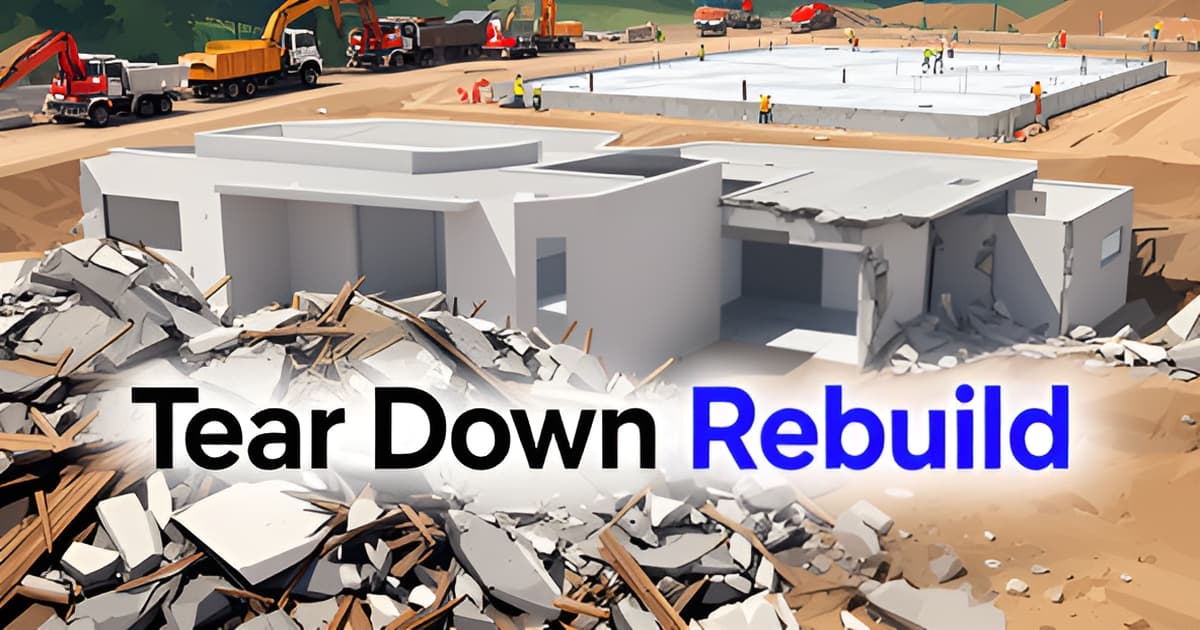
Tear-Down Rebuild Costs in Altadena: Demolition, Disposal, and New Construction
Key Facts
- Pre-construction costs in Altadena commonly consume $75,000–$200,000 before framing begins.
- Private debris removal benchmarks at roughly $100,000 per parcel, though LA County's Army Corps Phase II program clears it free for eligible owners.
- 62% of surveyed 2025 LA fire survivors reported being underinsured, per a United Policyholders survey.
- Fire-resilient WUI code upgrades added just $13,070 to a 1,750 sq ft Altadena model home while cutting destruction risk up to 43%, a Headwaters/IBHS analysis found.
- Pacific-region C&D tipping fees hit $72.88 per ton in 2024, up 17%, regional fee data shows.
- 70% of damaged Eaton burn-scar homes remain in rebuilding limbo according to UCLA research.
- Full Altadena rebuilds run 18–36 months, with temporary housing adding $60,000–$120,000 out of pocket at LA-market rents.
Why Altadena Rebuild Budgets Break: The Hidden Pre-Construction Bill
Most Altadena rebuild budgets fail before the first stud goes up. Homeowners who budget only for construction routinely run out of money mid-project, because the pre-construction phases quietly drain the insurance payout first.
According to rebuild cost analysis, debris removal, hazmat remediation, soil testing, permits, and engineering commonly consume $75,000–$200,000 before framing begins. Once pre-construction, permits, temporary housing, and finishes are tallied, the total regularly lands 40–60% above the base construction contract.
The single biggest hidden line item is debris removal. LA County's Phase II program, run by the Army Corps of Engineers, clears fire debris at no direct cost to eligible owners — but homeowners who miss the opt-in window or pursue private removal face a benchmark of roughly $100,000 per parcel. That gap alone can consume a third of a typical dwelling payout.
Insurance rarely covers it fully. Standard policies cap debris removal at just 5% of dwelling coverage, per California Department of Insurance figures, and a United Policyholders survey of 2025 LA fire survivors found 62% reported being underinsured — with another 33% not yet sure of their status. Common gaps include insufficient Ordinance or Law coverage, no demand-surge provision, and outdated dwelling limits.
The pre-construction bill typically stacks up like this:
- Debris removal and hazmat remediation — free via Army Corps Phase II, or ~$100,000/parcel privately
- Soil testing and compaction reports — a compaction report is triggered if the foundation is demolished and soil is disturbed more than 12 inches
- Permits and engineering — roughly $12,000 for a 1,500 sq ft home, $22,000 for 3,000 sq ft, though like-for-like rebuilds via Regional Planning run $1,404
- Temporary housing during an 18–36 month rebuild — $60,000–$120,000 out of pocket at LA-market rents
The compounding effect is brutal. A homeowner who budgets $600,000 for construction on a $600,000 insurance payout discovers the first $150,000 never reaches the builder. UCLA research found 70% of damaged homes in the Eaton burn scar remain in rebuilding limbo, and 67% of Altadena residents were still in temporary housing more than a year post-fire.
At Altadena Custom Home Builder, we advise homeowners to model the rebuild as a phase-by-phase budget — debris, testing, permits, then construction — before signing anything. If you're weighing a tear-down or Eaton Fire rebuild, a free build consultation can map these pre-construction costs against your coverage while Phase II opt-in windows and fee-waiver options are still on the table.
The Three Cost Lines Nobody Quotes You: Demolition, Disposal, and LA County Permits
Most tear-down budgets fail before the first stud goes up — not because construction is expensive, but because nobody quoted the three lines that come first. Demolition, disposal, and permits quietly consume $75,000–$200,000 before construction begins, according to rebuild cost research, and they drain insurance payouts before the frame ever rises.
Disposal is the silent budget killer. Pacific-region construction and demolition tipping fees average $72.88 per ton, up 17% in 2024 alone, per regional fee data. And that's just the average — mixed C&D processing in California runs $90–$160 per ton at dedicated facilities versus $120–$200 per ton at landfills. As one industry analyst puts it, tipping fees are "the silent cost line on almost every demolition bid sheet," and they've been moving in one direction for a decade.
LA County sharpens the math further. As of August 2024, the county mandates 70% recycling of mixed C&D debris and 100% of soil debris, up from 50% for both. That's good policy, but it changes how you budget: concrete and aggregate make up roughly 67.5% of C&D waste by weight, so where your debris goes — and whether your contractor sorts it — materially changes your invoice.
Permits are the third line, and they scale with ambition:
- Like-for-like rebuild through Regional Planning: $1,404, with fees potentially waived for qualifying fire-affected homeowners
- New 1,500 sq ft home: roughly $12,000 in LA County permit costs
- New 3,000 sq ft home: roughly $22,000
The spread tells the real story. If you rebuild what you had, the county has created a deliberately cheap path — the $1,404 like-for-like option through Regional Planning exists precisely to keep fire survivors from being priced out of returning. Change the footprint, add a second story, or redesign the layout, and you're back into standard permit territory, where fees scale with size and scope.
There's also a hidden cost inside the disposal line: if you demolish the foundation and disturb soil more than 12 inches, a compaction report gets triggered — another pre-construction expense that catches owners off guard. Altadena Custom Home Builder's guidance for hillside lots is to map these triggers before demo day, not after.
The practical takeaway: ask any contractor for a line-item disposal quote showing tonnage, facility type, and diversion rate. If the bid just says "dump fees," you're not seeing the real number. A free build consultation with a licensed Altadena contractor — like JMB Builders LLC (CSLB #1103479) — can turn these three lines from surprises into a real budget.
Construction Costs and the Fire-Resilient Premium: What $570/Sq Ft Really Buys
Ask ten Altadena rebuilders what their new home cost per square foot, and you'll hear a number that surprises most people: around $570 per square foot in the Eaton fire area, with total single-family rebuilds ranging from $300,000 to well over $1 million. That figure comes from owner-reported data — not cost-database figures — so treat it as a directional reference point rather than a fixed price tag, as the sources themselves caution.
What does that per-square-foot number actually buy? At the baseline, a code-compliant home. But in Altadena's burn scar, the smarter question is what a modest premium buys on top of it — and the answer is remarkably good value.
A 2025 Headwaters Economics and IBHS analysis found that meeting wildland-urban interface (WUI) code requirements added just $13,070 to a 1,750 sq ft Altadena model home compared with traditional construction. Upgrading to the full IBHS Wildfire Prepared Home Plus standard raised that to $15,242 — still less than 10% above baseline — while cutting the home's destruction risk by up to 43%. On a six-figure construction budget, that is arguably the highest-return line item in the entire project.
The premium covers measurable upgrades:
- Class A roofing and ember-resistant venting, the two features most correlated with home survival in wind-driven fires
- Noncombustible exterior walls and dual-pane tempered glazing
- Fire sprinklers, now required under the new WUI code
- Noncombustible Zone 0 landscaping — about $3,742 versus $1,106 for traditional bark mulch and wood fencing
Timing matters here too. California's new WUI code (Title 24, Part 7) takes effect January 1, 2026, and mandates many of these same features for new construction in fire-prone areas. Building to the standard now — rather than retrofitting later — means the premium is largely baked into the base price rather than added on top of it.
Context on the broader cost environment is mixed but leaning favorable. LA-area repair cost inflation slowed to 3% year-over-year in Q1 2026, the smallest gain since late 2019, according to Mercury News reporting. Still, contractors are padding budgets with 5–10% "market volatility" contingencies for tariff exposure on imported windows, doors, and plumbing, and post-disaster demand has historically pushed prices up 20–40% within months of a major fire. A 20–30% contingency buffer remains the prudent planning range.
The takeaway for Eaton Fire rebuilders and tear-down owners alike: the fire-resilient premium is not a luxury tax. It is a few thousand dollars of insurance-grade hardening that also happens to be where the building code is headed anyway. When Altadena Custom Home Builder walks owners through rebuild budgets, this is the line item we encourage clients to keep — and a free build consultation with our team, including featured builder JMB Builders LLC (CSLB #1103479), can help you price it against your own lot, design, and insurance recovery.
Timeline Risk, Tariffs, and Contingency: Budgeting for What Goes Wrong
The most expensive part of an Altadena rebuild often isn't construction — it's everything that goes wrong while you wait. A realistic budget assumes delays, price spikes, and permit friction, not just lumber and labor.
Start with time. Full rebuilds run 18 to 36 months from lot clearance to occupancy, and temporary housing during a 24-month rebuild at LA-market rents can add $60,000–$120,000 out of pocket, according to rebuild cost research. That line item alone can exceed many homeowners' entire demolition budget.
Permitting is the dominant bottleneck. More than a year after the Eaton Fire, SBA reporting shows fewer than 3,000 rebuild permits issued across LA City and County, with fewer than ten homes completed, and UCLA research finds 70% of damaged Eaton burn-scar homes still in "rebuilding limbo." Some Altadena families report applications stalled for months before learning they never reached the right department.
On top of delays, two pricing pressures compound each other:
- Demand surge: contractor and material prices typically spike 20–40% within months of a major fire and can stay elevated for a year or more — waiting rarely saves money.
- Tariff padding: contractors are adding 5–10% contingencies for "market volatility," with some homeowners pre-purchasing and storing materials to lock in prices, per LA Times reporting.
There's genuine good news, though. Repair-cost inflation in LA-area markets slowed to 3% year-over-year in Q1 2026 — the smallest gain since late 2019, down from 7% the prior year, per Mercury News analysis. Cumulative costs are still up 53% since 2019, so the relief is relative, not a rollback.
The practical takeaway: carry a 20–30% contingency buffer on top of your construction contract, and treat the 5–10% tariff padding and temporary housing as separate, named budget lines rather than surprises. Altadena Custom Home Builder recommends building that buffer into your pro forma from day one, before demolition ever begins.
If you're weighing a tear-down or Eaton Fire rebuild and want a realistic, line-by-line budget for your lot, schedule a free build consultation with our featured builder, JMB Builders LLC (CSLB #1103479) — an Altadena-based licensed contractor documenting its Eaton Fire rebuild work at jmb-builders.com.
Your Rebuild Action Plan: Permits, Pathways, and Next Steps in Altadena
A rebuild plan that survives contact with reality starts before any foundation work. Research on wildfire rebuilds shows pre-construction phases — debris removal, hazmat remediation, soil testing, permits, and engineering — commonly consume $75,000 to $200,000 before construction begins, and homeowners who budget only for the build itself often run out of money mid-project. Structure your budget phase by phase, and protect it with the right permitting pathway.
Phase-by-phase budgeting checklist
- Phase 1 — Site clearance: LA County's Phase II Army Corps debris removal is free to eligible owners; private removal benchmarks around $100,000 per parcel. Confirm which route you qualify for before committing funds.
- Phase 2 — Testing and design: A compaction report is triggered if the foundation is demolished and soil is disturbed more than 12 inches. Add geotechnical, hazmat, and engineering costs here, plus a 20–30% contingency buffer.
- Phase 3 — Permits: LA County permit costs run roughly $12,000 for a 1,500 sq ft home and $22,000 for 3,000 sq ft, while like-for-like rebuilds through Regional Planning cost about $1,404.
- Phase 4 — Construction: Owner-reported Eaton-area benchmarks run about $570 per square foot — treat these as directional reference points, not fixed pricing.
- Phase 5 — Carry costs: Full timelines run 18–36 months from lot clearance to occupancy, and temporary housing can add $60,000–$120,000 out of pocket.
Permitting strategy
LA County has set accelerated review targets: 10 business days for initial Building, Safety, and Fire review, and 5-day rechecks, per rebuild cost research. Build your schedule around these targets but don't assume they're guaranteed — more than a year after the fires, fewer than 3,000 rebuild permits had been issued across LA City and County, and fewer than ten homes had been completed.
If you're an SBA disaster borrower stuck waiting 60 or more days for permits, a new pathway may help: your builder can self-certify compliance with state and local requirements, allowing construction to begin immediately with a Disaster Loan Modification application and a Builder's Certification. Note that LA County also requires 70% recycling of mixed C&D debris and 100% of soil debris — factor disposal routing into your demolition contract.
Official resources and next steps
Anchor your planning to official sources: the SBA disaster assistance program (which has approved $3.2 billion in relief for the January 2025 fires, less than 25% drawn down), LA County Public Works for debris removal status, and UCLA's Eaton Fire recovery research for context on where the broader recovery stands.
If you want a second set of eyes on your phase budget or a realistic sequencing plan for an Altadena tear-down or Eaton Fire rebuild, JMB Builders LLC (CSLB #1103479) — the featured builder on this guide, a paid placement — offers a free build consultation covering custom homes, ADUs, and fire rebuilds. No consultation creates any permit or timeline guarantee; it's a planning conversation, and your official approvals remain with LA County.
ctaText: Schedule Your Free Altadena Build Consultation socialProofText: JMB Builders LLC (CSLB #1103479) — Altadena-based licensed general contractor for custom homes, ADUs, and Eaton Fire rebuilds
Frequently Asked Questions
How much does it really cost to tear down and rebuild a house in Altadena?
Is debris removal really free, or will it eat a big chunk of my insurance payout?
How much are LA County permits for an Altadena rebuild?
Is it worth paying extra for fire-resilient construction on my rebuild?
How long will my Altadena rebuild take, and what does waiting cost me?
What contingency should I budget for an Altadena tear-down or fire rebuild?
Rebuild the Budget Before You Rebuild the Home
An Altadena tear-down or Eaton Fire rebuild succeeds or fails on the budget you build before construction ever starts. The numbers in this guide tell a consistent story: pre-construction phases can consume $75,000–$200,000, permits run $1,404 to $22,000 depending on your pathway, disposal fees and diversion mandates shape your demo contract, and an 18–36 month timeline can add $60,000–$120,000 in temporary housing. Layer in a 20–30% contingency buffer, the modest $13,000–$15,000 premium for fire-resilient construction, and the permitting bottlenecks that have left 70% of damaged Eaton burn-scar homes in rebuilding limbo, and the path forward becomes clear: model every phase, confirm your Phase II debris removal status, and choose your permit route deliberately. Altadena Custom Home Builder exists to help you turn these figures into a realistic, lot-specific plan. If you're ready to pressure-test your numbers, schedule a free build consultation with our featured builder, JMB Builders LLC (CSLB #1103479) — a planning conversation, with no timeline or permit guarantees, that could be the difference between a budget that holds and one that breaks.