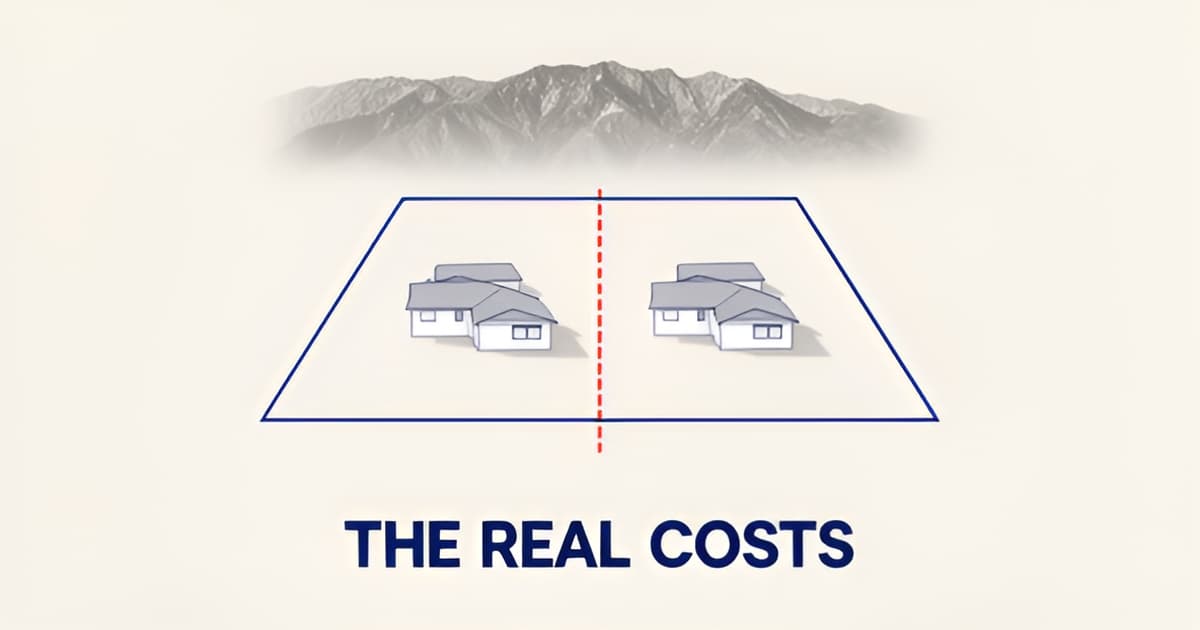
SB 9 Urban Lot Split in LA County: Costs and Fine Print
Key Facts
- Los Angeles recorded 28 SB 9 lot split applications in 2022 and approved zero, Terner Center research shows.
- Each new lot from an LA County urban lot split must be at least 1,200 square feet, with splits capped at a 40-60 ratio, per county rules.
- The SB 9 lot-split path typically runs $50,000–$80,000 before construction, on 9–15 month timelines, per engineering analysis.
- LA County requires a recorded final map before any construction, followed by Ministerial Site Plan Review for the homes, per county guidance.
- Under HCD guidance, agencies aren't required to allow more than two units per resulting lot — ADUs and JADUs count toward it, Riechers Engineering notes.
- SB 9 lot splits require an owner-occupancy affidavit, a constraint planners call the biggest brake on uptake, Terner Center interviews found.
- ADU design and construction typically costs $300,000–$400,000+, versus the split's pre-construction-only costs, per illustrative planning ranges.
Why So Few Lot Splits Happen: The Reality Behind SB 9's Promise
On paper, SB 9 sounds transformative: split your lot, build up to two homes on each side, and turn one parcel into four. The reality, one year in, looked very different — Los Angeles recorded 28 lot split applications in 2022 and approved zero of them, according to Terner Center research covering 13 California jurisdictions.
The contrast with SB 9 units is striking. The same city saw 211 applications for new SB 9 units (38 approved) in the same period — meaningful activity, if modest. Lot splits, the more complex and harder-to-reverse path, barely moved. Statewide, the pattern held: even high-performing housing jurisdictions like San Diego recorded just three lot split applications with none approved.
Why do inquiries run hot while approvals run cold? Planners interviewed by the Terner Center point to a cluster of practical barriers:
- Owner-occupancy affidavits — lot splits require owners to commit to living on the property for a set period, a constraint standard ADUs don't carry.
- Staff capacity — planning departments absorbed high inquiry volume with limited review bandwidth, alongside rising rates and supply-chain disruption.
- Financing complexity — lenders and title companies must review newly created parcels, and the split itself is only step one.
- ADU competition — more flexible ADU rules (no owner-occupancy, limited impact fees) pull homeowners toward the simpler path.
There's also a structural catch many homeowners miss. In LA County, the urban lot split covers only the split itself: a final map must be recorded before any construction, and only then does a Ministerial Site Plan Review approve the homes, per LA County Planning. That's a long, expensive runway before a single foundation is poured.
For Altadena properties, the fine print tightens further. LA County constrains SB 9 projects in fire, earthquake, and flood hazard areas — directly relevant to hillside lots and Eaton Fire-affected parcels. Per California HCD guidance cited by Riechers Engineering, a local agency isn't required to allow more than two units per resulting lot, a count that can include ADUs and JADUs, so the "four homes" math doesn't always hold.
The Terner Center cautions it's still too early to declare SB 9 a failure — and larger, well-centered parcels remain the strongest candidates. That's why Altadena Custom Home Builder approaches every lot-split question as a feasibility review first, not a foregone conclusion. If you're weighing a split on a hillside or rebuild site, a free build consultation is the place to start.
The LA County Fine Print: Eligibility, the Two-Step Process, and Owner-Occupancy
Most homeowners who call us about an SB 9 lot split in Altadena have read the headlines — "four homes on one parcel" — but haven't hit the county's fine print yet. That fine print is exactly where hillside projects live or die, and it's worth understanding before you spend a dollar on surveys or maps.
Start with geometry. Under LA County's SB 9 rules, each new lot created by an urban lot split must be at least 1,200 square feet, and the two resulting parcels must be "generally equal in size" — with splits permitted only up to a 40-60 ratio. On a modest Altadena lot, that ratio alone can rule out a split before anything else comes into play.
Then comes the sequence most people miss: the split and the homes are two separate processes. A final map must be recorded before any construction begins, and only afterward does a Ministerial Site Plan Review approve the proposed development. Housing analysts note the lot split is the most involved path — requiring a survey, tentative and final parcel map, and recording of new parcel numbers — and it's hard to reverse once recorded.
The owner-occupancy affidavit is another defining constraint. SB 9 lot splits require the owner to commit, in writing, to live on the property for a set period. Terner Center research found planners consistently identify this requirement as a barrier to uptake — Los Angeles recorded 28 lot split applications in 2022 with zero approved.
For Altadena specifically, the hazard exclusions matter most. LA County bars urban lot splits in coastal zone and wetlands areas, and treats fire, earthquake, and flood hazards as constraints — directly relevant to hillside and fire-affected properties. A few key limits to check early:
- Each resulting lot must be at least 1,200 sq ft, split no more unevenly than 40-60
- The final map records before construction; Ministerial Site Plan Review follows
- Fire, earthquake, and flood hazard designations can disqualify a split
- An owner-occupancy affidavit commits you to reside on the property
Finally, don't assume units stack. Per HCD guidance, a local agency is not required to allow more than two units per resulting lot — a count that can include primary units, ADUs, and JADUs. Homeowners sometimes plan for SB 9 duplexes plus ADUs on top, and the county isn't obligated to allow it.
At Altadena Custom Home Builder, we treat these constraints as the first conversation, not the last — a feasibility-first review beats falling in love with a split the county won't record. If you're weighing a lot split on an Altadena hillside lot or an Eaton Fire rebuild site, a free build consultation is the place to start.
What It Actually Costs: Illustrative Ranges, Not Quotes
Ask five Altadena homeowners what an SB 9 lot split "should" cost and you'll get five different numbers — because the honest answer is a range, not a quote. Planning-level figures for the lot-split path in LA County run roughly $50,000 to $80,000 before any new-home construction, with timelines often stretching 9 to 15 months, according to engineering analysis of SB 9 versus ADU projects. Treat those as illustrative planning ranges, not guarantees.
That figure covers the split itself — survey, tentative and final parcel map, county review, and recording of new parcel numbers — not the homes. In LA County, the split and the construction are separate processes: a final map must be recorded before any building begins, after which a Ministerial Site Plan Review approves the proposed development, per LA County's SB 9 guidance.
Compare that to the ADU path. Design and construction for an ADU typically runs $300,000 to $400,000 or more, with timelines of 10 to 18 months. The lot split costs less upfront, but it's the most complex of the three paths — and the hardest to reverse once recorded.
A few things to weigh before choosing a path:
- A recorded parcel may support financing options an ADU cannot — but lender and title review must come first, and some analysts note financing two smaller new parcels can be more complex.
- LA County application fees weren't captured in the sources reviewed here; confirm current figures through the County's SB 9 resources, which include a memo, summary, and virtual counseling.
- The owner-occupancy affidavit — a commitment to live on the property for a set period — applies to lot splits but not to standard ADUs, and planners say it's a major reason uptake has lagged.
- Hazard constraints matter in Altadena: fire, earthquake, and flood hazard areas face restrictions under County rules.
The upside can be real — one analysis pegs illustrative SB 9 value creation at $300,000 to $1 million or more, explicitly not a guarantee. But the right question isn't which path costs less; it's which creates the best outcome after feasibility, cost, value, timeline, and local constraints are reviewed. At Altadena Custom Home Builder, that feasibility-first review — including hillside and slope lots — is where every project starts, and it's available through a free build consultation with our featured builder, JMB Builders LLC (CSLB #1103479).
SB 9 Lot Split vs. ADU: Choosing the Right Path for Your Altadena Property
For most Altadena homeowners, the honest answer to "SB 9 lot split or ADU?" is that the ADU path wins on flexibility. Statewide data backs this up: cities with friendly ADU rules show almost no SB 9 activity, and planners hypothesize that more flexible ADU rules — no owner-occupancy requirement, limited impact fees, and larger permitted units — pull homeowners toward ADUs instead, according to Terner Center research across 13 jurisdictions.
The numbers in Los Angeles tell the same story. In 2022, the city recorded 211 applications for new SB 9 units (38 approved) but only 28 lot split applications — with zero approved. Planners report high inquiry volume but low application rates, reflecting the time, resources, and constraints involved in pursuing a split.
The lot split is also the most complex and least reversible of the three paths. It requires a survey, tentative and final parcel maps, city review, and recording of new parcel numbers — and once recorded, it is difficult to undo. In LA County, the process is two-step: a final map must be recorded before any construction, after which a Ministerial Site Plan Review approves the proposed homes. Illustrative planning ranges put the pre-construction cost of the split path at roughly $50,000–$80,000 with a 9–15 month timeline — figures that are planning estimates, not guarantees.
That said, the split path has real advantages for the right property. Planners note that SB 9 works best where homes sit centered on larger parcels, making splits geometrically and financially viable. A recorded lot also creates an ownership structure an ADU cannot replicate — which matters for families planning to gift or sell a separate parcel. But homeowners should not assume units stack: under California HCD guidance, an agency is not required to allow more than two units per resulting lot, a count that can include ADUs and JADUs. Hazard constraints — fire, earthquake, and flood zones — also apply under LA County's SB 9 rules, a real consideration for hillside and fire-affected Altadena parcels.
When weighing the choice, keep these factors in view:
- Owner-occupancy: lot splits require an affidavit committing you to live on the property for a set period; standard ADUs generally do not
- Lot geometry: each new lot must be at least 1,200 square feet, with splits up to a 40-60 ratio
- Reversibility: a recorded split is effectively permanent; an ADU plan can be revised or abandoned
- Cost structure: ADUs run roughly $300,000–$400,000+ for design and construction, versus the split's pre-construction costs before new homes are even built
As Riechers Engineering frames it, the right question is not simply which path costs less, but which creates the best outcome for the property after feasibility, cost, value, timeline, and local constraints are reviewed. At Altadena Custom Home Builder, we start every engagement with that feasibility-first review — whether the answer is an ADU, a lot split, or a ground-up rebuild — and a free build consultation is the best first step for sizing up your parcel's real options.
Your Feasibility-First Action Plan for an Altadena Lot Split
Most SB 9 lot splits never get past the first conversation — Los Angeles recorded 28 lot split applications in 2022 with zero approved, according to Terner Center research. A feasibility-first plan keeps your Altadena project from stalling the same way.
Step 1: Verify lot size and split geometry. LA County requires each new lot to be at least 1,200 square feet, and the two resulting parcels must be roughly equal — splits may not exceed a 40/60 size ratio, per the County's SB 9 rules. Planners note splits work best where the home sits centered on a larger parcel, so check where your house and driveway fall before assuming the geometry works.
Step 2: Screen hazard constraints early. This matters doubly in Altadena. The County excludes or constrains parcels in fire, earthquake, and flood hazard areas, and coastal zone and wetlands parcels are ineligible outright. Hillside lots and Eaton Fire-affected parcels deserve extra scrutiny here — a slope lot that clears lot-size math can still fail the hazard screen.
Step 3: Confirm the owner-occupancy commitment. An SB 9 lot split requires an owner-occupancy affidavit committing you to live on the property for a set period — a requirement standard ADUs generally don't carry, as this comparison of the three paths explains. Terner Center interviews found planners consider this the biggest brake on SB 9 uptake statewide. If you don't intend to occupy, the split may be the wrong tool.
Step 4: Budget the two-step process before construction. In LA County, the split and the homes are separate approvals: a final parcel map must be recorded before any construction, then a Ministerial Site Plan Review covers the buildings. Plan for survey, tentative and final map, review, and recording costs — illustrative planning ranges run roughly $50,000–$80,000 for the lot-split path before new-home construction, with timelines often 9–15 months. Treat these as planning ranges, not quotes.
Step 5: Read the County's own materials. The LA County SB 9 page links its SB 9 memo, summary, and virtual counseling sessions — use them, since application fees and processing details live there rather than in state law.
Your pre-application checklist:
- Lot size ≥ 1,200 sq ft per new parcel, within the 40/60 ratio
- Hazard screen cleared — fire, earthquake, flood, hillside conditions
- Owner-occupancy affidavit signed and understood
- Survey and parcel map recording budgeted before construction
- County SB 9 memo and counseling resources reviewed
One more caution: don't assume units stack. State HCD guidance says agencies aren't required to allow more than two units per resulting lot, counting ADUs and JADUs toward that cap. The right question, as one engineering firm puts it, isn't which path costs less — it's which path creates the best outcome for this property after feasibility, cost, and constraints are reviewed.
That's exactly what Altadena Custom Home Builder's free build consultation does: assess whether a lot split, SB 9 duplex, or ADU actually fits your parcel — hillside, fire-affected, or flat — before you spend on surveys and maps. Book yours and get a straight answer on paper first.
Frequently Asked Questions
How many SB 9 lot splits have actually been approved in Los Angeles?
How much does an SB 9 lot split cost in LA County?
Can I really build four homes on one parcel with SB 9?
What are the lot size requirements for an SB 9 urban lot split in LA County?
Do I have to live on the property to do an SB 9 lot split?
Does an SB 9 lot split work on a hillside or fire-affected lot in Altadena?
The Paper First, Then the Pour
SB 9's promise of four homes on one parcel collides quickly with LA County's fine print: 1,200-square-foot minimums, a 40-60 split ratio, hazard constraints, the owner-occupancy affidavit, and a two-step process where the final map records long before any construction begins. It's no surprise that Los Angeles recorded 28 lot split applications in 2022 with zero approved — while the ADU path, with its flexibility and lower barriers, quietly absorbed most of the demand. But "too early to declare failure" isn't "never," and for the right parcel — larger, well-centered, clear of hazard overlays — a recorded split creates an ownership structure an ADU simply can't replicate. The difference between those outcomes is feasibility, checked before you spend a dollar on surveys or maps. That's exactly where Altadena Custom Home Builder starts: a free build consultation that sizes up your lot's geometry, hazards, and honest options — split, duplex, ADU, or rebuild — with our featured builder, JMB Builders LLC (CSLB #1103479). Get the straight answer on paper first, then decide if the pour is worth it.