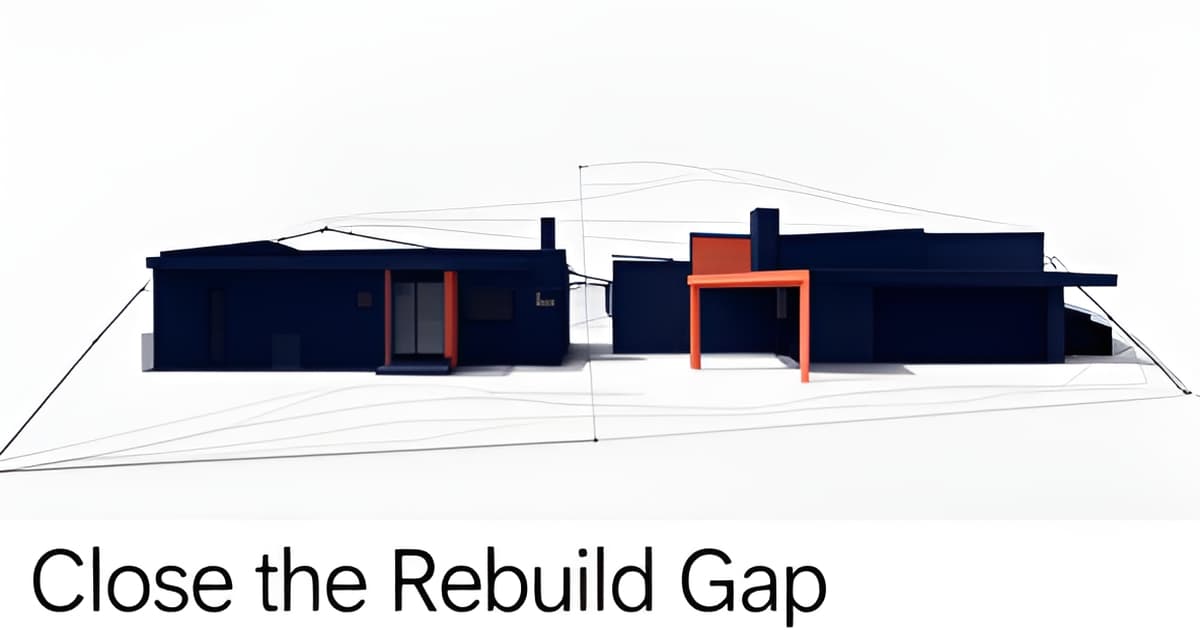
SB 9 Lot Splits in LA County: Two Homes on One Altadena Lot
Key Facts
- The typical Altadena rebuilding homeowner faces a $550,000 shortfall after insurance, per a Department of Angels survey.
- Only 52 of 5,645 fire-damaged Altadena parcels have active SB 9 permits, with just 2 homes complete.
- 95% of homes in fire-affected Altadena were single-family houses, according to a UCLA analysis.
- Los Angeles approved zero lot splits and just 38 SB 9 units in 2022, Terner Center data shows.
- SB 9 lot splits require parcels of at least 2,400 square feet, with new lots no smaller than 1,200 sq ft each.
- SB 1090 would suspend SB 9 in Altadena through 2030, according to CalMatters reporting.
- SB 9 permit expediters can cost up to $20,000, with approvals taking weeks to months.
The $550K Rebuild Gap: Why Altadena Homeowners Are Looking at SB 9
A $550,000 hole in your rebuild budget changes every decision you make. For Altadena homeowners sorting through insurance payouts and construction bids, that number isn't abstract — it's the typical shortfall a rebuilding household faces after insurance comes in, according to a Department of Angels survey.
The math is unforgiving, and the neighborhood's housing stock makes it worse. A UCLA analysis found that 95% of homes in fire-affected Altadena were single-family — meaning most families are rebuilding one house, on one lot, with one insurance check that doesn't stretch far enough. Of the 5,645 damaged or destroyed parcels in the community, the vast majority face this same squeeze.
That's why SB 9 keeps coming up in rebuild conversations. The law lets owners build two units on a single-family lot or split it into two parcels, and either move can close the gap: sell half the lot, build a second home to sell or rent, or keep one unit and monetize the other. For a homeowner short $550,000, that's not a zoning curiosity — it's a potential financing tool.
Yet actual uptake has been strikingly low. Only 52 of those 5,645 damaged parcels have active SB 9 permits, with 14 under construction and just 2 complete, per a town council-commissioned dashboard. Several factors explain the gap between interest and action:
- Lot geometry — Altadena's characteristic narrow, deep lots make a compliant 60/40 split harder to design than on wider parcels, as one local builder observed.
- Hazard-zone restrictions — 2025 executive orders nullified SB 9 in "very high" fire severity zones, disqualifying some hillside lots, though much of the burn area fell outside that category.
- Process complexity — the split requires a recorded final map before any construction, followed by a separate Ministerial Site Plan Review, with expediter costs running up to $20,000.
There's also a legislative clock ticking. SB 1090, now moving through the Legislature, would exempt Altadena from SB 9 entirely through 2030 — a window that could slam shut for homeowners who wait. And statewide, adoption has been minimal: Los Angeles approved zero lot splits and just 38 SB 9 units in 2022, while ADUs — with lower fees and no owner-occupancy requirement — have outcompeted SB 9 almost everywhere.
The takeaway for Altadena homeowners is straightforward: SB 9 is a real option for closing the rebuild gap, but it's not a simple one. Whether your parcel qualifies, how a split would pencil out, and whether an ADU makes more sense all depend on your specific lot. At Altadena Custom Home Builder, we help Eaton Fire families run that parcel-specific feasibility math before committing to a path — because a $550,000 gap deserves better than guesswork.
SB 9 in Altadena: LA County Rules, Not LA City Rules
Altadena sits in unincorporated Los Angeles County, which means your SB 9 project answers to a completely different set of officials than most LA homeowners expect. If you start your research with LADBS or LA City Planning, you're reading the wrong rulebook.
SB 9, effective since January 1, 2022, gives single-family zoned lots two options: build up to two main dwelling units on one lot (detached or as an attached duplex), or split the lot into two parcels through an urban lot split, per LA County Regional Planning. In the City of LA, these pathways even run through different agencies — lot splits through City Planning, two-unit developments through LADBS. In Altadena, both routes go through the county.
Because Altadena is unincorporated, LA County Regional Planning governs every SB 9 application here — not LA City Planning, not LADBS. That matters practically: forms, timelines, and interpretation of state law all follow county procedures. Homeowners who download city templates or call city offices lose weeks before realizing the mismatch.
The county's rules set hard parameters that determine whether your parcel qualifies at all:
- Minimum parcel size of 2,400 sq ft, with each new lot at least 1,200 sq ft, according to SB 9 application guidance.
- Split ratios must fall between 60/40 and 50/50 — roughly equal lots, no lopsided divisions.
- A 3-year owner occupancy requirement applies to lot splits.
- Fire hazard severity zones matter: 2025 executive orders nullified SB 9 in "very high" zones in LA County, though much of the Eaton Fire burn area fell outside that category, CalMatters reports.
The urban lot split application covers only the split itself. You must record a final map before any construction begins; only afterward does a Ministerial Site Plan Review approve the proposed development. Skipping this sequence is one of the most common and costly mistakes we see Altadena homeowners make when planning a rebuild around a lot split.
Adoption remains rare — Los Angeles approved zero lot split applications in 2022 and just 38 SB 9 units citywide, the most of any surveyed municipality, per early adoption data. In Altadena specifically, only 52 of 5,645 fire-damaged parcels have active SB 9 permits, partly due to the community's "narrow and deep" lot geometry.
Before you commit to a pathway, verify your parcel's size, hazard zone status, and split feasibility. A parcel-specific feasibility check — like the ones Altadena Custom Home Builder runs for Eaton Fire rebuild clients — tells you quickly whether a lot split or a two-unit build fits your lot, or whether an ADU is the smarter route.
SB 1090 and the Closing Window: Timing Your Lot Split Decision
A bill moving through Sacramento could close the door on lot splits in Altadena for the rest of the decade — and homeowners who wait to decide may lose their window entirely. SB 1090, authored by Senator Sasha Renée Pérez, would suspend SB 9 and SB 1123 in Altadena's single zip code through 2030, a measure that has already passed Assembly committees unanimously and cleared the Senate on partisan lines, according to CalMatters reporting.
The debate cuts to something real for fire survivors. With a typical rebuilding homeowner short $550,000 after insurance payouts, a lot split can be the difference between rebuilding and walking away — selling or building on half a lot to close the funding gap. Yet supporters of the exemption argue that same mechanism invites outside investors to buy up parcels from vulnerable families.
Both concerns are legitimate. Senator Pérez says residents should rebuild "without the overpowering influence of predatory developers," while Assemblymember John Harabedian argues Altadena "shouldn't be a playground for people who want a return on investment." On the other side, resident and construction company founder Caroline Paules counters that the bill "prevents Altadenans from housing themselves — and also Altadenans from helping to house each other."
What the executive orders did — and did not — do
In 2025, Governor Newsom and Mayor Bass issued executive orders nullifying SB 9 in "very high" fire hazard severity zones in LA County. But here is the fact many homeowners miss: much of the Eaton Fire burn area did not fall into that category, so most burn-scar parcels remain SB 9-eligible. Some hazard-zone properties may even qualify if certain building requirements are met, per lot split application guidance.
If you are weighing a split, the practical steps are straightforward:
- Confirm your parcel meets the 2,400 sq ft minimum and can accommodate a 60/40 to 50/50 split with lots of at least 1,200 sq ft each.
- Verify your fire hazard severity zone status — "high" and "very high" designations carry different consequences than many assume.
- Begin the application with LA County Regional Planning before SB 1090 becomes law; the lot split must record a final map before any construction begins.
Timing matters because the window may close abruptly. Once SB 1090 takes effect, an Altadena homeowner who could have used half a lot to fund a rebuild would have no recourse until at least 2030 — years that a family displaced by the Eaton Fire may not have.
At Altadena Custom Home Builder, we are advising Eaton Fire rebuild clients to run parcel-specific feasibility checks now, even if a final decision feels premature. Knowing whether your lot qualifies — and what a split could realistically fund — costs nothing and preserves every option on the table.
SB 9 vs. ADU vs. Straight Rebuild: Choosing the Right Path for Your Lot
Three paths lead off most Altadena lots today: build an ADU, split the parcel under SB 9, or simply rebuild what burned. Choosing the wrong one can cost a fire-rebuild family six figures — so it pays to run the numbers before the lot does.
Start with the honest scoreboard. ADUs outcompete SB 9 on nearly every practical measure — lower fees, no owner-occupancy requirement, and streamlined permitting — which is why Los Angeles approved 5,064 ADUs in 2021 but zero lot splits and just 38 SB 9 units the following year, per Terner Center data. SB 9's 3-year owner-occupancy rule and county review process slow things down considerably.
But ADUs don't create a second saleable parcel. If your goal is closing the funding gap — and the typical Altadena rebuild is short $550,000 after insurance — only a lot split converts dirt into cash or a second home you can finance. That's why SB 9 still earns a serious look on qualifying lots, even with only 52 active permits among Altadena's 5,645 damaged parcels.
Run your parcel through this feasibility framework before committing either way:
- Lot size and geometry: the parcel needs at least 2,400 sq ft, with each new lot at least 1,200 sq ft — and Altadena's "narrow and deep" lots often make a usable split physically awkward.
- Split ratio math: new lots must fall between a 60/40 and 50/50 divide, so check whether both halves can actually hold a home plus setbacks.
- Fire severity zone status: "very high" zones are disqualified under recent executive orders, though much of the Eaton burn area sits outside them — verify your parcel's mapped designation.
- Owner-occupancy tolerance: SB 9 requires 3 years of owner occupancy, which some fire-cleared lots complicate further.
Then weigh the money against your situation. A straight rebuild avoids permit expediter costs — up to roughly $20,000 for SB 9 — and the county's two-step process, which requires a recorded final map before any construction, followed by Ministerial Site Plan Review through LA County Regional Planning. An ADU adds rental income without disturbing the parcel. A lot split adds a salable asset, but only if the geometry and hazard mapping cooperate.
The right answer is parcel-specific, and it's rarely obvious from the street. Altadena Custom Home Builder runs exactly this kind of lot-level feasibility check for Eaton Fire rebuild families — measuring the split math, confirming zone eligibility, and matching the pathway to your budget before you spend a dollar on applications. With SB 1090 threatening to suspend lot splits in Altadena through 2030, that parcel review is worth scheduling sooner rather than later.
Your Altadena Lot Split Action Plan: From Feasibility to Final Map
A lot split only becomes real when you stop reading about SB 9 and start running your actual parcel through the county's eligibility rules. With just 52 of 5,645 fire-damaged Altadena parcels holding active SB 9 permits, the homeowners who succeed are the ones who sequence the process correctly from day one (CalMatters reporting).
Step 1: Verify parcel eligibility. Your lot must be at least 2,400 square feet, with each resulting parcel no smaller than 1,200 square feet and the split falling between a 50/50 and 60/40 ratio (LA County Regional Planning). Then confirm your fire hazard status: 2025 executive orders nullified SB 9 in "very high" severity zones, though much of the Eaton Fire burn area sits outside that category (per CalMatters). Finally, clear the lookbacks — no tenant evictions in the past 15 years and no rental units demolished within the past 3 years (SB 9 application guides).
Step 2: Run a split feasibility study. Altadena's narrow-and-deep lot geometry is a real constraint — local builders cite it as a key reason uptake stays so low (CalMatters notes). A feasibility study maps setbacks, access, and utilities against the 60/40 ratio before you spend a dollar on applications. This is where a builder familiar with Altadena's lot patterns earns their fee, flagging dead-end parcels before the county does.
Step 3: Budget and plan the timeline realistically. Expect permit expediter costs up to roughly $20,000 and approval timelines ranging from a few weeks to a few months (industry estimates). Build that into your rebuild math, especially if you're among the typical Altadena homeowners facing a $550,000 shortfall after insurance (survey data shows).
Step 4: Record the final map before construction. The lot split process covers only the split itself — a final map must be recorded before any construction begins, after which a Ministerial Site Plan Review approves the proposed development (LA County Regional Planning). Skipping this sequencing is the most expensive mistake an owner can make. And remember: Altadena is unincorporated, so all applications route through Regional Planning, not LA City agencies.
Your working sequence looks like this:
- Confirm lot size, hazard zone, and tenant/rental lookbacks
- Commission a feasibility study for narrow or deep lots
- Budget ~$20K in expediter fees and weeks-to-months of approval time
- Record the final map before pulling any construction permits
Given the pending SB 1090 exemption that would suspend lot splits in Altadena through 2030, timing matters as much as technique (CalMatters reports). A local builder who works LA County Regional Planning and the Eaton Fire rebuild process daily — like Altadena Custom Home Builder — can tell you quickly whether your parcel clears these hurdles or whether an ADU gets you two homes with fewer constraints.
Frequently Asked Questions
Can I split my lot and build two homes under SB 9 if I live in Altadena?
Does my Altadena lot qualify for an SB 9 urban lot split?
Is an SB 9 lot split or an ADU the better way to fund my rebuild?
What is SB 1090 and will it take away my right to split my lot in Altadena?
How long does an SB 9 lot split take and what does it cost in LA County?
Are other Altadena homeowners actually using SB 9 to rebuild after the Eaton Fire?
Key Takeaways
{ "title": "Two Homes, One Lot, One Closing Window", "content": "SB 9 could be the tool that closes Altadena's typical $550,000 rebuild gap — but only if your parcel qualifies and your paperwork moves before the rules change. The essentials to remember: your lot needs at least 2,400 square feet