Restoring a Historic Craftsman Home: A Realistic Cost Guide
Key Facts
- Whole-house rewiring of original knob-and-tube wiring runs $8,000–$20,000+ in Craftsman homes, per Craftsman renovation research.
- One seller spent $18,000 covering 1920s oak floors with vinyl plank and dropped the asking price $12,000 — refinishing would have cost $4,000, per a documented case study.
- A $2,000 inspection can prevent a $50,000 mid-project surprise on century homes, according to historic restoration cost research.
- Replacing corroded galvanized pipes runs $7,000–$15,000 because the work requires opening plaster walls, per expert cost analysis.
- Restoring a 1920s window costs $150–$300 per window, versus $400–$5,000 for basic replacement units, per restoration cost analysis.
- Spending $100,000 on restoration may add only $60,000–$80,000 in value, yet doing nothing erodes value faster, per cost analysis.
- Recreating a single lost built-in from scratch costs $5,000–$15,000, while restoring the original costs far less, per Craftsman cost data.
The Real Budget Killer: Hidden Systems, Not Craftsman Finishes
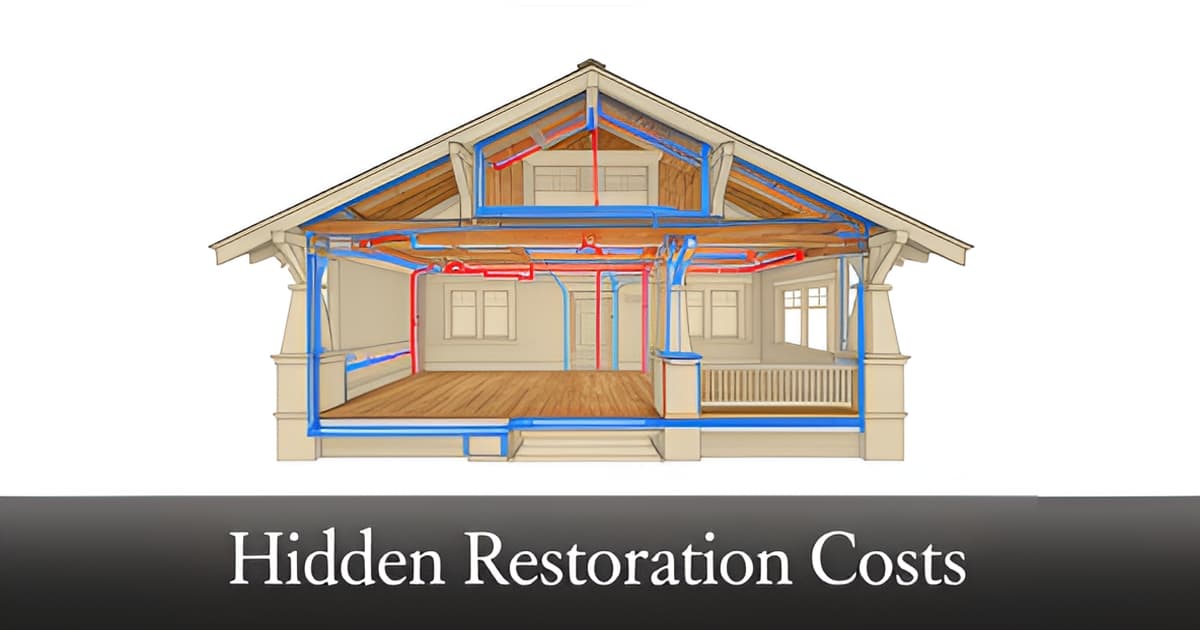
Ask any Craftsman owner who's been through a restoration what blew their budget, and they rarely mention tile or light fixtures. The money disappears into walls, pipes, and foundations — the systems you can't see at the walkthrough.
The big three are predictable for homes built between 1905 and 1930. Whole-house rewiring of original knob-and-tube systems runs $8,000–$20,000+, according to Craftsman-specific renovation research. That wiring often lacks grounding wires, won't safely handle three-prong appliances, and becomes a fire hazard when worn insulation contacts wood framing — which is also why many insurers restrict or refuse coverage until it's replaced.
Plumbing follows close behind. Galvanized steel pipes corrode from the inside out, and replacing them runs $7,000–$15,000 because the work requires opening walls and ceilings, per expert cost analysis of older-home purchases. Since original plaster is expensive to replicate, every access point matters.
Foundations are the wildcard. Costs range from minor repointing to $20,000–$50,000+, and the difference hinges on one question: is the settlement active or stable? Many century-old homes have cracks that have held steady for 50+ years, and an engineer's assessment can distinguish a $3,000 monitoring plan from a $30,000 stabilization project. As preservation guidance puts it, "a $2,000 inspection can prevent a $50,000 surprise mid-project."
For Altadena hillside homes, that inspection deserves one extra layer of scrutiny. Early Craftsman-era construction often lacks modern seismic connections — the hardware that ties the frame to the foundation — and on a slope lot, that gap matters more than it would on flat ground. A structural inspection before design work, which costs only a few hundred dollars, can surface these issues and reorder the entire budget. It's the first move we recommend on any Altadena Custom Home Builder project assessment, and it's especially critical for Eaton Fire rebuild planning where original foundations are being evaluated.
Before signing a contract, make sure your inspection covers:
- Knob-and-tube wiring, including grounding and insulation condition
- Galvanized supply lines and original drain materials
- Foundation type, crack activity, and drainage behavior
- Seismic connections between sill, framing, and foundation — non-negotiable on hillside lots
- Asbestos and lead paint, common in this era
One more number to lock in before work begins: contingency. Sources disagree on the exact figure — recommendations range from 15–20% on typical historic projects to 25% or more for poorly maintained homes — but the consensus is clear that century houses demand more padding than modern renovations. Plan toward the higher end, and the hidden systems become line items instead of emergencies.
Preserve, Don't Gut: Why Replacement Destroys Craftsman Value
The most expensive mistake in a Craftsman restoration isn't what you add — it's what you throw away. Most failed projects follow the same pattern: owners gut interiors to drywall, then discover the features they removed were what justified the purchase price in the first place, according to Craftsman-specific renovation research.
The numbers make the case bluntly. One documented seller spent $18,000 covering 1920s oak floors with luxury vinyl plank — and had to drop the asking price by $12,000 because the home "felt cheaper than its neighbors." Refinishing the originals would have cost $4,000, per a case study from Clever Real Estate's PR director.
The same math applies to built-ins. A cabinet shop charges $5,000–$15,000 to recreate a single built-in from scratch, while restoring the existing one costs far less. As Block Renovation's Cheyenne Howard puts it, ripping out old-growth fir and oak for new "quality" millwork is a material downgrade, not an upgrade — original trim was milled from old-growth lumber with tighter growth rings, making it denser and more rot-resistant than anything available today.
Before demolition day, know what you're protecting:
- Old-growth trim and millwork — stripping paint professionally runs $200–$500 per opening, a fraction of replacement cost
- Original built-ins — restoration costs far less than the $5,000–$15,000 recreation price tag
- Art glass — salvage panels run $100–$600, and originals are essentially irreplaceable
- Cast iron tubs — reglazing costs $400–$800, versus several times that for demo and replacement
Preservation isn't just about what you keep — it's about what you repair with. Well-meaning contractors routinely repoint stone foundations with modern Portland cement mortar, which is too rigid and traps moisture against softer stone, accelerating decay rather than stopping it. Historic preservation standards, citing the National Park Service, call for lime mortar that breathes with the building, according to historic restoration cost research.
And even when you choose the right approach, the labor pool is thin. Plaster restoration specialists, historic window restorers, and preservation-trained masons command premium rates because "they're rare and their mistakes are expensive." On complex stone facades, a masonry crew may repoint only 20–30 linear feet per day. Custom millwork for mantels, moldings, and stair railings adds further cost and requires artisans who are in high demand, per period-restoration budgeting guidance.
For Altadena homeowners weighing a Craftsman restoration — or an Eaton Fire rebuild that honors the town's architectural traditions — this is where experienced guidance pays for itself. Altadena Custom Home Builder connects owners with contractors who understand the difference between restoring character and erasing it; a free build consultation is the place to start that conversation.
The Itemized Cost Guide: What Each Restoration Line Actually Runs
Restoration budgets live or die on the line items — and on a 1900s–1920s Craftsman, the numbers behind each repair are more knowable than most owners expect. Below is a practical breakdown of what each major line actually runs, drawn from corroborated industry data.
Porch and exterior details. Rebuilding a porch column runs $1,000–$3,000 per column, according to Craftsman-specific renovation cost data. Stripping paint from original old-growth trim costs $200–$500 per opening professionally — tedious, but far cheaper than replacing trim milled from denser, more rot-resistant old-growth fir or oak.
Windows: the honest debate. Restoring a 1920s window by a skilled craftsperson runs $150–$300 per window, per historic restoration cost analysis. Basic replacement units run $400–$5,000 each. The restore-vs-replace question is genuinely contested: single-pane originals transfer heat and cold, and some sources argue energy-efficient replacements pay off long-term — but many historic districts legally require restoration over replacement, and original wood windows are often restorable.
Plaster, tubs, and interiors. Plaster repair or replication averages about $48 per square foot, so budget for it whenever walls open up for plumbing or wiring. A cast iron tub reglazing costs $400–$800 — several times less than demolition and replacement. Recreating a lost built-in from scratch runs $5,000–$15,000; restoring an existing one costs far less.
HVAC that respects historic fabric. A ductless mini-split runs $950–$4,100 installed, and HVAC experts note these systems avoid the damage that ductwork inflicts on original floors, trim, and plaster. High-velocity central AC with small flexible ducts is the alternative when whole-home coverage is needed.
The knob-and-tube caveat. Whole-house rewiring of knob-and-tube systems runs $8,000–$20,000+, and the issue is bigger than cost: most insurers restrict or refuse coverage on homes with active knob-and-tube wiring, so confirm this with your agent before closing. The same friction applies to galvanized plumbing ($7,000–$15,000 to replace) and foundations ($20,000–$50,000+ at the high end).
A few planning notes for Altadena owners working on the town's Craftsman stock — much of it a century old and, post-Eaton Fire, often being evaluated alongside rebuild decisions:
- Get a structural and systems inspection before design work; a few hundred dollars spent early can reorder the entire budget.
- Set contingency at 15–20% minimum, and 25%+ for poorly maintained homes — sources conflict, so plan toward the higher end.
- Do the porch first: highest curb-appeal return, usually no permits, and rewiring costs far less while walls are already open.
- Preserve original trim, built-ins, and art glass — one documented seller spent $18,000 covering 1920s oak with LVP and dropped the price $12,000 as a result.
No source provides a reliable all-in total for a full Craftsman restoration, and none of these figures are California-specific — treat them as directional planning ranges, not quotes. If you're weighing a restoration against a rebuild on an Altadena lot, Altadena Custom Home Builder offers a free build consultation to talk through the options, with work by featured builder JMB Builders LLC (CSLB #1103479).
Phasing, Contingency, and Permits: A Realistic Budget Framework
The cheapest restoration is the one sequenced correctly. Owners who phase their project — envelope first, systems second, finishes last — can live in the home while spreading costs across multiple years, according to historic restoration cost research.
The standard phase framework allocates the exterior envelope 30–40% of the budget over 4–8 weeks, systems upgrades 25–35% over 6–12 weeks, and interior finishes 20–30% over another 4–8 weeks. Structure and weather-tightness always come before cosmetics. When budget-constrained, prioritize work that preserves the building's structure first.
For Craftsman bungalows specifically, the porch is the smartest starting point. It delivers the highest curb-appeal return, usually requires no permits, and creates no conflicts with interior trades. And rewiring during renovation costs far less than rewiring a finished home — with walls already open, whole-house knob-and-tube replacement runs $8,000–$20,000+ rather than requiring expensive plaster demolition and repair afterward.
Contingency is where century-home budgets most often fail. Guidance varies across sources: 15–20% for historic projects, 20–30% over initial budget, or at least 25% of the total. The honest answer for a 100-year-old home with unknown wall cavities is the higher end. Knob-and-tube wiring, galvanized pipe ($7,000–$15,000 to replace), and foundation surprises ($20,000–$50,000+ at the extreme) are the predictable budget-killers.
Permits and review timelines deserve their own line item. Historic district review can add 4–8 weeks to a project and sometimes forces design modifications, and some districts legally require restoring rather than replacing original windows. In Altadena and other LA County unincorporated areas, plan for county permitting processes and review timelines without assuming standard remodel schedules apply — and be wary of anyone who guarantees otherwise.
One incentive worth researching early: the federal rehabilitation tax credit returns 20% of qualified expenses for income-producing certified historic properties — a $100,000 project generates a $20,000 credit, provided the work clears the substantial rehabilitation threshold.
- Phase 1: exterior envelope — roof, gutters, foundation, porch (30–40% of budget)
- Phase 2: systems — electrical, plumbing, HVAC while walls are open (25–35%)
- Phase 3: interior finishes — plaster, trim, flooring (20–30%)
- Contingency: 25%+ for poorly maintained century homes
For Altadena homeowners navigating hillside lots, unincorporated LA County permits, or Eaton Fire rebuild decisions alongside restoration work, a free build consultation with an experienced local team like JMB Builders LLC (CSLB #1103479) can help sequence these phases realistically. No permit or timeline is ever guaranteed — but a phased, well-contingenced plan keeps a century home's budget from unraveling.
When Restoration Isn't the Answer: Honest Value Math and Rebuild Options
Let's be honest about the math: restoration is rarely a dollar-for-dollar investment. According to cost analysis of historic home projects, spending $100,000 on restoration might add only $60,000–$80,000 in property value — yet deferred maintenance erodes value faster than restoration costs accumulate, which is why doing nothing is often the most expensive option of all.
There's also a failure mode many owners don't anticipate. A sloppy restoration using inappropriate materials can actually reduce value below what the home was worth in original condition. The cautionary example is well documented: a seller spent $18,000 covering 1920s oak floors with luxury vinyl plank, and the home sold for $12,000 less than comparable preserved neighbors — when refinishing the originals would have cost $4,000. Wrong-material mistakes compound, too: repairing stone foundations with rigid Portland cement mortar can accelerate decay by trapping moisture against softer stone.
So how do you choose a path? Start with an honest assessment of your goals, budget, and the home's actual condition:
- Full restoration makes sense if you plan to stay long-term and the home's old-growth trim, built-ins, and art glass remain largely intact — features that would cost a fortune to recreate today.
- Phased preservation fits tighter budgets: restore the exterior envelope first (typically 30–40% of budget), then systems, then interior finishes, spreading costs across several years while you live in the home.
- Tear-down and rebuild may be the realistic option when foundations, wiring, and structural deficits exceed what the preserved shell justifies — a calculation many Altadena owners are weighing after the Eaton Fire, where rebuild decisions carry their own permitting and design considerations.
For Altadena homeowners navigating these decisions — whether restoring a surviving Craftsman or planning an Eaton Fire rebuild — a free build consultation with a licensed contractor can put real numbers against each scenario. JMB Builders LLC (CSLB #1103479), the featured licensed general contractor on this guide, works on custom homes, whole-home remodels, and fire rebuilds throughout Altadena, and can help you compare restoration costs against rebuild costs before you commit.
Whatever path you choose, get a structural and systems inspection before design work begins — a few hundred dollars spent up front can prevent a $50,000 surprise mid-project. And budget a contingency of at least 20–25%, since century-old homes consistently reveal hidden wiring, plumbing, and foundation work once walls open up.
Frequently Asked Questions
How much does it cost to rewire a Craftsman house with knob-and-tube wiring?
Should I replace my original Craftsman oak floors with luxury vinyl plank?
What's the biggest hidden cost when restoring a 100-year-old home?
How much contingency should I budget for a historic home restoration?
Is it cheaper to restore or replace original wood windows?
Will restoring my Craftsman actually increase my home's value?
Your Craftsman's Next Hundred Years Start With One Inspection
Restoring a Craftsman home successfully comes down to three disciplines: know what's behind the walls before you budget, preserve the old-growth features that make the home valuable, and phase the work so hidden systems get fixed while walls are open. The budget-killers are predictable — $8,000–$20,000+ for knob-and-tube rewiring, $7,000–$15,000 for galvanized pipe replacement, and foundation work that can swing from $3,000 monitoring to $30,000+ stabilization — which is why a few hundred dollars spent on inspection first can prevent a $50,000 surprise mid-project. Pair that with a 25% contingency and a porch-first sequencing plan, and a century home becomes a manageable project instead of an unfolding emergency. For Altadena owners weighing restoration against a rebuild — especially on hillside lots or after the Eaton Fire — the numbers only matter once they're applied to your actual house. Altadena Custom Home Builder offers a free build consultation, with work by featured builder JMB Builders LLC (CSLB #1103479), to put real figures against each path before you commit.