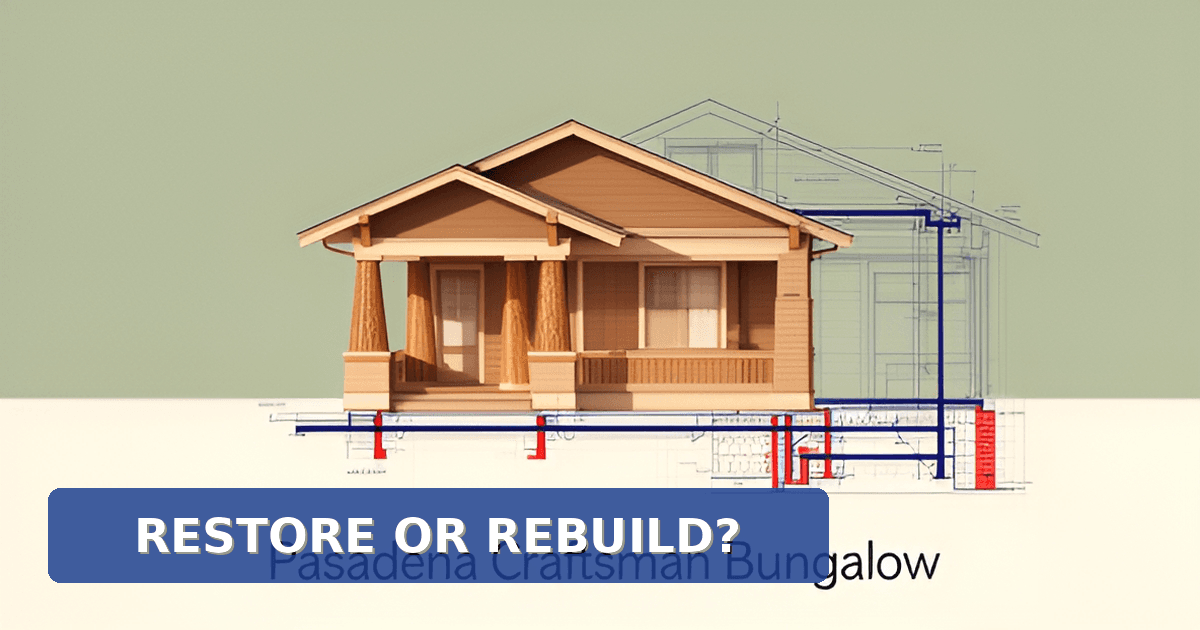
Restoring a Craftsman Home: Costs and Considerations in the Pasadena Area
Key Facts
- Whole-house rewiring of knob-and-tube systems runs $8,000–$20,000+ and can block homeowners insurance coverage per restoration benchmarks.
- Foundation repairs on 1905–1930 homes range from minor repointing to $20,000–$50,000+, according to national cost data.
- Whole-home renovations in the Pasadena area typically run $120,000 to $300,000+ per local vendor estimates.
- One seller spent $18,000 covering 1920s oak floors with vinyl, then dropped the price $12,000 — refinishing would've cost $4,000 in one case study.
- Pasadena plan check takes 6–10 weeks, with historic district design review adding another 2–6 weeks per local permitting guidance.
- More than 1 in 5 U.S. tradespeople are over 55, and 2.1 million skilled trades jobs could go unfilled by 2030 reports Pasadena Now.
- A few-hundred-dollar structural inspection should always precede design work in a Craftsman restoration according to cost research.
The Three Budget Realities of a 1905–1930 Craftsman Restoration
Walk through a 1915 Pasadena bungalow and the first things you notice — the oak floors, the art glass, the tapered porch columns — are almost never the things that decide your budget. In homes built between 1905 and 1930, the core costs live behind the walls and under the house.
Systems upgrades, not cosmetics, drive the real budget. According to national restoration benchmarks, whole-house rewiring to replace knob-and-tube wiring typically runs $8,000–$20,000+, while foundation work ranges from minor repointing up to $20,000–$50,000+. Add those two line items alone and you can exceed the cost of an entire cosmetic refresh.
The insurance stakes make the electrical issue urgent. Most insurers restrict or refuse coverage on homes with active knob-and-tube wiring, which also cannot legally be buried in insulation. That means the wiring isn't just a safety item — it can block the policy you need to close escrow or keep the home insured during construction.
At the whole-project level, Pasadena-area vendor estimates place whole-home renovations at $120,000 to $300,000+. Those figures assume the systems work goes smoothly; a surprise under the floor or inside the walls moves the number fast.
That's why restoration professionals preach a simple sequencing rule: structural inspection first, design second. A few-hundred-dollar structural inspection should precede any design work, because what it reveals determines what the design can even be.
The core budget realities for a pre-war Craftsman restoration:
- Knob-and-tube rewiring: $8,000–$20,000+, cheapest when walls are already open
- Foundation and seismic work: from minor repointing up to $20,000–$50,000+
- Whole-home renovation baseline in the Pasadena area: $120,000–$300,000+
- Structural inspection: a few hundred dollars, done before design begins
Restorers like Brett Waterman put it plainly: "Start with the essentials: maintain the structural soundness and safety of the home." That advice holds whether you're planning a phased restoration in Bungalow Heaven or weighing a gut remodel against a rebuild on an Altadena lot — a decision where Altadena Custom Home Builder recommends getting a licensed contractor's read on the systems before committing either way.
The practical takeaway: budget the invisible work first, and time the rewiring for when walls are open anyway. Cosmetics can wait; a failing foundation and live knob-and-tube wiring cannot.
Restore, Don't Replace: Why Original Details Are the Asset
The most expensive mistake a Craftsman owner can make is also the most common one: tearing out the original details that give the home its value. Old-growth fir and oak trim has tighter growth rings than modern lumber, making it denser, more stable, and more rot-resistant — replacing it with new materials is a downgrade at any price point, according to renovation cost research.
The economics consistently favor restoration over replacement. Consider a case study where a seller spent $18,000 covering 1920s oak floors with luxury vinyl plank, then dropped the asking price by $12,000 anyway. Refinishing the original floors would have cost roughly $4,000. The gutted version sold for less than the intact one would have — the buyer premium attached to period character exceeded the cost of preserving it.
Built-ins tell the same story. Recreating a missing Craftsman cabinet or sideboard runs $5,000–$15,000 in custom millwork, while restoring an existing one costs far less. Other restore-don't-replace wins include:
- Cast iron tub reglazing at $400–$800, versus several times that for demolition and replacement
- Salvaged art glass panels at $100–$600, a fraction of commissioning new period-style leaded glass
- A whole-house hardware pass for $1,500–$4,000, with no permit required
- Professional paint stripping on original trim at $200–$500 per opening, revealing wood that cannot be bought new
The appraisal downside of gutting is real. Removing bearing walls to force an open-plan layout runs $3,000–$10,000+ before finishes, and industry analysis notes that gutted bungalows appraise lower than homes retaining their original floor plan and features. Michael Robleto, Pasadena Heritage board chair and a historic-property realtor, puts it plainly: restoring historical details delivers "not only a sense of pride but also a financial reward when the day comes to sell," and demand for pre-war Pasadena properties is constant.
This principle extends to how we think about rebuild work at Altadena Custom Home Builder. Whether a project is a careful restoration or an Eaton Fire rebuild, the goal is the same — carry forward the proportions, millwork traditions, and material quality that define these homes, rather than defaulting to generic new construction. As preservationist Mark Ramler frames it, owners are stewards of buildings meant to outlast them.
The practical takeaway: before demo day, assess what you actually have. Selective demolition, not a sledgehammer, reveals which floors, trim, and built-ins can be saved — and every element preserved is money that stays in the budget and value that stays in the house.
Pasadena's Permitting Maze and the Shrinking Preservation Trades
Even the best-planned Craftsman restoration can stall before the first nail is pulled — not for lack of money, but for lack of time and tradespeople. In Pasadena, the two constraints most homeowners underestimate are the city's permitting process and a shrinking pool of craftspeople who can actually do period-appropriate work.
Pasadena is known for thorough plan check, so complete submittals matter. Budget 6 to 10 weeks for plan check, and if your home sits in a historic district, add another 2 to 6 weeks for design review. In Bungalow Heaven — a designated landmark district — exterior changes, window replacements, and additions all require review before work begins.
If your property is individually designated or in a landmark district, you may need a Certificate of Appropriateness before touching anything. Pasadena Heritage recommends calling the City's Design & Historic Preservation section at (626) 744-4009 before starting any project. Pasadena has designated more than 100 local landmarks and numerous landmark districts across its 23 square miles, so many Craftsman owners fall under these rules.
The second constraint is quieter but arguably more serious. Artisans who can rebuild a window sash to match 1910 millwork or repair historic plaster "are not easy to find," and they're aging out faster than they're being replaced. Nationally, more than 1 in 5 tradespeople are over 55, and research projects 2.1 million skilled trades positions could go unfilled by 2030. No reliable count of preservation-specific craftspeople even exists.
The January 2025 Eaton Fire made this crisis acute. Rebuilding Altadena — including historic Janes Village — with period-appropriate materials requires exactly the workforce that's vanishing. As Dr. Bridget Lawlor of Pasadena Heritage puts it, "Preservation is no longer just about protecting historic buildings. It's also about community recovery and resilience and identity."
How to navigate both constraints:
- Verify your designation status with Design & Historic Preservation at (626) 744-4009 before any exterior work.
- Use Pasadena Heritage's annually updated Referral List to identify specialist contractors, and get multiple estimates while verifying licenses and insurance.
- Book scarce tradespeople early — the same specialists are now in demand for Altadena fire rebuilds.
- Phase your project so permit-dependent work and specialist work don't stall the whole timeline.
If you're weighing a Craftsman restoration against a ground-up rebuild in the Altadena area, the permitting and trades landscape should factor into that decision from day one. Altadena Custom Home Builder helps homeowners think through these trade-offs — schedule a free build consultation to map your options, with no permit or timeline promises, just honest guidance.
Your Restoration Roadmap: Phasing, Budgeting, and Finding the Right Specialists
A successful Craftsman restoration isn't won at the design table — it's won in the sequencing. Get the order wrong, and you'll spend your budget twice.
Start with a structural inspection, which typically costs only a few hundred dollars but should always precede design work. In 1905–1930 homes, the big-ticket items hide behind the walls: whole-house rewiring of knob-and-tube systems runs $8,000–$20,000 or more, and foundation repairs can climb from minor repointing to $20,000–$50,000+. Restoration expert Brett Waterman puts it plainly: "Start with the essentials: maintain the structural soundness and safety of the home." Tackle rewiring while walls are already open — it's far cheaper than revisiting it later.
Once structure and systems are scoped, phase the work to match the funds you actually have. With materials and labor costs rising, restoration professionals advise clients to group projects: "What really needs to be achieved? Can it be grouped into phase one and phase two?" Many homeowners have saved for years, so every dollar needs a deliberate job. A smart early move is the porch — porch column rebuilds run $1,000–$3,000 per column, usually require no permits, and deliver the highest curb-appeal return with visible progress from day one.
Finding the right specialists may be your biggest constraint. The trades shortage is real: the U.S. construction industry needs 349,000 new workers in 2026 alone, and more than 1 in 5 tradespeople nationally are over 55. Artisans who can rebuild a window sash to match 1910 millwork "are not easy to find," a shortage intensified by Eaton Fire rebuild demand across Altadena. Before you hire, use these local vetting tools:
- Pasadena Heritage's annually updated Referral List of contractors, tradespeople, and preservation consultants
- The Regional Restoration Expo at Pasadena's Blinn House, which gathers 40–50 curated restoration specialists with free admission
- Multiple written estimates — Pasadena Heritage notes "it is always wise to get more than one estimate"
- Verification of current contractor licenses and insurance before signing anything
If your home sits in a landmark district like Bungalow Heaven, build time into the plan: Pasadena plan check runs 6–10 weeks, with historic district design review adding another 2–6 weeks, and designated properties may need a Certificate of Appropriateness before exterior work begins.
For homeowners weighing a full restoration against a ground-up rebuild — a question many Altadena families are asking after the Eaton Fire — talking through sequencing and budget with an experienced builder early pays off. At Altadena Custom Home Builder, our free build consultation covers exactly these trade-offs, and our featured builder, JMB Builders LLC (CSLB #1103479), brings licensed whole-home remodel and rebuild experience to the table. Whether you restore or rebuild, the goal is the same: steward a home that will stand for hundreds of years past you.
When Restoration Isn't Enough: Restore, Remodel, or Rebuild?
Some fire-damaged or badly compromised Craftsman homes can't be saved by restoration alone. When structural damage, foundation failure, or fire loss extends beyond what repair can economically address, Altadena homeowners face a harder question: whole-home remodel, or tear-down and rebuild?
The answer starts with a structural inspection — a few hundred dollars that should precede any design work. Foundation repairs on early-1900s homes can run from minor repointing up to $20,000–$50,000+, and knob-and-tube rewiring adds $8,000–$20,000 or more. When those systemic costs stack on top of fire or water damage, a whole-home renovation in the Pasadena area typically ranges from $120,000 to $300,000+, according to local remodel estimates. At that point, a ground-up rebuild that honors the original architecture can become the more rational path.
The deciding factors usually come down to a short list:
- Structural integrity: whether the foundation, framing, and load-bearing walls can be feasibly brought back to code.
- Surviving period details: original built-ins, old-growth trim, and art glass — features that cost $5,000–$15,000 to recreate new — are worth salvaging and integrating wherever possible.
- Historic designation: designated properties or landmark-district homes may require design review or a Certificate of Appropriateness before exterior work, so check status early.
- Budget and phasing: restoration professionals advise grouping work into phases matched to available funds, especially with rising materials and labor costs.
For Eaton Fire survivors in Altadena, this decision carries extra weight. Rebuilding neighborhoods like historic Janes Village with period-appropriate materials depends on a preservation workforce that is shrinking — more than 1 in 5 tradespeople nationally are over 55, and the industry needs 349,000 new workers in 2026 alone, per Pasadena Now's reporting. As Pasadena Heritage's executive director Dr. Bridget Lawlor puts it, preservation is now "about community recovery and resilience and identity." Start with official recovery resources, and lean on local expertise: Pasadena Heritage maintains an annually updated Referral List of vetted contractors, and it advises getting more than one estimate and verifying licenses and insurance.
For readers weighing a rebuild on an Altadena hillside or slope lot — or a fire rebuild that must respect the town's Craftsman traditions — Altadena Custom Home Builder offers a free build consultation. The featured builder, JMB Builders LLC (CSLB #1103479), is an Altadena-based licensed general contractor experienced in custom homes, whole-home remodels, and period-appropriate rebuilds, with work documented at jmb-builders.com. A conversation with a licensed local builder is the most reliable way to turn a directional budget range into a real plan for your specific lot and home.
Frequently Asked Questions
How much does it really cost to restore a Craftsman bungalow in Pasadena?
Do I have to replace my knob-and-tube wiring, and why is it such a big deal?
Should I restore or replace my original wood floors, trim, and built-ins?
What permits or approvals do I need before restoring a Craftsman in a Pasadena historic district?
How do I find contractors who can do period-appropriate Craftsman work?
After a fire, is it better to restore my Craftsman or tear down and rebuild?
Your Craftsman's Next Hundred Years Start With One Phone Call
Restoring a pre-war Craftsman in the Pasadena area comes down to three principles: budget the invisible systems first, restore the original details that carry the home's value, and lock in scarce tradespeople and permits early. A few-hundred-dollar structural inspection should come before any design work, because the real costs — knob-and-tube rewiring at $8,000–$20,000+ and foundation work up to $50,000+ — hide behind the walls. Meanwhile, the economics consistently favor preservation: gutted bungalows appraise lower, while intact period details command a constant buyer premium, especially with more than 1 in 5 tradespeople nationally over age 55 and the preservation workforce shrinking. If restoration can't economically save your home, a period-appropriate rebuild may be the wiser path. Whether you're weighing a phased restoration in Bungalow Heaven or a rebuild on an Altadena lot, Altadena Custom Home Builder offers a free build consultation to map your options — honest guidance from a licensed local builder, with no permit or timeline promises, just a real plan for your home.