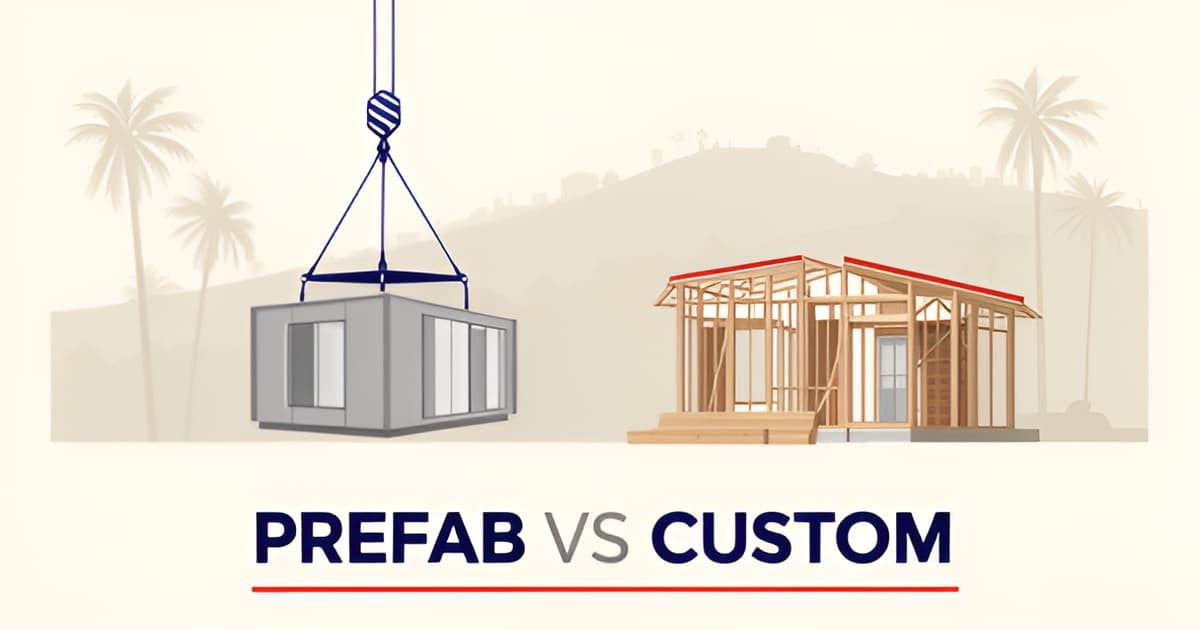
Prefab vs Custom ADU in Los Angeles: Real Cost and Timeline Comparison
Key Facts
- Three independent analyses of LA ADU costs converge: prefab and stick-built ADUs cost about the same once delivery and site work are counted, per LADU's review of 18,848 permits.
- That $80K–$150K factory quote excludes foundation, utilities, permits, and crane costs — all-in prefab pricing runs $120K–$300K in LA, according to ADUscale's cost analysis.
- Median LA County ADU permit valuations climbed 170%, from $74,000 in 2018 to $200,000 by early 2026, per analysis of $5.09 billion in ADU investment.
- Roughly 1 in 4 LA residential lots has hillside exposure, adding a $25,000–$80,000 premium that prefab marketing never mentions, per LA ADU cost data.
- Prefab wins on speed — factory units set in days versus up to two years for stick-built — but LA permitting takes 2–3 months for both routes, per California ADU cost analysis.
- The widely repeated claim that prefab saves 10–25% traces back to a prefab manufacturer's own marketing page, not independent data, per vendor statistics.
- The 10–25% prefab savings claim comes from a prefab manufacturer itself, while three independent sources find cost parity, per the vendor's own statistics page.
The Deceptive Prefab Price Tag: Why Factory Quotes Mislead LA Homeowners
That $95,000 "starting at" price on a prefab ADU brochure is real — it's just not the whole story. Factory quotes for prefab units typically run $80,000 to $150,000, but according to ADU cost analysis for Los Angeles, those numbers exclude most of the LA-specific cost stack that every project must eventually pay for.
The factory builds the box. You pay for everything that makes the box habitable on your lot. Industry breakdowns note that many prefab quotes omit site work, foundation, utilities, permits, and delivery or crane costs, making their base price look deceptively low. A realistic prefab budget in LA includes:
- Foundation and site grading — hillside and slope lots can add a $25K–$80K premium
- Utility connections and sewer lateral work ($15K–$30K where upgrades are needed)
- Permits and city fees — $8K–$15K for a 600 sq ft ADU, plus soft costs running 15–25% of total project cost
- Delivery and crane fees, which can spike or kill the project entirely on narrow or tight-access lots
Here is the part most homeowners don't hear: once you count all-in delivered costs, prefab and stick-built land in the same range. LADU's analysis of 18,848 LA County ADU permits concludes that after site preparation, transportation, and installation, prefab pricing is "usually comparable to building from the ground up." ADUscale's data shows prefab units running $120K–$250K — up to $300K with full site work — squarely inside the band for mid-range site-built units.
Maxable's California ADU cost breakdown goes further, stating plainly that all three construction methods yield a similar total cost. When three independent sources with different commercial biases converge on the same answer, that convergence is worth more than any single vendor's pitch.
So where does the persistent "prefab saves money" belief come from? Largely from prefab companies themselves. The widely repeated claim that prefab delivers 10–25% savings traces back to a prefab manufacturer's own statistics page — a vendor with obvious commercial interest, not independent data. Treat it as marketing until a delivered-cost comparison proves otherwise.
Compare all-in delivered costs, never factory prices. That means demanding fully itemized quotes covering site prep, foundation, utilities, permits, delivery, and contingency from every bidder — prefab or custom. For Altadena homeowners on hillside lots especially, prefab's transportation and crane risks can erase any paper savings fast. If you're weighing an ADU alongside a rebuild or custom home project, Altadena Custom Home Builder offers a free build consultation to help you compare real numbers for your specific lot.
Real Numbers: What ADUs Actually Cost in Los Angeles (With Altadena Context)
Ask most homeowners what an ADU costs in Los Angeles and you'll get a guess. The real answer, drawn from 18,848 permits filed across LA County since 2018, is a range of $150,000 to $400,000+ — with construction running $300–$550 per square foot, and $500–$700 per square foot on hillside or HPOZ lots, according to LA-specific cost analysis.
The trend line matters as much as the range. Median permit valuations climbed roughly 170% between 2018 and early 2026, from $74,000 to $200,000, driven by material costs, labor shortages, and a shift toward larger detached units. That's per an analysis of LA County permit data totaling about $5.09 billion in ADU investment.
Costs vary sharply by project type:
- Garage conversions: $95,000–$225,000
- Attached ADUs (500–1,000 sq ft): $175,000–$325,000
- Detached ADUs (up to 1,200 sq ft): $200,000–$400,000+
- Prefab/modular (400–800 sq ft): $120,000–$250,000, up to $300,000 with full site work
Altadena homeowners should pay particular attention to the site-condition premium. Roughly one in four LA residential lots has hillside exposure, and hillside soils alone can add $25,000–$80,000 to a project. Add sewer lateral upgrades ($15,000–$30,000) and soft costs — which run 15–25% of the total and are the most underestimated line item — and the ground under your ADU often moves the budget more than the structure itself.
The local numbers back this up. Altadena's median ADU permit valuation sits at $160,000, well above the City of LA's $101,000 but below Arcadia's $180,000 — consistent with a community of larger lots, slope conditions, and higher-spec builds. For context on where Altadena fits regionally, a 600 sq ft detached ADU runs $240,000–$330K in LA and $270,000–$370K in nearby Pasadena.
One caution when comparing quotes: permit valuations understate real spend. About 62% of LA County ADU projects come in under $150,000 on paper, yet few owners actually build at that figure once site work, fees, and finishes are counted. At Altadena Custom Home Builder, we advise budgeting a 10–20% contingency on top of any estimate, whether prefab or stick-built.
If you're weighing an ADU on a slope lot or an Eaton Fire rebuild property, the cost drivers above are the ones that matter most. A free build consultation can help you pressure-test your budget against your specific lot before you commit to either route.
Timeline Showdown: Where Prefab Actually Wins
If you ask most homeowners why they chose a prefab ADU, the answer isn't cost — it's the calendar. Factory construction is the one area where prefab delivers a clear, defensible advantage over stick-building on your lot.
The numbers tell the story. A prefab unit can be set on its foundation in a couple of weeks, sometimes even days, while a traditional stick-built ADU can stretch up to two years depending on size and complexity, according to California ADU cost analysis. Factory conditions eliminate most weather delays and subcontractor scheduling gaps, which is why prefab's edge is schedule reliability, not price.
But here's what prefab marketing often glosses over: the permitting clock runs identically for both routes. In Los Angeles, ADU permits typically take 2–3 months, and that's before anyone breaks ground. When plan-check corrections enter the picture, expect the process to stretch to 3–6 months. LADBS plan checks commonly go through 2–3 correction rounds, and each round adds 4–8 weeks plus $1,500–$5,000 in architect re-work fees, per LA permitting data.
That's why the single biggest timeline lever isn't prefab versus custom — it's who draws your plans. An inexperienced designer, architect, or engineer can add months to a project if they aren't fluent in the ADU ordinance. A designer who knows the rules cold can sail through plan check in a month; one who doesn't can trap you in a correction loop that erases prefab's factory advantage entirely.
A few realities worth budgeting for:
- Plan for 2–3 months of permitting at minimum, and 3–6 months if your submission is likely to draw corrections.
- Each correction round costs 4–8 weeks and $1,500–$5,000 in re-work fees — hire ADU-experienced designers to avoid them.
- Factory speed only pays off on flat, accessible lots; hillside, tight-access, and HPOZ lots undermine prefab's logistics.
- No architect is legally required for most ADUs — a structural engineer's stamp often suffices, which can compress the design phase.
For Altadena homeowners, the lot itself matters as much as the method. Many of the hillside and slope lots we cover at Altadena Custom Home Builder fall squarely into the categories where prefab struggles, so the schedule math needs to account for grading, access, and crane logistics — not just factory turnaround. And if you're navigating an Eaton Fire rebuild, permit timelines can differ from standard ADU reviews, so check official LA County recovery resources before committing to any schedule assumption.
One documented custom build in LA saw city plan review finish in roughly 30 days when the plans were clean. That's the real lesson of the timeline showdown: prefab wins on construction speed, but preparation wins on total project time. If you want a realistic schedule for your specific lot, a free build consultation is the fastest way to find out which route fits your timeline — and no reputable builder will promise you a guaranteed date, only an honest range.
socialProofText: Timelines drawn from LADBS plan-check data and documented LA ADU builds — not manufacturer marketing.
ctaText: Get a free build consultation to map a realistic permit-and-construction timeline for your Altadena lot.
Lot Fit: Why Hillside, Tight-Access, and HPOZ Lots Point to Custom
On a flat, open lot with easy street access, prefab's factory-built speed is a genuine advantage. But in Altadena — where hillside and slope lots are the norm, driveways are narrow, and architectural character matters — the prefab math changes fast. According to LA ADU cost analysis, prefab's sweet spot is schedule reliability on accessible lots, while it consistently loses on hillside lots, tight-access lots, and HPOZ districts.
The reasons are practical, not aesthetic. A modular unit needs to be transported and craned into place, and narrow roads or difficult access can raise costs or block installation entirely. Hillside lots add their own premium: grading, soils work, and foundations on sloped terrain can add $25,000 to $80,000 to a project, and site conditions — not the structure itself — are what move budgets most in LA.
HPOZ overlay districts are another prefab stumbling block. Design review in these districts adds a $20,000–$50,000 premium and 8–16 weeks to the process, and prefab's limited design flexibility makes it harder to satisfy review boards. As ADU consultancy Maxable puts it, modifications to standard factory designs can be costly — and roughly 1 in 4 LA residential lots has hillside exposure, with 35+ HPOZ districts across the city.
For Altadena homeowners, custom building offers three concrete advantages:
- Design freedom to match the town's architectural traditions, from Craftsman bungalows to mid-century homes — a real consideration in a community rebuilding after the Eaton Fire.
- Better blending with existing structures, which matters for hillside lots where grading, foundations, and access must be engineered around the terrain rather than delivered onto it.
- Potentially stronger appraisals, since site-built ADUs are perceived as permanent additions. Panelized and custom units are typically appraised higher than prefab at resale.
None of this means prefab is wrong. If your lot is flat, your access is wide, and finishing on a predictable schedule matters more than design nuance, prefab delivers — factory conditions reduce weather and subcontractor delays. And despite the common assumption, prefab rarely saves meaningful money either way: once site prep, transportation, and installation are counted, the price is usually comparable to building from the ground up, as analysis of 18,848 LA County ADU permits confirms.
That's the decision framework we use at Altadena Custom Home Builder: let your lot characteristics — slope, access, and overlay district — drive the prefab-vs-custom call, not the sticker price. If you're weighing an ADU on a hillside, tight-access, or fire-rebuild lot, a free build consultation can help you map which route fits your property before you commit to either.
Your Action Plan: Comparing Bids, Budgeting Contingency, and Next Steps
The bid you receive is rarely the project you'll pay for. The single most important move you can make is demanding fully itemized, all-in pricing from every bidder — prefab and custom alike — before you compare a single number.
Prefab quotes are especially prone to this. Research shows many factory quotes omit site work, foundation, utilities, permits, and delivery/crane costs, "making their base price look deceptively low" (per a comparative analysis). Insist that every bid itemize site prep and grading, foundation, utility connections, permits, delivery and crane logistics (for prefab), finishes, and contingency.
Once you have real numbers, budget honestly:
- Contingency of 10–20% — sources consistently recommend this range, with some suggesting at least 10% as a floor (LA Family Builders; Maxable).
- Soft costs at 15–25% of total — design fees alone run $8,000–$25,000+, and soft costs are the most underestimated line item in LA projects.
- At least three competitive bids across both routes, so you're comparing delivered costs, not marketing.
- A correction-loop buffer: each LADBS plan-check round can add 4–8 weeks and $1,500–$5,000 in re-work fees (ADUscale).
Don't leave statutory savings on the table. Under California law (AB 68 / SB 13), sewer and water connection fees are waived for qualifying ADUs — LADBS cannot charge them (per ADUscale's LA cost analysis). The California ADU Grant Program can reduce costs by up to $40,000. Verify both with your jurisdiction before signing anything, since eligibility varies by project.
Finally, weigh the decision factors that actually matter: timeline certainty, customization needs, and your lot's characteristics — not the sticker price (as Maxable's cost breakdown concludes). On hillside or tight-access lots common in Altadena, prefab's transportation and crane risks can erase its schedule advantage entirely.
Before you commit to either route, walk your lot with someone who knows the terrain. Altadena Custom Home Builder offers a free build consultation — a field guide to evaluating your specific lot, from slope and access to LA County unincorporated permitting — so you can choose prefab or custom with your eyes open. Featured builder JMB Builders LLC (CSLB #1103479) builds ADUs and custom homes throughout Altadena, with work documented at jmb-builders.com. Book your consultation and start with the facts, not the brochure.
Frequently Asked Questions
Does a prefab ADU actually save money compared to building custom in Los Angeles?
How much does an ADU really cost in Los Angeles in 2026?
Why is my prefab ADU quote so much lower than the bids I'm getting from contractors?
Is a prefab ADU faster to build than a custom one?
Will a prefab ADU work on my hillside or narrow-access lot in Altadena?
How long does ADU permitting take in Los Angeles, and how can I avoid delays?
The Bottom Line: Your Lot Decides, Not the Brochure
The data is clear: once delivered costs are counted, prefab and custom ADUs land in the same price band — analysis of 18,848 LA County permits finds prefab "usually comparable to building from the ground up." Prefab's genuine edge is schedule reliability on flat, accessible lots; custom wins on hillside, tight-access, and HPOZ properties where crane logistics and grading premiums erase prefab's paper advantages. In Altadena, where slope lots and narrow driveways are common, your lot's characteristics — not a factory sticker price — should drive the decision. Before comparing a single bid, demand fully itemized all-in quotes from at least three bidders, budget a 10–20% contingency, and verify the fee waivers and grant savings you're legally entitled to. Whether you're planning an ADU or weighing one alongside an Eaton Fire rebuild, walk your lot with someone who knows the terrain first. Book a free build consultation with Altadena Custom Home Builder to map real costs and timelines for your specific property — and choose your route with facts, not marketing.