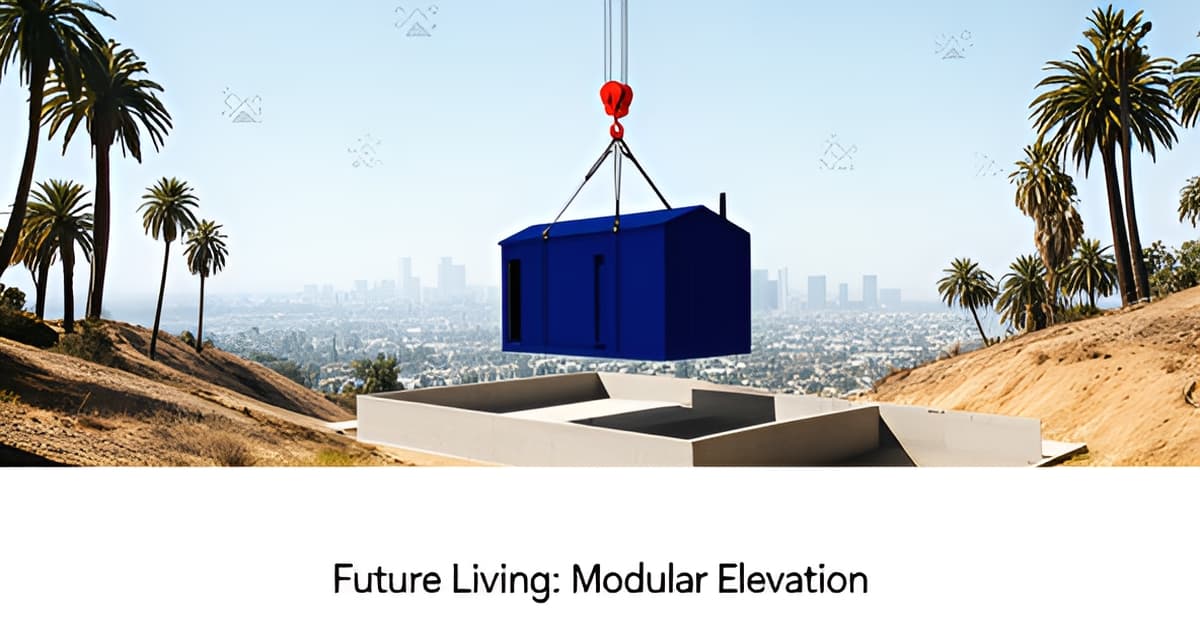
Prefab ADUs in Los Angeles: Costs, Quality, and Delivery Timelines
Key Facts
- Prefab ADUs in LA cost $140,000–$320,000 all-in once delivered and installed, according to field data.
- Site work adds $70,000–$185,000 on top of the factory price, making all-in totals run 2.0–2.5× the sticker, per California project data.
- LA County's 18,848 ADU permits show a median valuation of $120,000 but an average of $278,000, per public permit records.
- Despite '90-day' marketing claims, prefab ADUs in LA realistically take 5–9 months from contract to occupancy, LA permitting analysis shows.
- Prefab's cost advantage is just 5–15% on flat lots and disappears entirely once site work exceeds $80,000, industry analysis finds.
- ADUs made up 37% of LA County's new housing in 2025, with over 10,200 units completed, USC Lusk Center data shows.
- LA County approved $3.8 million in state funding to help unincorporated-community residents build ADUs after the Eaton Fire, Smart Cities Dive reports.
The Factory Price Trap: What Prefab ADUs Actually Cost in LA
You've found the perfect ADU online — a crisp factory price of $80,000 to $120,000, glossy renderings, and a "delivered in months" promise. Then the real invoices start arriving, and the number you budgeted becomes the smallest line in the stack.
Here's the trap: prefab marketing anchors on the factory price, but that figure covers only the box itself. Across California, field data on prefab ADU projects shows site work adds $70,000 to $185,000 on top of the sticker — and all-in totals typically run 2.0 to 2.5 times the advertised factory price. Homeowners who anchor on the sticker routinely watch their budgets balloon 80–150% before permits are even issued.
So what does the site-work stack actually contain? The major line items look like this:
- Foundation or slab: $15K–$35K, before any hillside complications
- Utility connections: $15K–$50K, with sewer-lateral replacement alone running $15K–$30K
- Crane and delivery: $5K–$15K, plus street permits and traffic control
- Grading and site prep: $5K–$20K on standard lots — $20K–$60K on hillside terrain
- Permits, HVAC connection, and soft costs: another $35K–$65K combined
That math produces realistic delivered-and-installed totals of roughly $140,000 to $320,000 in LA County, with studios starting near $180K and two-bedroom hillside builds reaching $400K or more. A stick-building contractor's LA cost analysis puts prefab totals at $140,000–$230,000 for a 350–600 sq ft unit — in line with or above comparable site-built construction.
The most honest baseline comes from public records, not vendors. LA County's 18,848 ADU permits show a median valuation of $120,000 but an average of $278,000 — a gap that exists precisely because so many projects carry heavy site costs. That median has climbed roughly 170% since 2018, from about $74,000 toward $200,000.
For Altadena homeowners, the stakes are higher still. On sloped lots and long utility runs, prefab's modest flat-lot advantage (5–15% at best) disappears entirely. At Altadena Custom Home Builder, we've seen this pattern repeatedly: the factory price is real, but it answers the wrong question. The right question is what your specific lot requires — and that answer only comes from a site-conditions review before you sign anything.
Prefab vs. Site-Built: Why Your Lot Decides the Answer
Google "prefab ADU cost" and you'll find two confident answers that can't both be true: one camp promises savings of up to 30% over stick-built, while another insists prefab is not cheaper at all once site costs are counted. Both camps are selling something — and the honest answer is that your lot, not the vendor, decides the winner.
The balanced picture: prefab wins on cost, but modestly. Independent-leaning analysis puts the advantage at just 5–15% on flat, standard lots, eroding entirely once site work exceeds roughly $80,000 (https://aduscale.com/adu/prefab/). Meanwhile, a stick-built contractor's own numbers show prefab totals ($140,000–$230,000 for 350–600 sq ft) landing "in line with or above" site-built ($115,000–$200,000 for the same footprint) (https://aplaconstruction.com/prefab-adu-los-angeles/). The reason is simple: the factory only builds the box. Everything the box sits on — grading, foundations, utility runs — costs the same either way, and on a difficult lot it costs more.
Prefab's advantage disappears when your lot presents any of these conditions:
- Hillside or slope lots, where grading alone can run $20,000–$60,000 (https://aduscale.com/adu/prefab/)
- Long utility runs or sewer-lateral work ($15,000–$30,000 on its own)
- Design-review or HPOZ districts that may reject a "modular look" (https://aduscale.com/adu/prefab/)
- A goal of matching your existing home's architecture — most California providers offer only 4–12 catalog models with limited customization
This is where Altadena readers should pay close attention. Much of Altadena sits on hillside and slope lots — exactly the terrain where prefab's economics fall apart. Prefab is also, by one contractor's account, structurally limited to single-story designs, since no prefab ADU company offers two-story models due to factory and transport constraints (https://cali-adu.com/blog/cost-to-build-adu/) — a vendor claim, but one consistent with what's actually on the market. On a sloped lot where you're maximizing buildable footprint, going vertical with site-built framing is often the only viable path.
There's also a design-tradition consideration. Altadena's older neighborhoods carry distinct architectural character, and a catalog floor plan rarely matches it. Site-built construction lets you adapt the ADU to the slope, the setbacks, and the streetscape simultaneously — something a factory-built box fundamentally can't do.
The practical takeaway: before comparing a single price sheet, get a real read on your site. Slope, soils, utility distance, and design-review exposure will eliminate or vindicate prefab faster than any vendor comparison chart. For Eaton Fire rebuild households weighing an ADU alongside the main house — LA County has approved $3.8 million in state funding to support ADU construction in unincorporated communities (https://www.smartcitiesdive.com/news/adu-affordable-housing-la-county-california/828137/) — a site-conditions-first conversation is the cheapest due diligence you'll ever do.
Realistic Timelines: The 5–9 Months Nobody Advertises
"Move-in ready in 90 days" is the promise you'll see on most prefab ADU websites. The reality, according to converging industry data, is that prefab ADUs in LA take 5–9 months from contract to occupancy — and the factory is only a small part of that clock.
The reason is simple: factory manufacturing does not reduce LA permitting time. As one detailed LA analysis puts it, city review applies equally to prefab and site-built units, so a prefab ADU waits in the same permit queue as any stick-built garage conversion. A realistic prefab timeline looks like this:
- Permitting: 3–4 months, even for compliant by-right ADUs
- Factory lead time: 3–6 months for your unit to be built
- On-site installation: 2–4 weeks, sometimes as little as days
That's why sources report 6–10 months total for prefab versus 7–12 months for stick-built — a real but modest advantage. Even pro-prefab sources like USModular's ADU FAQ put prefab at 6–9 months from permit submission to completion.
There is good news buried in the process. California's ADU laws work in your favor: most single-family lots can build 800–1,200 sq ft ADUs by right, with 4-foot side and rear setbacks and parking relief near transit, according to LA ADU permit data. Compliant ADUs are reviewed ministerially — meaning no public hearing and no discretionary review that neighbors can use to block you. Cities cannot deny a compliant ADU, though they can apply objective design standards, and HPOZ or design-review districts may reject a "modular look."
Prefab-specific rules matter too. Under LADBS bulletin P/BC 2026-112, open-framed prefab is inspected by LADBS just like site-built framing. Closed panels with concealed wiring or plumbing require state HCD approval with an insignia, while LADBS handles the foundation, utilities, and site work. Pre-approved plan libraries can shorten review timelines further, since the plans have already cleared the city's checklist.
The practical takeaway: budget your calendar around permits and factory lead times, not the installation truck. At Altadena Custom Home Builder, we advise homeowners to treat any timeline promise under six months with healthy skepticism — and to verify that whoever manages the project, prefab manufacturer or local contractor, holds a valid CSLB license. If you're weighing prefab versus site-built on a hillside or slope lot, a free build consultation can map your specific permitting path before you sign anything.
Quality, Warranty Risk, and Vetting Prefab Providers
A prefab ADU is only as good as the company that stands behind it — and in California, that company may not exist in five years. Several prefab providers have closed over the last five years, leaving homeowners with warranties no one will honor and no source for replacement parts, a risk documented in ADU market analysis.
Quality also varies dramatically by manufacturer. High-end makers such as Dvele and Cover produce excellent units with strong factory quality control, while lower-end prefab can mean a shorter lifespan for the building. Factory construction does offer real advantages — it eliminates exposure to wet weather during framing, which proponents argue reduces the chance of mold in the finished unit.
Design flexibility is the other constraint. Most California prefab providers offer just 4–12 catalog models with limited customization, which makes prefab a poor match for unusual lots, slopes, or homes with distinctive architecture. That matters in Altadena, where hillside lots and established architectural traditions — from Craftsman bungalows to mid-century ranch homes — often demand a design that responds to the site rather than a catalog. Cities can also impose objective design standards, and in HPOZ or design-review districts, a "modular look" may face rejection.
Before signing a prefab contract, run this vetting checklist:
- Manufacturer stability: How long has the company been in business, and how many units has it delivered in California? A young company is a warranty risk.
- CSLB license verification: Confirm the builder's license is active and in good standing at cslb.ca.gov — the same check we apply to any featured contractor, including JMB Builders LLC (CSLB #1103479).
- HCD approval for closed panels: Under LADBS bulletin P/BC 2026-112, open-framed prefab is inspected like site-built framing, but closed panels with concealed wiring and plumbing require state HCD approval with insignia.
- Warranty terms in writing: Ask who services the warranty if the manufacturer exits the market — and get the answer in the contract.
- Design fit: Match the unit's architecture to your neighborhood and existing home, not just your budget.
One caution on research itself: nearly every cost and quality claim about prefab comes from commercial vendors with a stake in the answer — pro-prefab manufacturers and site-built competitors alike. Treat all figures as directional, and weigh them against your specific lot.
For Altadena homeowners — especially those navigating Eaton Fire rebuild decisions, where LA County has approved $3.8 million in state funding to help unincorporated-community residents build ADUs — the choice between prefab and a site-built ADU starts with your lot, not a catalog. Altadena Custom Home Builder offers a free build consultation to assess your site conditions and walk through both paths honestly.
Your Next Step: Site-Conditions-First Planning in Altadena
The most expensive prefab ADU decision you'll make isn't the floor plan — it's skipping the site review. In Altadena, where hillside lots, slope conditions, and long utility runs are the norm rather than the exception, the research is clear: prefab's cost advantage holds on flat, standard lots but erodes entirely once site work passes $80,000, according to industry analysis. That makes your lot — not any manufacturer's catalog — the starting point.
Los Angeles County's Board of Supervisors approved $3.8 million in state funding to help unincorporated-community residents build ADUs after the Eaton Fire, and Supervisor Kathryn Barger noted that ADUs can house displaced family members, provide rental income to offset rebuilding costs, and offer long-term stability, as reported by Smart Cities Dive. For households weighing a rebuild, an ADU can serve double duty: housing now, income later.
The income case is concrete. Los Angeles ADU rental data shows studios and compact one-bedrooms renting at roughly $2,000–$2,800 per month, with larger units reaching $3,000–$4,000 — producing break-even periods of roughly 7.6 to 7.8 years on representative projects like a $220,000 unit at $2,400/month or a $300,000 unit at $3,200/month, per LA County ADU cost research. A detached ADU can also add meaningfully to property value while a family rebuilds.
Before you request a single factory quote, get these questions answered on your actual lot:
- Slope and access: Can a crane and delivery truck reach the pad, or will hillside grading ($20,000–$60,000 in some cases) erase prefab's savings?
- Utility runs: Are sewer, water, and power close by, or will long connections push site work toward the $70,000–$185,000 range documented across California projects?
- Design fit: Does a catalog model suit your lot's shape and the neighborhood's architecture, or does the site argue for site-built?
- Manufacturer stability: Several California prefab providers have closed in the past five years, leaving warranty and parts questions — verify licensing and track record before signing.
That's exactly how Altadena Custom Home Builder approaches every ADU and rebuild conversation: the free build consultation begins with a site review of your lot's slope, access, and utility conditions — the single biggest factor in whether prefab or site-built wins on your property. Our featured builder, JMB Builders LLC (CSLB #1103479), builds custom homes, ADUs, and Eaton Fire rebuilds throughout Altadena (disclosed paid placement), and every estimate reflects all-in costs, not factory-price anchors. For official recovery resources and county program details, check LA County's Eaton Fire recovery pages directly before committing to any timeline.
Frequently Asked Questions
How much does a prefab ADU actually cost in Los Angeles once everything is included?
Is a prefab ADU really cheaper than building one on-site?
How long does it really take to get a prefab ADU from contract to move-in?
Does prefab make sense on a hillside or sloped lot in Altadena?
What should I check before signing a prefab ADU contract?
Can an ADU pay for itself through rental income after an Eaton Fire rebuild?
Your Lot, Not the Catalog, Decides the Build
The numbers tell a consistent story: prefab ADUs in LA realistically run $140,000–$320,000 all-in once site work adds $70,000–$185,000 to the factory price, timelines land at 5–9 months rather than the advertised 90 days, and the cost advantage holds only on flat, standard lots. On Altadena's hillside and slope properties — where grading alone can reach $60,000 — that advantage erodes entirely, and catalog designs rarely fit the terrain or the town's architectural character. For Eaton Fire rebuild households weighing an ADU alongside the main house, the smartest first move isn't comparing quotes; it's understanding your lot. Slope, access, and utility distance will answer the prefab-versus-site-built question faster than any vendor's price sheet. That's exactly how Altadena Custom Home Builder approaches every project: our free build consultation starts with a site-conditions review before any numbers are discussed, and our featured builder, JMB Builders LLC (CSLB #1103479), provides all-in estimates — not factory-price anchors. Before you sign anything, verify licenses, demand written warranty terms, and get your site assessed. Book your free build consultation and find out what your lot is really telling you.