Modular vs Site-Built ADUs: Durability and Efficiency Compared
Key Facts
- Modular ADUs pass through 15-20 factory inspection stations versus just 3-5 typical site inspections for traditional builds, according to prefab construction statistics.
- Modular homes report 40-60% fewer first-year warranty claims, though these figures are industry-reported, not independently verified, per industry data.
- Site-built construction dominates larger units, accounting for roughly 57% of ADUs over 800 square feet and 63% of luxury backyard homes, market research shows.
- Modular builds average 8 months versus nearly 10 for stick-built, while 85-91% of traditional projects hit delays, prefab statistics indicate.
- Modular buildings are 15% more energy-efficient and require roughly 40% fewer labor hours than site-built equivalents, according to market analysis.
- Fixed on-site costs of $50K-$120K apply regardless of module size — buyers anchoring on sticker price can see budgets shift by $80,000, one modular guide warns.
- No independent head-to-head studies exist comparing long-term durability of modular versus site-built ADUs — most claims come from industry sources.
- California approved over 26,000 ADU permits in 2023 — more than 35% of the U.S. total — with Los Angeles alone issuing 7,000+, ADU market research reports.
The ADU Decision Altadena Homeowners Actually Face
If you own a lot in Altadena, chances are you've already had the ADU conversation — and probably gotten two completely different answers about how to build it. California approved more than 26,000 ADU permits in 2023, over 35% of the U.S. total, and Los Angeles alone issued more than 7,000, according to ADU market research. The question isn't whether to build an ADU anymore. It's how.
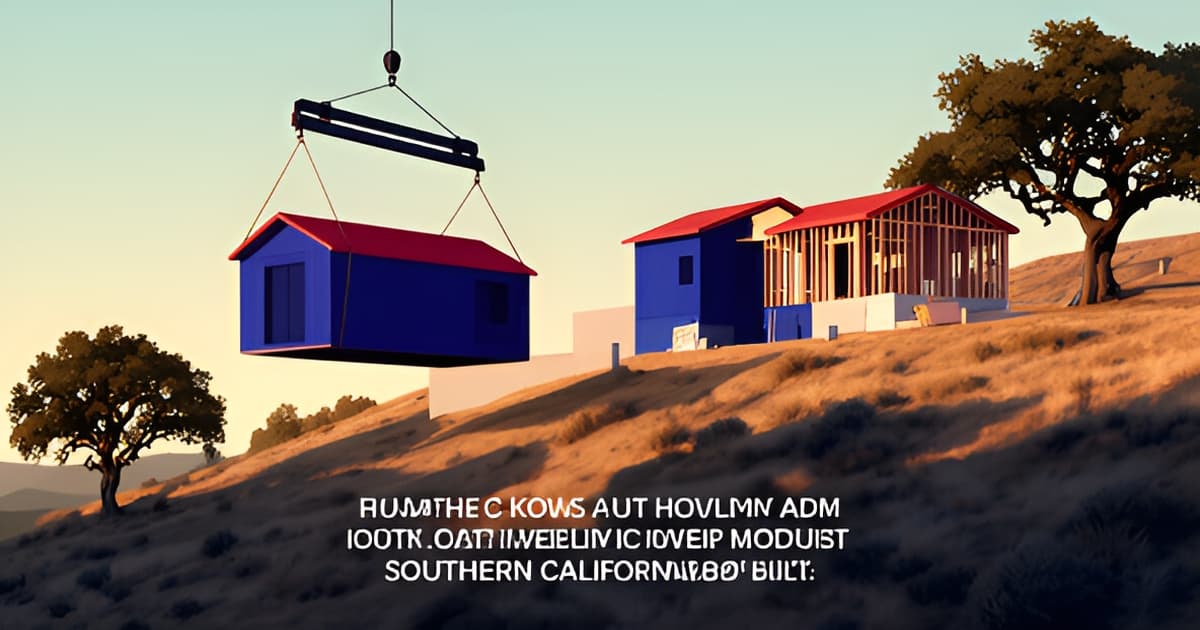
In Altadena, that question gets harder. Hillside lots, slope parcels, and properties rebuilding after the Eaton Fire rarely offer the flat, wide-open backyard that prefab manufacturers show in their brochures. Crane access, trenching distances, and foundation work on uneven terrain can quietly reshape a budget — one modular buying guide warns of buyers whose budgets moved by $80,000 after anchoring on the module price alone.
Here's the complication most comparison articles skip: no independent head-to-head long-term durability studies exist for modular versus site-built ADUs. The research we reviewed — market reports, trade association data, and vendor guides — contains zero directly comparative lifespan, maintenance-cost, or structural-performance data. Most durability claims trace back to industry advocacy groups or companies selling prefab products.
What the data does show is that the choice splits along practical lines:
- Site-built dominates larger and luxury units — roughly 57% of ADUs over 800 sq ft and 63% of luxury backyard homes use conventional construction, per market analysis.
- Modular leads in smaller, standardized sizes, holding about 56% of the global ADU market.
- Speed favors modular: average build times run about 8 months versus nearly 10 for stick-built, while 85–91% of traditional projects hit delays.
- Permitting is identical for both — factory-built units must still meet local building codes, foundation requirements, and utility standards.
For Altadena homeowners weighing an ADU on a slope lot, an SB 9 lot split, or a fire-rebuild parcel, this is the honest starting point: the durability debate is largely built on quality-control logic, not decades of field data. Factory builds see 40–60% fewer first-year warranty claims, but those are industry-reported figures, not independent testing. Our approach at Altadena Custom Home Builder is to work from what's documented — and be upfront about what isn't.
Durability Compared: Factory Quality Control vs. Site Craftsmanship
Ask any builder which construction method produces a more durable home, and you'll get a confident answer — usually the one they build. The honest answer is more nuanced: modular's durability case rests on measurable quality-control advantages, while site-built's rests on decades of proven practice. Neither side has the long-term data to fully close the argument.
The factory's strongest evidence comes from inspection density and defect rates. Modular units pass through 15-20 factory inspection stations during production, compared with the 3-5 site inspections typical of traditional construction. That repeated checkpoint structure catches errors while materials are still on the line, not after drywall is up.
The warranty and rework numbers reinforce the pattern. Industry-reported figures show modular homes experience 40-60% fewer first-year warranty claims, and rework costs run 1-2% of project value for modular versus 5-10% for traditional builds. Factory production also improves material utilization by nearly 22%, according to market research, which reduces the hidden material defects that surface years later.
- 15-20 factory inspection stations versus 3-5 typical site inspections
- 40-60% fewer first-year warranty claims for modular units
- Rework costs of 1-2% for modular compared with 5-10% for site-built
- Factory precision improvements of roughly 26% through digital fabrication
Site-built construction tells a different quality-control story. Its inspection regime is sparser, and its rework rate is several times higher — but its craftsmanship tradition, design flexibility, and dominance in larger and luxury ADUs (roughly 57% of units over 800 square feet) reflect a track record that factory construction hasn't yet matched in longevity.
Here's the caveat we'd flag to any Altadena homeowner weighing these options: these durability figures are industry-reported, not independently verified. No source in our research provides direct, head-to-head data on long-term lifespan, maintenance costs, or structural performance for modular versus site-built ADUs. Most of the pro-modular claims come from vendors and trade associations with commercial incentives, and no independent study has tracked either method over decades.
The Modular Building Institute argues that modular delivers "higher quality control compared to projects utilizing only site-built construction," and the quality-control logic is sound — controlled environments, precise fabrication, more inspections. But sound logic isn't the same as longitudinal proof, particularly for California-specific concerns like seismic performance, where published comparative data simply doesn't exist yet.
For hillside lots, irregular parcels, and fire-rebuild projects around Altadena, that evidence gap matters. The right choice depends less on factory-versus-site ideology and more on your specific lot, design goals, and tolerance for each method's known tradeoffs. If you're evaluating an ADU on an Altadena property — including Eaton Fire rebuild parcels — a free build consultation with our featured builder, JMB Builders LLC (CSLB #1103479), can help you weigh both methods against your site's actual conditions.
Efficiency, Cost, and Timeline: What the Numbers Show
The sticker price of a modular ADU tells you almost nothing about what you'll actually pay — and the efficiency numbers only matter once you understand why. Here's what the hard data shows when modular and site-built ADUs go head to head.
Speed is modular's clearest advantage. Factory production cuts project timelines by 20-50%, and modular builds average 8 months versus nearly 10 for stick-built, according to prefab construction statistics. Site-built carries real delay risk: 85-91% of traditional projects run behind schedule, and nearly half of those see delays add more than 20% to total cost.
Efficiency gains extend to operations and labor. Modular buildings are 15% more energy-efficient than conventional construction, and modular units require roughly 40% fewer labor hours than site-built equivalents. Factory conditions also cut building-phase energy consumption by 67% and reduce waste by up to 90%.
Cost savings are real but contested. Sources conflict — figures range from 10-20% savings (up to 30%) to 25-40% per-unit reductions — so treat any single number with skepticism. The honest framing: modular typically costs less, but the advantage shrinks or disappears with high-design brands and difficult sites.
That's where the sticker-price trap comes in. PERCH's guidance is blunt: fixed on-site costs of $50K-$120K apply regardless of module size, and a buyer who anchors on the module price "calls their builder six weeks in asking why the budget moved by $80K."
- Site prep and foundation: $25,000-$90,000 combined, before the unit arrives
- Utility connections and permits: $18,000-$60,000 depending on trenching length and panel upgrades
- Delivery and crane: $5,000-$15,000 — and crane requirements climb sharply on sloped terrain with limited access
That last point matters in Altadena. Hillside and slope lots — common here, and common among Eaton Fire rebuild parcels — can push site work toward the $60K-$150K+ range that difficult rural conditions command. A flat-lot cost comparison simply doesn't transfer.
Permitting, meanwhile, is identical for both methods. As installation cost breakdowns note, a factory-built unit must still comply with local building codes, foundation requirements, and utility connection standards — including LA County requirements for unincorporated areas.
The takeaway: modular wins on speed, energy efficiency, and labor hours, but only if your site cooperates. Site-built costs more and runs later, but its budget behaves more predictably on irregular hillside lots. If you're weighing the two on an Altadena property, Altadena Custom Home Builder offers a free build consultation to run your actual lot conditions against these numbers — no generic estimates, just your parcel.
When Site-Built Wins: Size, Slopes, and Customization
Modular's efficiency story has a clear ceiling, and the market data reveals exactly where it sits. Once an ADU crosses roughly 800 square feet — or enters luxury territory — homeowners overwhelmingly choose to build on site. The numbers are striking: market research shows site-built construction accounts for about 57% of ADUs over 800 square feet and roughly 63% of luxury backyard homes.
Why? The same research points to "maximum architectural flexibility for irregular residential lots and customized homeowner preferences." That phrase could have been written about Altadena. Many local lots sit on slopes, have awkward setbacks, or offer limited backyard access — conditions that make crane placement and module delivery genuinely expensive propositions. Prefab cost breakdowns show delivery and crane work alone runs $5,000–$15,000 in favorable conditions, and sloped terrain or narrow access only pushes that higher.
There's also a design philosophy difference worth understanding. As one ADU industry guide puts it, prefab floor plans "optimize space efficiency rather than comfort, whereas site-built custom ADUs are designed more for comfort." A standardized module maximizes every square foot of a 400-square-foot studio. But a 900-square-foot guest home for aging parents or an Eaton Fire rebuild rental demands ceiling heights, sightlines, and room proportions tuned to how people actually live.
Site-built wins most often when three conditions align:
- The lot is irregular or sloped — stepped foundations and cantilevered designs work around terrain that modular boxes can't
- The unit exceeds 800 square feet, where custom layouts and architectural detail dominate buyer preferences
- The homeowner wants comfort-driven design rather than a space-efficiency template
One caution applies to both methods: sticker price rarely equals final cost. As one prefab guide warns, a buyer who anchors on the module price and forgets site work "is the buyer who calls their builder six weeks in asking why the budget moved by $80K." On an Altadena hillside, that gap can be larger still.
Where modular's standardized sizes fit best is the mirror image: flat, accessible lots, smaller footprints, and homeowners who value speed and predictable per-square-foot pricing over bespoke design. If your lot and goals fall on the site-built side of that line — especially for hillside properties or rebuild parcels — Altadena Custom Home Builder offers a free build consultation to evaluate what your specific parcel can support.
Choosing Your Build Path: Permits, Costs, and Next Steps for Your Lot
Here's the good news at the decision point: once your ADU plans are drawn, the permitting path is largely the same regardless of how the unit is built. A factory-built module must still comply with local building codes, foundation requirements, and utility connection standards — and in LA County unincorporated areas (which includes Altadena), that means identical plan review, Title 24 energy compliance, and inspection requirements for both modular and site-built ADUs. Financing parity exists too: for permanent modular units on your lot, Fannie Mae and Freddie Mac buy these mortgages on the same guidelines as site-built.
What actually differs is how your specific lot shapes the budget. Site work is the biggest pricing variable for either method: a developed urban backyard might run $20K–$50K in site preparation, while a difficult rural site can exceed $60K–$150K. Before you fall in love with a floor plan, evaluate:
- Slope and terrain — Altadena's hillside and slope lots add foundation and engineering complexity that favors site-built's architectural flexibility for irregular residential lots.
- Crane and delivery access — narrow driveways and tight backyard entries can add $5,000–$15,000 in delivery and crane costs for a modular install.
- Utilities — long trenching runs and outdated electrical panels add expense to prefab installs; budget $10,000–$35,000 for utility connections.
- Size goals — site-built accounts for roughly 57% of ADUs over 800 sq ft and about 63% of luxury backyard homes, where customized layouts dominate.
Beware the sticker-price trap in both directions. Modular buyers who anchor on the module price and forget site work are, as one guide puts it, the buyers who call their builder six weeks in asking why the budget moved by $80K. Site-built buyers face the opposite risk: 85–91% of traditional construction projects experience delays, and nearly half see delays add more than 20% to total costs. In California — which approved over 26,000 ADU permits in 2023, with LA issuing more than 7,000 — either method can pencil if you budget all-in from day one.
If you're weighing a modular or site-built ADU on an Altadena lot — particularly a hillside property or an Eaton Fire rebuild parcel — the free build consultation from Altadena Custom Home Builder is a sensible next step. You'll walk your lot's slope, access, and utility situation with a builder who handles both methods. The consultation features JMB Builders LLC (CSLB #1103479), an Altadena-based licensed general contractor that builds custom homes and ADUs, including Eaton Fire rebuilds (disclosed paid placement). No permit or timeline guarantees — just a clearer read on your specific lot.
Frequently Asked Questions
Are modular ADUs actually more durable than site-built ones?
How much faster is a modular ADU to build compared to stick-built?
Is a modular ADU really cheaper once you add up all the costs?
Does a hillside lot in Altadena make modular a bad choice?
Do modular ADUs have to pass the same permits and inspections as site-built in LA County?
Are modular ADUs more energy-efficient than site-built?
The Real Answer Lives in Your Lot, Not the Brochure
The modular-versus-site-built debate, as it turns out, isn't settled by ideology — it's settled by your parcel. Modular ADUs deliver measurable advantages in speed (about 8 months versus nearly 10), energy efficiency, and factory quality control, with 40-60% fewer first-year warranty claims. Site-built construction dominates larger and luxury units — roughly 57% of ADUs over 800 square feet — because irregular lots and comfort-driven designs reward architectural flexibility. What no one can honestly promise is a proven long-term durability winner: no independent head-to-head studies exist, and most claims come from sources selling one method or the other. In Altadena, where hillside slopes, tight access, and Eaton Fire rebuild parcels reshape budgets in ways no brochure predicts, the sticker price is only the beginning of the conversation. Your next step is simple: walk your actual lot — slope, access, utilities — with a builder who works in both methods. Altadena Custom Home Builder offers a free build consultation featuring JMB Builders LLC (CSLB #1103479), an Altadena-based licensed general contractor experienced with ADUs and fire rebuilds (disclosed paid placement). No guarantees — just a clear read on what your land can support.