Kitchen Remodel in Altadena: Cost Ranges and Layout Mistakes to Avoid
Key Facts
- A midrange minor kitchen remodel recoups 112.9% of its cost at resale nationally, per the Zonda 2025 Cost vs. Value Report cited by LA cost analysis.
- A full gut renovation adds 15–25% to materials and labor versus a rip-and-replace of the same-sized kitchen, according to LA renovation cost research.
- A single kitchen island adds $5,000–$15,000, often requiring the slab to be opened and re-poured, per Southern California estimates.
- Improper load-bearing wall removal can cause ceilings to sag 1–2 inches within three years, costing $8,000–$15,000 to remediate, per design-build cost data.
- Opening walls in pre-1970s homes routinely reveals knob-and-tube wiring and unpermitted plumbing that are never part of the initial bid, per LA remodel cost research.
- Design Onn Point recommends a $5,000–$12,000 discovered-conditions reserve plus a 10–15% contingency on pre-1970s homes in its LA cost breakdown.
- Keeping the existing layout keeps a remodel in the $25k–$45k tier, while wall removal with steel beams pushes it to $120k–$180k+, per design-build cost mapping.
What a Kitchen Remodel Actually Costs Near Altadena
Before you price out cabinets or pick a countertop slab, understand this: the single biggest driver of your kitchen remodel budget is the scope of work — not the square footage, and not the address. As one Southern California cost guide puts it, the price tracks the scope of work far more than where the kitchen sits.
One honest caveat up front: no published, Altadena-specific kitchen remodel pricing data exists. The figures below are Los Angeles–wide and Southern California proxies, and they're useful precisely because Altadena's housing stock and labor market sit squarely within that regional picture.
Across sources, a consistent three-tier structure emerges:
- Cosmetic refresh: ~$20,000–$60,000. Keep the existing layout, plumbing, and electrical in place, and swap finishes, fixtures, and appliances. This is the cheapest tier by definition.
- Mid-range full remodel: ~$45,000–$120,000. New cabinetry, counters, and appliances, with modest layout adjustments. Renology's modeled median project landed around $88,000 for a 200-square-foot kitchen.
- Premium or structural work: $120,000–$250,000+. Wall removal with steel beams, relocated plumbing, islands over slab, or full gut renovation. Block Renovation identifies layout change and expansion as the main driver behind projects crossing $200,000.
The layout decision is where the money moves. A full gut remodel adds 15–25% to materials and labor for the same-sized kitchen, and an island alone can add $5,000–$15,000 — often requiring the slab to be opened and re-poured. Moving the sink or relocating the range immediately pushes a project out of the cosmetic tier.
Older Altadena homes add a layer of risk worth budgeting for. Pre-1970s houses commonly hide knob-and-tube wiring, unpermitted plumbing, and termite damage once walls open — conditions that must be corrected to pass inspection and are never part of the initial bid. Designers recommend a $5,000–$12,000 discovered-conditions reserve on homes of this era, plus a 10–15% contingency. California compliance costs — Title 24 energy requirements, seismic cabinetry fastening, and electrical code upgrades — add another $5,000–$15,000 that frequently goes unitemized.
Here's the encouraging part: scope restraint pays. The Zonda 2025 Cost vs. Value Report shows a midrange minor kitchen remodel recouping 112.9% nationally, while full guts with structural change recoup far less — much of that money goes into things a buyer never sees.
At Altadena Custom Home Builder, we walk homeowners through exactly this math before any design work begins — especially on hillside lots and Eaton Fire rebuild projects, where scope decisions ripple through permitting and structural requirements. If you're weighing a refresh against a reconfiguration, a free build consultation is the fastest way to pressure-test your budget against your layout.
The Layout Is the Biggest Cost Lever — and the Most Expensive Mistake
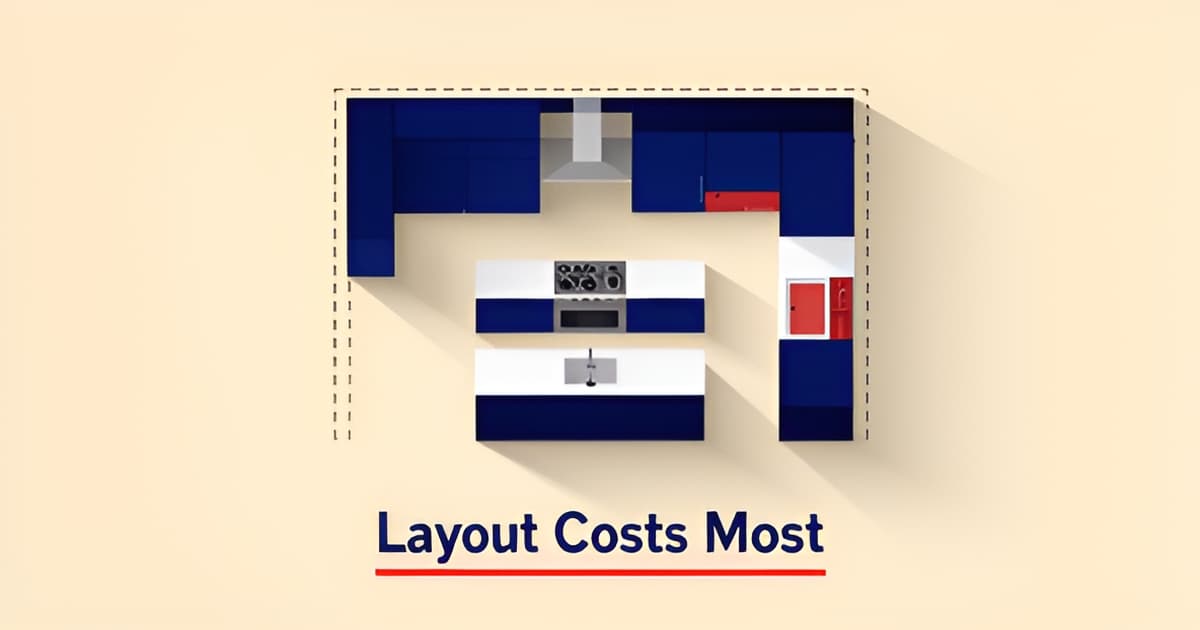
The cheapest kitchen remodel decision you'll make happens before anyone picks a cabinet or a countertop slab: whether the sink stays where it is. Across every cost source we reviewed, the dividing line between a $25,000 refresh and a $120,000 project isn't the finish level — it's whether plumbing, electrical, and walls move.
Keeping the existing layout defines the entire bottom tier. Cosmetic refreshes that leave plumbing and wiring in place run roughly $20,000–$45,000 in the Los Angeles market, according to Bay Cities Construction's 2026 Southern California estimates. The moment you move the sink, relocate the range, or take out a wall, the project leaves that tier entirely.
The numbers escalate quickly once the layout changes:
- A single island adds $5,000–$15,000 on its own, often requiring the slab to be opened and re-poured for plumbing.
- A full gut renovation adds 15–25% to materials and labor compared with a rip-and-replace of the same-sized kitchen.
- Wall removal plus steel beam installation pushes projects into the $120,000–$180,000+ tier.
Design Onn Point's LA cost breakdown maps the tiers directly to layout: keep the layout and plumbing for $25k–$45k, move it and add an island for $85k–$120k, and remove walls with structural steel for $120k and up. Block Renovation calls layout change and expansion the main driver behind projects that cross $200,000.
Here's the counterintuitive part: the most expensive layout mistake may be changing the layout at all. Renovation expert Cherie Barber puts it plainly in Houzz's layout-mistakes guide: "I'd never automatically dismiss the existing layout of a kitchen... It's often planned that way for very practical reasons." Door and window placement, traffic flow, and utility runs usually dictated the original design — and a careful tweak often delivers the improvement without moving electrical and plumbing systems.
This matters especially in Altadena's older housing stock. Many pre-1970s homes here have layouts that were engineered around load paths, galley-style footprints, and plumbing runs that would cost real money to relocate — and opening walls in these homes can reveal knob-and-tube wiring or unpermitted plumbing that must be corrected before inspection.
Before you commit to moving anything, ask whether the existing layout is actually failing you. If the work triangle is functional and clearance is adequate, the smarter spend is finishes, lighting, and cabinetry — the elements buyers actually see. Altadena Custom Home Builder approaches layout questions this way in every scope conversation: change the bones only when the bones are the problem.
If you're weighing a layout change against a refresh — or planning a kitchen as part of a larger rebuild — a free build consultation is the fastest way to pressure-test the scope before the bids arrive.
Five Layout Mistakes That Cost the Most to Fix
Some layout mistakes are expensive the day you make them — and others quietly compound for years before the bill arrives. The five below are the ones that show up most often in Altadena's older housing stock, where pre-1970s homes hide knob-and-tube wiring, unpermitted plumbing, and termite damage behind walls that "must be addressed to pass inspection, and they are never part of the initial bid," according to LA cost modeling.
Improper wall removal tops the list. When a load-bearing wall comes out with dimensional lumber instead of engineered steel or LVL beams, the ceiling can sag 1–2 inches within three years — and remediation runs $8,000 to $15,000, per design-build cost data. Wall removal done right means a structural engineer, permits, and beams budgeted from day one.
Undersized electrical panels come second. Many pre-1990 homes still carry 60–100 amp panels, while a modern kitchen pulls 40–60 amps on its own. Retrofitting costs $3,500–$6,000, and code upgrades for dedicated circuits, GFCI outlets, and Title 24 lighting can add $6,000–$12,000 more.
Missing counter waterproofing fails silently. Fake or absent waterproofing under stone counters typically produces cracks within two to four years, and remediation runs 60–80% of a fresh install. It is a small line item during the build and a large one afterward.
Two design errors round out the list:
- Appliance-driven design. As one contractor puts it, clients "design their kitchen around an appliance they already own" and end up with an oversized work triangle. Design how you actually cook first, then place appliances — and choose appliances before cabinetry.
- Poorly positioned islands. A misplaced island bottlenecks traffic to the sink, refrigerator, and stove. It also adds $5,000–$15,000 on its own, often requiring slab opening and re-pour, per Bay Cities Construction.
The clearances that prevent both: a minimum 42-inch aisle width (48 inches preferred in multi-cook kitchens), roughly 40 inches of island clearance on both sides, and work-triangle appliances kept 4–9 feet apart, per Houzz layout guidance. Before committing to any layout change in an older Altadena home, a build consultation can tell you whether that wall is worth moving at all.
Altadena-Specific Risks: Older Homes, Title 24, and Hillside Lots
Much of Altadena's housing stock predates 1970, and that history doesn't stay hidden for long once a kitchen remodel opens the walls. What looks like a straightforward cabinet swap can quickly become a project with wiring, plumbing, and structural surprises — none of which appear in the initial bid.
According to LA remodel cost research, opening walls in pre-1970s homes routinely reveals termite damage, dry rot, outdated knob-and-tube wiring, or unpermitted plumbing. These conditions must be fixed to pass inspection, and they are never part of the original quote. Bay Cities Construction likewise flags 1940s–1970s Southern California housing stock and unpermitted prior work as major cost drivers in the LA market.
The practical protection is budgetary. Design Onn Point, a licensed design-build firm, recommends a $5,000–$12,000 discovered-conditions reserve on pre-1970s homes, on top of the standard 10–15% contingency. As the firm's principal puts it, honest quotes carry a documented reserve line — lowball bids that don't are simply converting future change orders into surprise pricing.
Beyond what's behind the walls, California compliance adds line items that bids frequently omit:
- Title 24 and seismic compliance: $5,000–$15,000, covering LED high-efficacy lighting, vacancy sensors, vented range hoods with makeup air, seismic cabinetry fastening, and gas shut-off valves.
- Electrical code upgrades: $6,000–$12,000 for dedicated circuits, GFCI outlets, and Title 24 lighting — often the biggest surprise line item on older kitchens.
- Hillside geotechnical work: $3,000–$6,000 for homes on slope lots, which are common throughout Altadena's foothill neighborhoods.
Hillside lots deserve special mention here. Many Altadena homes sit on grades that trigger additional engineering review during permitting, and a kitchen project that touches structure or layout will surface those requirements at plan check. Budgeting the geotech adder upfront beats discovering it mid-permit.
For homeowners weighing a kitchen remodel against a larger rebuild — especially those navigating Eaton Fire recovery — these discovered-condition and compliance costs are exactly why Altadena Custom Home Builder recommends a scope conversation before committing to either path. A free build consultation can help you determine whether your kitchen's bones support a remodel or whether the numbers point toward a different project altogether.
Spend Where ROI Lives: Scope Restraint and Your Next Step
Here's the uncomfortable math: the kitchen remodel that costs the least is often the one that recoups the most. The 2025 Cost vs. Value data shows a midrange minor kitchen remodel recouping 112.9% nationally, while layout-preserving cosmetic work in the LA market returns an estimated 95–110% of cost at resale.
Full structural guts sit at the other end of the curve. Reconfigurations recoup an estimated 75–90%, and luxury projects with major structural change return just 55–75% — because, as the same analysis notes, much of that money goes into things a buyer never sees. A gut remodel also adds 15–25% to materials and labor for the same-sized kitchen, per LA renovation cost research.
That doesn't mean never touch your layout. If your kitchen has a genuinely bad floor plan, no cosmetic refresh will fix it. But renovator Cherie Barber's advice holds: existing layouts are often planned around practical realities — door and window placement, traffic flow — and keeping plumbing and electrical in place is the single biggest cost lever you control.
Before signing anything, protect yourself on the contract side:
- Insist on exact makes, models, and quantities for every material — broad allowances like "$5,000 for tile" are a documented recipe for conflict and change orders.
- Expect an honest bid to carry a documented discovered-conditions reserve of $5,000–$12,000, especially in pre-1970s Altadena homes where knob-and-tube wiring and unpermitted plumbing hide behind walls.
- Budget a 10–15% contingency for the same reason — opened walls regularly reveal termite damage and dry rot that were never part of the initial bid.
- Compare bids scope-for-scope. Wide swings between bids usually mean the scopes aren't actually the same — the single most important thing to verify before signing.
Remember that California compliance costs — Title 24 lighting and seismic requirements, electrical code upgrades — frequently go unitemized in initial bids, adding $5,000–$15,000 and $6,000–$12,000 respectively when they surface.
If you're weighing a refresh against a reconfiguration — or evaluating a layout as part of an Eaton Fire rebuild or hillside-lot project in Altadena — a professional read of your existing floor plan is the cheapest decision you'll make in the entire process. Altadena Custom Home Builder offers a free build consultation to evaluate your scope and layout against your budget, including input from featured builder JMB Builders LLC (CSLB #1103479). Bring your floor plan, your wish list, and your numbers; leave with a clear-eyed view of what your kitchen actually needs.
Frequently Asked Questions
How much does a kitchen remodel cost in Altadena?
What's the single biggest factor that drives up kitchen remodel costs?
Should I change my kitchen layout or keep the existing one?
What hidden costs should I budget for in an older Altadena home?
Are there California-specific code costs that contractors leave out of bids?
What are the most expensive kitchen layout mistakes to fix?
Your Kitchen's Cheapest Upgrade Is a Second Opinion
The numbers in this article point to one clear pattern: the kitchen remodels that cost the least and pay back the most are the ones that respect the bones already in place. Keeping your sink where it is, budgeting honestly for what Altadena's pre-1970s walls might hide, and spending on finishes rather than steel beams is where the smart money sits — a midrange minor kitchen remodel recoups 112.9% nationally, while full structural guts return far less. That doesn't mean your layout is off the table; it means the decision deserves a professional read before bids arrive. If you're weighing a refresh against a reconfiguration — or planning a kitchen as part of an Eaton Fire rebuild or hillside-lot project — Altadena Custom Home Builder offers a free build consultation to pressure-test your scope against your budget, with input from featured builder JMB Builders LLC (CSLB #1103479). Bring your floor plan, your wish list, and your numbers. The cheapest decision you'll make in the entire remodel is the one you make before any of it starts.