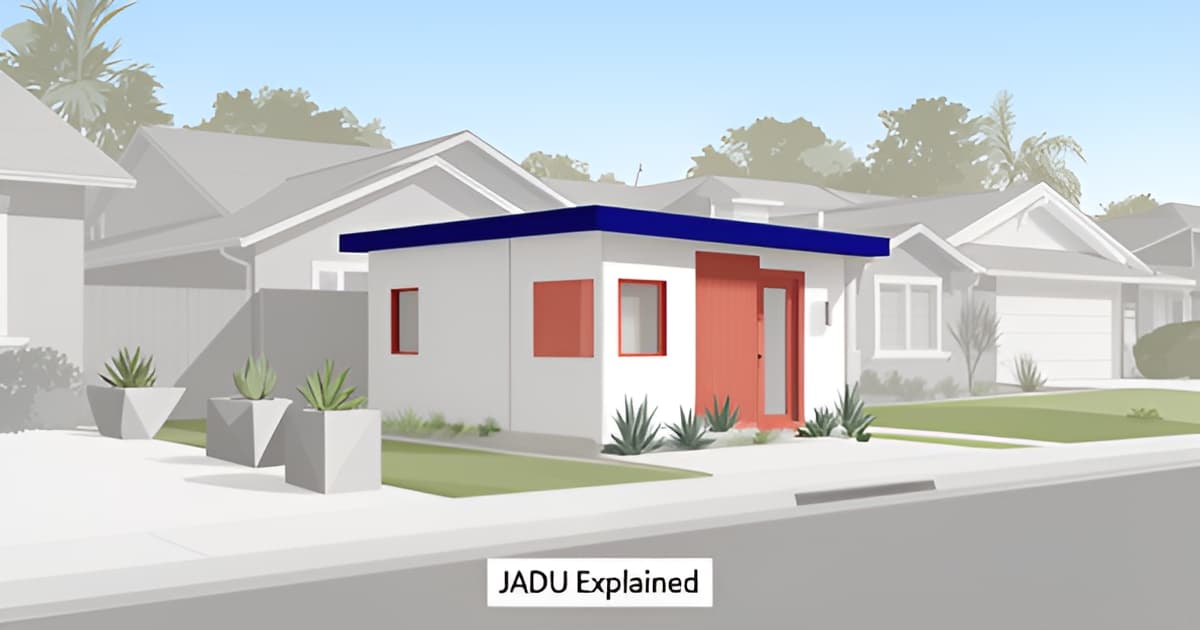
JADU vs ADU in California: Junior Units Explained for Altadena Homeowners
Key Facts
- Under AB 1154, a JADU with its own bathroom no longer requires the owner to live on the property per a legal analysis of the new ADU bills.
- JADUs are capped at 500 square feet of interior livable space and must be contained within an existing single-family residence per San Diego's Development Services.
- JADUs of 500 square feet or less are exempt from development impact fees and school impact fees according to the BBK legal alert.
- SB 543 explicitly allows a single-family lot to combine a JADU with a detached ADU per the legal analysis.
- Under AB 462, a detached ADU in a Governor-declared disaster area can receive a certificate of occupancy before the primary dwelling is rebuilt per the legal alert.
- Local agencies must determine ADU and JADU application completeness within 15 business days and issue appeal decisions within 60 per the BBK analysis.
- California's ADU push has produced over 65,000 new affordable homes statewide according to California YIMBY.
Two Units, Two Rulebooks: Why the JADU vs ADU Choice Confuses Altadena Homeowners
Ask ten Altadena homeowners what the difference is between a JADU and an ADU, and you'll likely get ten different answers — because until recently, even the state's own rules blurred the line. Both are secondary units on a single-family lot, but they follow different size caps, different occupancy rules, and different fee structures, which makes the choice more consequential than most people expect.
The fundamentals are straightforward. A JADU is capped at 500 square feet of interior livable space and must be contained entirely within an existing single-family residence, while an ADU can be larger and built as a detached structure. A legal analysis of the state's newest ADU legislation notes that ADUs also carry an 800-square-foot minimum standard under the Government Code — a floor that simply doesn't apply to junior units (BBK legal alert).
What has historically made this confusing is exactly what the 2026 law changes are designed to fix. AB 1154, signed in October 2025 and effective January 1, 2026, was written to create "a single set of clear rules" for small in-home units, eliminating the "overlapping definitions and inconsistent standards" that tripped up homeowners and reviewers alike (California YIMBY). SB 543 adds further clarity by confirming that the 500-square-foot JADU cap and the 800-square-foot ADU minimum both refer to interior livable space.
The changes matter most for Altadena homeowners weighing a rebuild or addition. Under the new rules:
- A JADU with its own bathroom no longer requires the owner to live on the property — the owner-occupancy requirement now applies only when the JADU shares a bathroom with the main dwelling.
- JADUs of 500 square feet or less are exempt from development impact fees, and units at or under 500 square feet are exempt from school impact fees, making them the financially lighter path.
- SB 543 explicitly allows a single-family lot to combine a converted ADU and a JADU with a detached ADU — meaningful density for homeowners rebuilding after the Eaton Fire.
- Permitting timelines are tightening statewide, with local agencies required to determine application completeness within 15 business days.
One caution applies before any of this gets penciled into a plan: Altadena sits in unincorporated Los Angeles County, and state law is implemented through local ordinances that vary by jurisdiction. The rules described here reflect state law, and LA County's specific requirements — setbacks, zoning, and permitting details — should be verified locally before committing to a design. That's a conversation we handle regularly at Altadena Custom Home Builder, where our free build consultation covers ADU and JADU feasibility alongside ground-up rebuilds and hillside-lot projects. Featured builder JMB Builders LLC (CSLB #1103479), an Altadena-based licensed general contractor, works on custom homes, ADUs, and Eaton Fire rebuilds throughout the community.
The New Rules That Changed Everything: AB 1154, SB 543, and the Bathroom Question
For years, the owner-occupancy rule kept many Altadena homeowners from building a JADU at all. That changed on January 1, 2026, when AB 1154 took effect — and the deciding factor now comes down to one fixture: the bathroom.
The bathroom question. Under AB 1154, signed October 10, 2025, a JADU with its own bathroom no longer requires the owner to live on the property. If the unit shares a bathroom with the main dwelling, the owner-occupancy requirement still applies, according to a legal analysis of the new bills. California YIMBY notes this aligns JADU rules with the ADU owner-occupancy standards in place since 2020, describing the reform as creating "a single set of clear rules for all ADUs under 500 square feet built within existing single-family homes" (press release).
What SB 543 clarifies. The companion bill pins down the numbers. The 500 sq ft JADU cap now explicitly refers to interior livable space, ending disputes over what counts toward the limit. SB 543 also confirms something Altadena homeowners planning a rebuild or addition will appreciate: a single-family lot may combine a JADU (or converted ADU) with a detached ADU — meaning you can legally add both units on one property.
The 30-day rental floor. JADUs remain rental housing, not vacation housing. State law prohibits renting a JADU for terms shorter than 30 days. Note that sources differ slightly on framing: one reading treats this as a statewide prohibition under Government Code § 66333, while the bill's sponsor describes it as local discretion to ban short-term rentals. Either way, plan on long-term tenants.
Tighter permit timelines. The state is also cracking down on slow permit counters. Local agencies must now determine whether an application is complete within 15 business days and issue final appeal determinations within 60 business days — deadlines that apply to both ADUs and JADUs. For homeowners navigating LA County unincorporated permitting, these clocks create real leverage.
Here is the quick summary of the 2026 rule changes:
- Owner-occupancy — dropped for JADUs with their own bathroom; retained when the bathroom is shared with the main house
- Size cap — 500 sq ft of interior livable space, per SB 543's clarification
- Combo allowance — a JADU plus a detached ADU on the same single-family lot
- Rentals — 30-day minimum stay for JADUs
- Permits — 15 business days for completeness, 60 for appeals
For Eaton Fire rebuild households, these rules interact with another new exception: AB 462 lets a detached ADU in a Governor-declared disaster area receive a certificate of occupancy before the primary dwelling is rebuilt. Altadena Custom Home Builder covers these rebuild-specific pathways in its field guide to ground-up homes and ADU construction in Altadena — and if you are weighing a JADU, an ADU, or both on your lot, a free build consultation is the simplest way to map the options to your parcel.
Costs and Trade-offs: Why JADUs Are the Fee-Free Play and ADUs Offer More Room
The cheapest square footage in California is often the square footage you already own. When you weigh a JADU against a detached ADU, the fee math alone can reshape the decision before a single wall gets framed.
JADUs are the fee-free play. Under state law, JADUs with 500 or fewer square feet of interior livable space are exempt from development impact fees, and JADUs and ADUs at 500 square feet or under also skip school impact fees, per a recent legal analysis of California's new ADU legislation. For a conversion inside your existing home's footprint, those exemptions can quietly save thousands.
The savings extend to energy systems too. San Diego's implementation of the state Energy Code illustrates the pattern: JADUs do not require solar panels, while newly constructed detached ADUs do. That's a meaningful line item removed from a conversion budget.
Detached ADUs trade those savings for space. State law sets an 800-square-foot minimum standard for ADUs under Government Code §§ 66314–66322, giving you room a 500-square-foot JADU simply can't match. A detached unit also opens rental flexibility that a JADU — which must be a conversion of or attached to the existing dwelling — cannot.
Here's the honest comparison at a glance:
- JADU: max 500 sq ft, must live inside the existing home, one per lot
- JADU fees: exempt from development impact fees and school impact fees at ≤500 sq ft
- Detached ADU: 800 sq ft minimum standard, solar required for new construction
- Both: permitted on the same lot — SB 543 explicitly allows a JADU plus a detached ADU
Two caveats deserve plain language. First, JADUs require a recorded JADU agreement with the local agency, a deed restriction that runs with the property. Second, short-term rentals are off the table: JADUs cannot be rented for terms shorter than 30 days, though legal readings differ on whether the ban is a blanket statewide rule or leaves local jurisdictions discretion to prohibit it.
One more constraint: JADUs are limited to one per lot, and they're excluded from bonus ADU programs. If you're weighing a JADU conversion against a detached ADU on an Altadena lot — especially a hillside property where site conditions drive detached construction costs — the fee exemptions may matter less than the buildability of the land itself. Altadena Custom Home Builder covers these trade-offs in depth in our field guide, and JMB Builders LLC (CSLB #1103479), our featured builder, builds both ADUs and in-home conversions in the area. Verify current LA County unincorporated requirements before committing, and consider a free build consultation to pressure-test the numbers for your specific lot.
The Eaton Fire Angle: AB 462 Lets a Detached ADU Be Occupied Before Your Main House
If your Altadena home was damaged or destroyed in the Eaton Fire, one new state law changes the order in which you can rebuild: a detached ADU can legally become livable before your main house does. For families displaced and weighing every option, that makes the ADU-versus-JADU question far more than a design exercise.
Under AB 462, which took effect October 10, 2025 as an urgency measure, a detached ADU in a Governor-declared disaster area can receive a certificate of occupancy before the primary dwelling. The exception applies to disasters declared on or after February 1, 2025, in areas where the primary dwelling was substantially damaged or destroyed — a description that fits much of Altadena.
In practical terms, this creates a potential housing bridge during a rebuild. Instead of waiting for a full custom home to be permitted, constructed, and signed off, a homeowner could potentially occupy a detached ADU on the same lot while the main house comes back. The law does not guarantee faster permits or shorter timelines — it simply removes the sequencing rule that previously required the primary dwelling to be certified first.
A few things worth keeping straight as you plan:
- The exception applies to detached ADUs, not JADUs, which by definition must be contained within an existing single-family residence.
- Eligibility hinges on the primary dwelling being substantially damaged or destroyed in a Governor-declared disaster area.
- Newly constructed detached ADUs are subject to solar requirements under state Energy Code rules, unlike JADU conversions.
- LA County unincorporated permitting standards still apply, and local implementation details should be confirmed with the county before you commit to a plan.
It's also worth noting how this fits with the rest of California's 2025–2026 ADU legislation. Statewide, the ADU push has produced over 65,000 new affordable homes, and California YIMBY notes that rules for small units have been consolidated into a single, clearer framework. For rebuilders, SB 543's confirmation that a lot can combine a JADU with a detached ADU opens the door to rebuilding with more flexibility than the original home allowed.
At Altadena Custom Home Builder, we track these changes as part of our field guide to Eaton Fire rebuilds, hillside lots, and ground-up construction in LA County unincorporated areas — and we recommend every homeowner verify current county requirements and official recovery resources before finalizing plans. If you're weighing whether a detached ADU, a JADU, or both belong in your rebuild, a free build consultation is a sensible first step. Our featured builder, JMB Builders LLC (CSLB #1103479), an Altadena-based licensed general contractor whose ADU and Eaton Fire rebuild work is documented at jmb-builders.com, can walk your lot and discuss options — though no article or consultation can guarantee permit outcomes or timelines.
Your Next Steps in Altadena: Verify LA County Rules and Plan the Right Unit
You've compared the state rules — now the decision gets local, and that's where Altadena homeowners need to slow down. Our research surfaced no Altadena or LA County unincorporated ordinance specifics, so treat everything below as a framework to verify, not a permit-ready answer.
Start with the county. Because Altadena sits in unincorporated LA County, local zoning, hillside, and slope-lot rules govern how state ADU and JADU law applies to your parcel. Some jurisdictions require a recorded JADU agreement, as San Diego's ordinance does, so ask the county whether similar documentation applies before you draw a single wall.
Then work through three decisions in order:
- Own bathroom or shared? Under AB 1154, effective January 1, 2026, a JADU with its own bathroom no longer triggers the owner-occupancy requirement, while one sharing sanitation facilities with the main house does, per a legal analysis of the new ADU legislation.
- Conversion or detached build? A JADU must live inside your existing home's envelope at 500 sq ft or less of interior livable space, while a detached ADU can be larger.
- One unit or two? SB 543 explicitly allows combining a JADU with a detached ADU on a single-family lot, which matters if you're maximizing a hillside parcel.
The fee math favors starting small: JADUs at 500 sq ft or less are exempt from development impact fees and school fees, while ADUs at 750 sq ft or less escape impact fees. California's broader ADU push has already produced over 65,000 new affordable homes statewide, so county staff should be familiar with the process.
For Eaton Fire rebuild households, one more wrinkle deserves attention. Under AB 462, a detached ADU in a Governor-declared disaster area can receive its certificate of occupancy before the primary dwelling is rebuilt — potentially letting you live on your own lot earlier in the rebuild. Confirm with the county that your parcel qualifies, and consult official LA County recovery resources for current requirements.
Altadena Custom Home Builder exists to help you make exactly these calls — ground-up homes, tear-downs, rebuilds, and hillside builds across the town's varied terrain. Book a free build consultation to talk through your lot, your goals, and which unit type fits before you commit to plans.
Disclosure: JMB Builders LLC (CSLB #1103479), an Altadena-based licensed general contractor building custom homes, ADUs, and Eaton Fire rebuilds, is our featured builder as a paid placement. Its work is documented at jmb-builders.com. We make no permit or timeline guarantees — every project depends on county approval and site conditions.
Frequently Asked Questions
What's the actual difference between a JADU and an ADU in California?
Do I have to live on the property if I build a JADU in Altadena?
Can I build both a JADU and a detached ADU on the same lot?
Which is cheaper — a JADU or a detached ADU?
Can I rent out my JADU on Airbnb for short stays?
I lost my home in the Eaton Fire — can I live in an ADU before my main house is rebuilt?
The Bathroom, the Fees, and Your Lot: Making the JADU vs ADU Call
The JADU vs ADU decision now hinges on a few clear questions. If you want the fee-free path, a JADU conversion of 500 square feet or less skips development impact fees and school fees — and under AB 1154, giving it its own bathroom removes the owner-occupancy requirement entirely. If you need more space or a housing bridge during an Eaton Fire rebuild, a detached ADU offers the larger footprint, and AB 462 may let it be occupied before your main house. SB 543 even confirms you can build both on a single lot. California's ADU push has already produced over 65,000 new affordable homes statewide, so the process is well-trodden. Before committing to plans, verify LA County unincorporated requirements for your parcel — setbacks, zoning, and recorded agreements all apply locally. Altadena Custom Home Builder helps homeowners weigh exactly these options across ground-up rebuilds and hillside lots. Book a free build consultation to map the right unit to your lot, your budget, and your rebuild timeline.