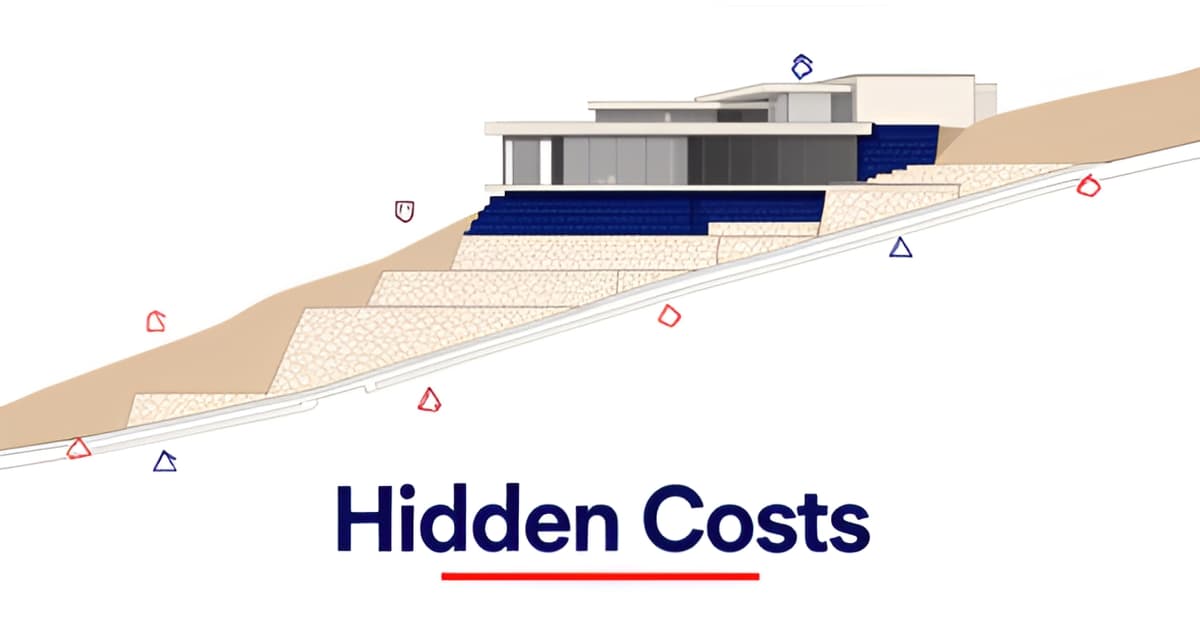
Hidden Costs of Building on an Altadena Hillside Lot
Key Facts
- Retaining walls on Altadena hillside lots are structural necessities, not landscaping — mid-height walls run $20,000–$50,000 per LA hillside cost data.
- Major hillside stabilization projects can exceed $100,000–$300,000 according to LA contractor estimates.
- Water, not structural design, is the #1 cause of retaining wall failure in LA say hillside contractors.
- A wall under 4 feet can still require a permit on a slope if it carries a slope surcharge.
- Altadena is unincorporated LA County, so permits route through LA County Public Works — not LADBS.
- California's $225 per square foot baseline already ranks third-most-expensive nationally before slope premiums.
- Tariffs add roughly $11,000 to the cost of a standard single-family home per NAHB figures.
Why Slope Lots Blow Up Flat-Lot Budgets
Building on a slope in Altadena doesn't just cost more than a flat-lot build — it costs more in ways most budgets never anticipate. The premiums arrive as line items buyers rarely see until the first engineering invoice lands.
Start with California's baseline, which is already the third most expensive in the nation. According to construction cost research, the state averages $225 per square foot, before you add $15,000–$35,000 in seismic code premiums for reinforced foundations and structural engineering. The same research pegs California's cumulative regulatory burden — Title 24, CEQA review, local solar mandates — at another $25,000 to $45,000 per standard build.
Here is the trap for hillside lots: those figures assume flat, unremarkable ground. Once your parcel hits a 15% natural slope gradient, it earns a Hillside Area designation, which triggers structural engineering calculations and specialized grading plan review even for smaller structures. Slope-specific premiums stack on top of the baseline rather than replacing it.
Through our work cataloguing ground-up builds and Eaton Fire rebuilds across Altadena, we've found the unbudgeted costs cluster into four categories:
- Retaining structures — not landscaping, but structural necessities running $20,000–$50,000 for mid-height walls and $50,000–$120,000 for tall engineered walls, with major hillside stabilization exceeding $100,000–$300,000+ per LA hillside cost data
- Soft costs — engineering ($3,000–$8,000), soils reports ($2,000–$5,000), and plan checks that stretch 6–12 weeks for hillside projects
- Drainage systems — mandatory, because saturated soil is the leading cause of wall movement during winter storms
- Site logistics — grading limits on dirt export, tiering requirements that force stepped walls instead of one tall wall, and narrow-street access constraints for concrete trucks
One Altadena-specific wrinkle compounds all of this: the city sits in unincorporated LA County, so permits route through LA County Public Works rather than LADBS. Filing with the wrong department causes delays, and your mailing address is not a reliable guide to jurisdiction.
The result is a budget that looks reasonable on a flat-lot spreadsheet and collapses on the hillside. A realistic plan layers slope premiums on top of that $225-per-square-foot baseline — not as contingency padding, but as distinct, predictable categories.
Retaining Walls and Drainage: The Biggest Hidden Line Items
Ask any Altadena hillside homeowner what surprised their budget most, and the answer is almost never the house itself — it's what holds the ground beneath it. Retaining walls and drainage are the two line items that quietly reshape hillside budgets, and they deserve far more scrutiny than most pre-construction spreadsheets give them.
Contractors who work LA hillside lots are blunt about it: "If you own a hillside home in Los Angeles... a retaining wall isn't optional. It's structural." These are engineered systems that hold back thousands of cubic yards of soil, not decorative landscaping you can value-engineer later. According to LA-market contractor estimates, a mid-height structural wall (4–8 feet, 30–60 linear feet) typically runs $20,000–$50,000, while tall engineered walls (8–15 feet) climb to $50,000–$120,000. Major hillside stabilization projects can exceed $100,000–$300,000+.
Material choice moves the number significantly, and tall walls demand the premium options:
- Segmental block: $25–$45 per square foot of wall face (walls under 4 feet)
- Concrete block (CMU): $35–$60 — the most common choice for walls over 4 feet
- Poured concrete: $45–$75 — the strongest option and best for tall walls
- Natural stone veneer: $50–$80, built on a CMU core
Then there's the failure point most budgets ignore entirely. As one hillside contractor puts it, "The #1 reason retaining walls fail in LA isn't structural — it's water." Saturated soil is the leading cause of wall movement during winter storms, which is why a proper drainage package — French drain behind the wall, weep holes every 6–8 feet, waterproof membrane, and surface drainage above — isn't an upgrade. It's the difference between a wall that lasts 50–75 years and one that fails in 5–10.
This is where a $30,000 wall becomes a $50,000 repair. Leaning wall fixes using soil anchors or full replacement run $10,000–$50,000+, and that assumes you catch the movement before it threatens the structure above. Unpermitted walls compound the problem — they're the most common issue flagged in LA home inspections and can derail a future sale.
Altadena's hillside lots add a jurisdictional wrinkle worth flagging early: because the town sits in unincorporated LA County, permits route through LA County Public Works rather than LADBS, and both departments mandate engineered walls on sloped ground. A wall under 4 feet can still require a permit on a hillside if it carries a slope surcharge — the extra load from sloping ground, a driveway, or a structure above it.
At Altadena Custom Home Builder, we advise hillside clients to budget retaining structures and drainage as structural line items from day one — not as landscaping allowances discovered mid-project. If you're planning a ground-up build or Eaton Fire rebuild on a slope lot, a free build consultation is the easiest way to map these costs to your specific parcel before they surprise you.
Hillside Rules That Trigger Extra Costs in LA County
The slope of your lot doesn't just shape your foundation — it determines which rulebook applies to your project. In Los Angeles County, hitting a single threshold can quietly add tens of thousands of dollars in soft costs before a shovel ever touches dirt.
The first trigger is the 15% natural slope gradient. Lots at or above this grade are designated Hillside Areas, which brings stricter grading limits, tiering requirements, and mandatory structural engineering review — even for smaller structures, according to regulatory guidance from DiBara Masonry. You can verify your lot's designation through county parcel lookup tools before you commit to a design.
The second trigger is the 4-foot retaining wall rule — and it's broader than most homeowners expect. A wall under 4 feet may be permit-exempt on a flat lot, but on a hillside it can still require a permit if it supports a "slope surcharge": the extra load that sloping ground, a driveway, or a structure above the wall places on it. The same wall, two different lots, two different answers.
Then come the soft costs that flat-lot budgets never anticipate. Per LA hillside cost data, expect:
- Structural engineering: $3,000–$8,000
- Soils reports: $2,000–$5,000
- Specialized hillside plan checks: 6–12 weeks of review time
- A grading permit if you're moving more than 50 cubic yards of earth
Here's the trap that catches even experienced LA-area builders: Altadena is unincorporated county land, so permits route through LA County Public Works — not LADBS, the City of Los Angeles department that most hillside guidance references. As one contractor source warns, "Your mailing address is not a reliable guide, since many addresses with a Los Angeles mailing city sit in unincorporated county land." Filing with the wrong department doesn't just cost a filing fee — it costs weeks of delay while your project restarts in the correct queue.
This jurisdictional split is exactly why Altadena Custom Home Builder emphasizes verifying your permitting path before finalizing plans. A builder who works County processes regularly can spot the slope-surcharge and grading triggers early, when they're still line items on a budget — not surprises mid-permit.
If you're weighing a hillside build or Eaton Fire rebuild on a sloped lot, a free build consultation can map these regulatory costs to your specific parcel before you invest in design work.
How to Budget an Altadena Slope Build Without Surprises
The difference between a smooth Altadena hillside build and a budget that spirals often comes down to what you verify before you file a single permit application. Slope lots reward preparation — and punish assumptions.
Start by confirming your jurisdiction. Altadena is unincorporated LA County, which means permits route through LA County Public Works rather than LADBS — and because many addresses with a Los Angeles mailing city sit in unincorporated county land, your mailing address is not a reliable guide. Filing with the wrong department causes delays that cost real money.
Next, check your slope designation early. Lots with a natural gradient of 15% or greater fall into Hillside Area territory, triggering stricter grading limits, tiering requirements, and structural engineering review even for smaller structures. A "slope surcharge" — extra load from sloping ground or a driveway above a wall — can require a permit for a retaining wall under 4 feet that would be exempt on a flat lot.
Then budget slope work as structural line items, not landscaping. Based on LA-market contractor estimates, mid-height structural retaining walls typically run $20,000–$50,000, tall engineered walls $50,000–$120,000, and major hillside stabilization can exceed $100,000–$300,000. Add $3,000–$8,000 for engineering and $2,000–$5,000 for soils reports, and treat drainage as non-negotiable: water — not structural design — is the leading cause of retaining wall failure, and repairs on failed walls run $10,000–$50,000 or more, per LA hillside cost analysis.
Finally, layer those premiums onto California's already-steep baseline. A realistic stack includes:
- A California baseline around $225 per square foot, per statewide construction cost data
- $15,000–$35,000 in seismic code premiums for reinforced foundations and structural engineering
- $25,000–$45,000 in cumulative regulatory costs, plus $15,000–$35,000 in permit and impact fees
- Roughly $11,000 in tariff impacts per single-family home, according to NAHB figures reported by Fox Business
For Eaton Fire rebuilders, the timeline math matters as much as the cost math. Traditional custom design takes 9–12 months before permits are even submitted, with review adding six months or more. Pre-approved catalog designs — like the Foothill Catalog and Case Study 2.0 programs — can move eligible rebuild applications through local review in a matter of weeks, with plans offered at roughly a 25% discount (about $25 per square foot). More than 2,600 residential permits have been issued between Pacific Palisades and Altadena since the January 2025 fires, per rebuild progress reporting.
No budget eliminates every surprise on a slope lot — and no one can guarantee permits or timelines. But a build consultation with a team that knows County processes, like the builders featured on Altadena Custom Home Builder, can surface the retaining, grading, and drainage costs before they surface themselves.
Frequently Asked Questions
How much more does it cost to build a house on a slope in Altadena?
Do I need a permit for a retaining wall under 4 feet on a hillside lot?
Does Altadena file permits through LADBS like the rest of LA?
Why is drainage such a big deal for hillside retaining walls?
What does the 15% slope threshold mean for my build?
Can Eaton Fire rebuilders on slope lots speed up the design and permit process?
Build the Budget Before You Build the House
A slope lot in Altadena doesn't have to be a budget trap — it just demands a different kind of planning. The numbers in this article tell a consistent story: retaining walls and drainage are structural necessities ($20,000–$50,000 for mid-height walls, far more for tall engineered systems), soft costs like engineering and soils reports add thousands before construction starts, and the 15% slope threshold can trigger requirements that never appear on a flat-lot spreadsheet. Layer those premiums on top of California's $225-per-square-foot baseline and the stakes of getting it wrong become clear. The single most valuable step you can take is verifying your jurisdiction — because Altadena's unincorporated status means permits route through LA County Public Works, not LADBS — and mapping your parcel's slope designation, surcharge risks, and grading limits before you invest in design work. That's exactly the kind of parcel-specific walkthrough we offer at Altadena Custom Home Builder. If you're planning a ground-up build, tear-down, or Eaton Fire rebuild on a hillside lot, request a free build consultation and turn the hidden costs into line items you planned for — not surprises you paid for.