Garage Conversion to ADU Cost in Los Angeles County: Full Breakdown
Key Facts
- A realistic LA garage conversion costs $100,000–$180,000, well above California's $60,000–$150,000 statewide range, according to cost research.
- Plumbing and sewer connection is the single most expensive line item at $15,000–$35,000, LA ADU cost analysis confirms.
- ADUs under 750 square feet are exempt from local impact fees under California state law, permit fee analysis shows.
- Despite a 60-day state mandate, realistic LA ADU permitting takes 4–6 months once plan-correction cycles are factored in, permitting research finds.
- A typical LA garage-conversion ADU rents for $1,800–$2,800 monthly, producing a 4–7 year payback on a $95,000–$225,000 project.
- Smaller ADUs cost more per square foot ($250–$500+) because kitchens, bathrooms, and utility upgrades don't shrink with square footage, per cost analysis.
- Staying at or under 500 square feet avoids mandatory school district fees of $0.56–$5.31 per square foot, LA permit research notes.
Why Garage Conversions Cost More Than the Brochures Say — and What Drives the Real Price Tag
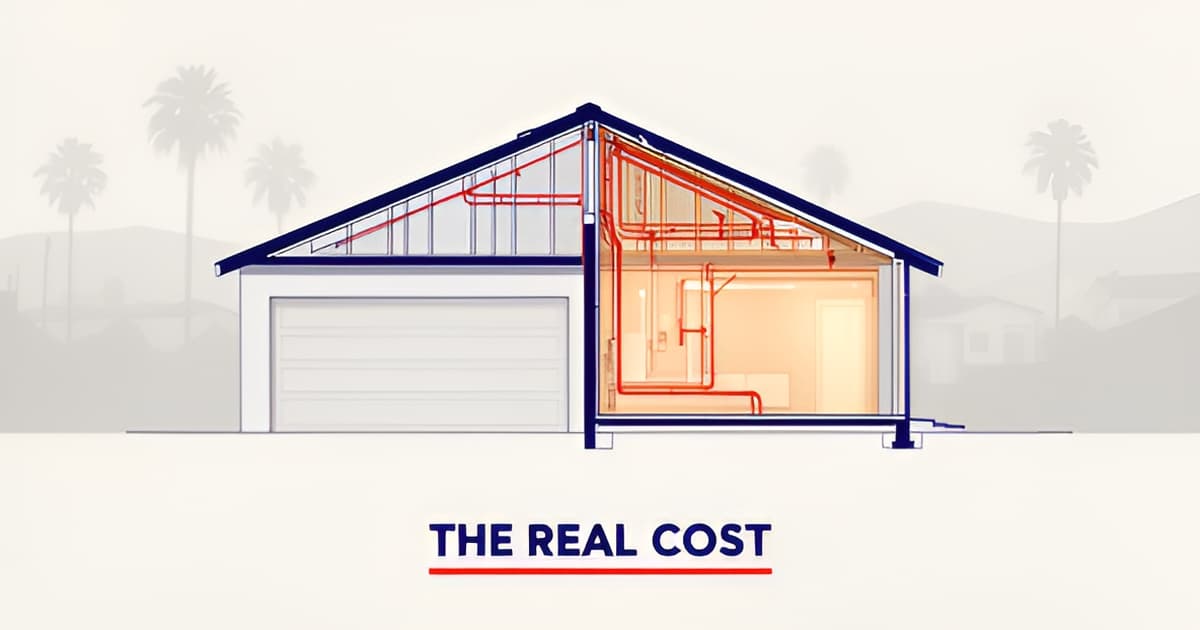
The brochure said a garage-to-ADU conversion would cost $60,000. The contractor's estimate came back at $140,000. This gap between expectation and reality is the single most common surprise LA homeowners encounter, and it's worth understanding before you commit to the project.
The honest starting point is a realistic range of $100,000–$180,000 for a garage conversion in Los Angeles, with high-end scopes reaching $225,000 or more. That's well above California's statewide range of $60,000–$150,000, and the reasons are structural to the LA market: higher labor rates, stricter inspection regimes, and some of the densest building regulations in the state, according to garage conversion cost research.
Per-square-foot math makes it worse, not better. At $250–$500+ per square foot, smaller units actually cost more per foot than large ones, because a kitchen, a bathroom, and utility upgrades don't shrink proportionally with square footage, as LA ADU cost analysis explains. A 400-square-foot studio still needs full plumbing, a code-compliant kitchen, and Title 24 compliance.
Most projects fall into one of three tiers:
- Basic ($95,000–$150,000): existing slab in good condition, minimal plumbing relocation, standard finishes.
- Mid-range ($150,000–$175,000): new electrical sub-panel, sewer line rerouting, moderate framing, upgraded kitchen and bath.
- High-end ($175,000–$225,000+): foundation repair, full plumbing relocation, structural shear walls, custom finishes.
The tier you land in depends heavily on what's under the garage floor. Existing garages are not always ready to convert as-is — foundation corrections, framing fixes, and utility service upgrades are the hidden cost drivers that push basic projects into higher tiers. Plumbing and sewer connection alone runs $15,000–$35,000, and trenching costs climb when sewer lines sit far from the garage.
Location within LA County matters too. Homeowners in unincorporated areas like Altadena route through County Public Works and County Fire rather than the streamlined LADBS process, which adds fees and review time — and hillside or slope lots may need soil reports costing $2,000–$5,000 on top of everything else.
If you're weighing a garage conversion alongside larger plans for your property — a rebuild, an SB 9 lot split, or a ground-up custom home — a free build consultation through Altadena Custom Home Builder can help you map which path fits your lot and budget.
The Full Line-Item Breakdown: Where Your Budget Actually Goes
Most homeowners who budget for a garage conversion underestimate two things: the plumbing and the condition of the slab under their existing garage. Once you see the actual line items, the $100,000–$180,000 range that LA cost research reports makes sense — and you can spot where a low bid is hiding scope.
Soft costs come first. Permits for a typical 400 sq ft conversion run $1,500–$2,500, far cheaper than a detached ADU because no new square footage is added, though LADBS sets the project valuation itself using standardized tables. Add design and architecture fees of $8,000–$20,000, plus a Title 24 energy compliance report at $500–$1,500, and plan-check correction cycles that can add $2,000–$5,000 before construction even begins.
The construction budget concentrates in a handful of big-ticket items:
- Plumbing and sewer connection: $15,000–$35,000 — the single most expensive line, and it climbs fast when the sewer main sits far from the garage
- Kitchen build-out: $15,000–$30,000; bathroom: $10,000–$25,000
- Structural and foundation reinforcement: $10,000–$30,000
- Electrical panel upgrade and wiring: $8,000–$20,000
- Fire separation (5/8" Type-X drywall, rated door): $2,000–$5,000
The hidden cost drivers are what separate a $95,000 project from a $225,000 one. Existing garages are not always ready to convert as-is — contractors routinely discover slab cracks, inadequate framing, and undersized electrical service after demo begins. Sewer trenching distance, tight site access on narrow lots, and drainage or grading issues all push the plumbing and structural lines toward the top of their ranges, as garage conversion cost analysis confirms.
For Altadena homeowners, one local factor compounds this: unincorporated LA County routes permits through Public Works and County Fire, and hillside lots commonly require soil reports ($2,000–$5,000) before plans move forward. Altadena Custom Home Builder recommends getting a structural and sewer assessment of the existing garage before committing to a budget — it is the single cheapest way to avoid the surprise change orders that blow up conversion projects. As one cost study warns, the cheapest ADU estimate is rarely the least expensive project in the end, because incomplete scopes and missed utility upgrades surface as major change orders later.
The Altadena Factor: Unincorporated LA County Fees, Hillside Lots, and What Adds Time
If your property sits in unincorporated Los Angeles County — as most Altadena parcels do — your garage conversion takes a different permitting path than a comparable project inside the City of LA, and that difference shows up in both your budget and your calendar. City of LA projects move through LADBS, which runs a relatively streamlined review. Unincorporated County projects instead route through Public Works and County Fire, and permitting research confirms this adds both fees and delays to the process.
State law technically requires agencies to approve or deny a complete ADU submittal within 60 days. In practice, realistic LA permitting runs 4–6 months once plan-correction cycles are factored in. Layer in the full project arc — feasibility (2–4 weeks), design (6–12 weeks), permitting (3–6 months), and construction (4–7 months) — and a garage-to-ADU conversion in Altadena realistically spans 10–18 months or more from first sketch to final inspection.
One point that catches homeowners off guard: you cannot lowball your declared project value to shrink permit fees. LADBS sets project valuation itself using standardized tables, so an artificially modest declaration buys you nothing. A standard 400 sq ft conversion with roughly $75,000 in declared value typically runs $1,500–$2,500 in permit fees — already bundled with plan check, inspections, and separate Title 24 energy permits.
Altadena's hillside lots add another layer. Slope properties in geo-hazard areas require soil reports and geological clearance before the County will move your plans forward, and ADU permitting analyses note these requirements "can add thousands of dollars" to soft costs. Budget accordingly:
- Soil report for hillside or slope lots: $2,000–$5,000
- Property survey: $1,000–$3,000
- Utility company coordination and fees: $1,000–$5,000
- Title 24 energy compliance report: $500–$1,500
The hillside premium is real, but so is the payoff. A legal garage-conversion ADU in LA rents for roughly $1,800–$2,800 per month, with typical all-in costs of $95,000–$225,000 producing a 4–7 year payback. Even with County Fire review and a soil report on the front end, the math holds — provided the project is scoped honestly from day one.
That scoping is where local expertise earns its keep. Altadena Custom Home Builder helps hillside homeowners assess slope conditions, County review requirements, and realistic budgets before design dollars are spent. If you are weighing a garage conversion, ADU, or full rebuild on an Altadena lot — including Eaton Fire recovery projects — book a free build consultation to map the County permitting path before you commit. JMB Builders LLC (CSLB #1103479), an Altadena-based licensed general contractor featured on this site, builds ADUs and custom homes across these same unincorporated-County jurisdictions.
Money-Saving Levers: Square Footage Thresholds, Pre-Approved Plans, and Fee Waivers
A few hundred square feet of design discipline can save you five figures before a single wall gets framed. The biggest cost-control decisions in a garage conversion happen on paper — at specific square footage thresholds written into state law and LADBS fee schedules.
The first threshold is 500 square feet. According to LA permit fee analysis, staying at or under 500 sq ft avoids mandatory School District Development Fees, which run $0.56–$5.31 per sq ft depending on the district. On a 499 sq ft unit, that could mean skipping a fee that would otherwise add thousands to your permit package.
The second threshold is 750 square feet. Under California state law, ADUs under 750 sq ft are exempt from local impact fees — a rule that applies regardless of which district you build in. Cross both thresholds and your soft costs stay lean; cross the 750 line and the fee math changes quickly.
Pre-approved and standard plans offer a second lever. The LADBS Standard Plan Program can shave weeks or months off plan review and reduce design costs, which otherwise run $8,000–$20,000 plus $2,000–$5,000 in plan-check correction cycles. When realistic LA permitting already takes 4–6 months despite the state's 60-day mandate, every compressed week matters.
Here are the practical levers, ranked by dollar impact:
- Design at or under 500 sq ft to avoid school district fees entirely
- Stay under 750 sq ft to keep the state impact-fee exemption
- Use pre-approved or standard plans to compress review time and design spend
- Ask about fee waivers — the City and County occasionally waive fees for deed-restricted ADUs rented to low-to-moderate-income tenants
The rental math makes these savings concrete. Typical LA garage-conversion ADUs rent for $1,800–$2,800/month, which supports a 4–7 year payback on a $95,000–$225,000 all-in project. Every fee you avoid shortens that timeline directly.
One caveat for local readers: unincorporated LA County — which includes Altadena — routes permits through Public Works and County Fire rather than LADBS, adding fees and delays, and hillside lots often require soil reports at $2,000–$5,000. Altadena Custom Home Builder recommends budgeting that extra review time up front rather than discovering it mid-permit. If you're weighing a conversion against a ground-up build on a hillside lot, a free build consultation can help you compare the two paths before you commit to plans.
Your Action Plan: From Garage Assessment to a Legal, Rentable ADU
The difference between a smooth garage conversion and a money pit usually comes down to what you know before you sign a contract. Follow this sequence and you protect both your budget and your legal standing.
Start with the garage itself, not the design. Existing garages are rarely conversion-ready as-is, and contractor assessments consistently find the biggest surprises hiding in the slab, framing, and utility connections. A structural and sewer/septic assessment before you commit typically reveals whether you face the $10,000–$30,000 structural reinforcement range or a clean slab that keeps you in the basic $95K–$150K tier. Plumbing and sewer connection is one of the most expensive line items at $15,000–$35,000, so knowing where your sewer line runs matters more than almost any finish choice you'll make.
Verify zoning and design to the fee thresholds. Confirm your parcel's zoning early — skipping this step is one of the most common budget mistakes identified by ADU builders. Then design smart: staying at or under 500 sq ft avoids school district fees, and under 750 sq ft preserves the state impact-fee exemption. If you're in unincorporated LA County — which includes Altadena — budget extra time and fees, since projects route through Public Works and County Fire rather than streamlined city review.
Scrutinize low bids ruthlessly. The cheapest estimate is rarely the cheapest project. Incomplete scopes, missed utility upgrades, and unrealistic allowances are the primary drivers of change orders, and a bid that comes in dramatically below the $100,000–$180,000 range for LA garage conversions deserves skepticism, not celebration. Hold a contingency reserve for the surprises even a good assessment can't fully predict.
Never build unpermitted. The consequences compound fast:
- Stop-work orders and code enforcement fines that halt the project mid-construction
- Tenant lawsuits to recover all rent paid, plus relocation-assistance liability
- Homeowner's insurance that almost never covers damages in unpermitted structures
The owner-builder permit route offers no escape hatch either — permit guides note that owners assume all legal and financial liability, including workers' compensation risk, if someone gets hurt on the job.
Your Altadena next step. Altadena Custom Home Builder recommends a free build consultation before you spend a dollar on plans — an experienced contractor can evaluate your garage's conversion feasibility in a single visit, flagging foundation, sewer, and hillside-soil issues specific to unincorporated County terrain. For that conversation, we feature JMB Builders LLC (CSLB #1103479), an Altadena-based licensed general contractor building ADUs, custom homes, and Eaton Fire rebuilds, with work and service areas documented at jmb-builders.com. (This is a paid placement; we encourage you to verify any contractor's license status directly with the CSLB.) A one-hour assessment now is the cheapest insurance you'll buy on this project.
Frequently Asked Questions
How much does a garage conversion to an ADU really cost in Los Angeles?
Why do contractors quote $60,000 for garage conversions when real bids come in much higher?
What permits and fees do I need for a garage conversion ADU in LA?
How can I save money on my garage-to-ADU conversion?
Is converting my garage to an ADU worth it as a rental investment?
Does it cost more to build an ADU in Altadena or unincorporated LA County?
The Bottom Line: Your Garage Is an Asset — If You Budget for What's Underneath It
A garage conversion in Los Angeles County realistically runs $100,000–$180,000, with high-end hillside projects reaching $225,000 — not the $60,000 figure that sells brochures. The budget concentrates in a few big line items: plumbing and sewer connection ($15,000–$35,000), kitchen and bath build-outs, and the structural corrections that surface once demo begins. The cheapest ways to protect your budget all happen on paper: assess the slab and sewer lines before signing anything, design at or under 500 square feet to skip school district fees, stay under 750 to preserve the state impact-fee exemption, and treat suspiciously low bids as a red flag rather than a bargain. Done right, the payoff is real — a legal ADU renting for $1,800–$2,800 per month with a 4–7 year payback, per garage conversion cost research. For Altadena homeowners, unincorporated County review and hillside soil requirements add time and fees worth planning for up front. Before you spend a dollar on plans, book a free build consultation with Altadena Custom Home Builder to map the path that fits your lot — or talk with JMB Builders LLC (CSLB #1103479), an Altadena-based licensed general contractor experienced with ADUs, custom homes, and Eaton Fire rebuilds.