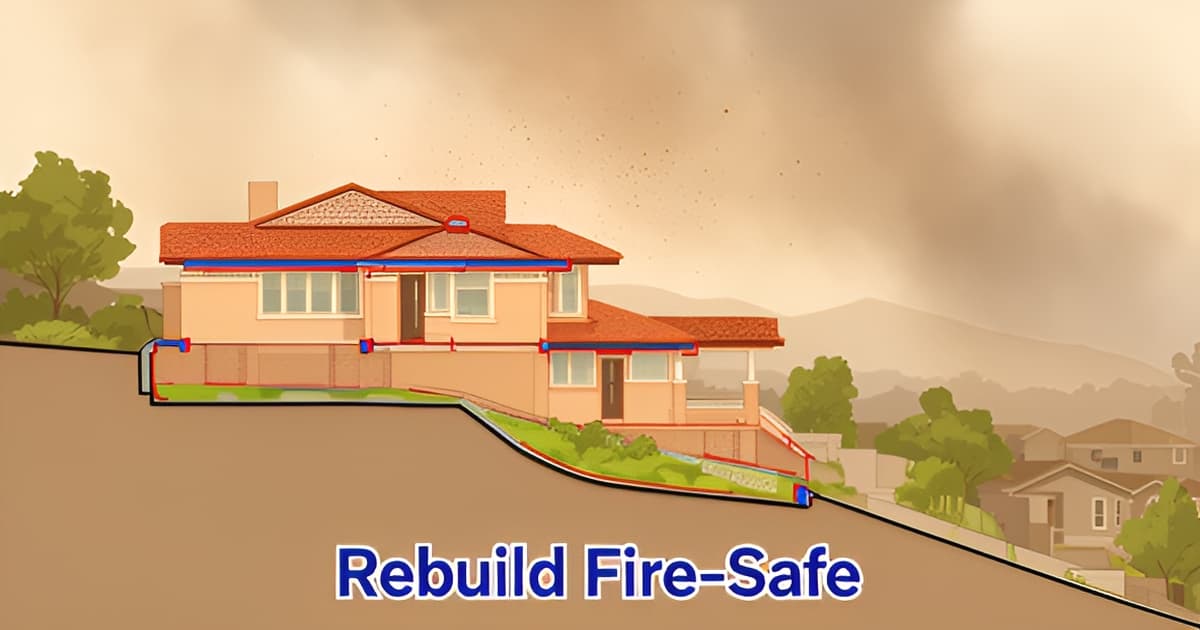
Fire Rebuild Design in Altadena: Rebuilding to WUI Standards Without Losing Character
Key Facts
- Embers — not flames — are the leading cause of home ignition and can travel more than a mile ahead of the fire, per LA County recovery guidance.
- Homes built to California's wildfire codes are 40% more likely to survive a wildfire, according to a study cited by NPR.
- Wildfire-resistant new construction was actually 2% less expensive than typical construction, per a Headwaters Economics cost study.
- Fiber cement siding that mimics wood saved $12,190 — a 25% reduction — versus cedar plank on exterior walls, Headwaters Economics found.
- More than 7,800 buildings burned in the Eaton Fire area sit outside mapped Fire Hazard Severity Zones where Chapter 7A doesn't legally apply, NPR reports.
- FEMA estimates California's wildfire codes will avoid $24 billion in damage to single-family homes over 75 years, per NPR.
- LA County's pre-approved rebuild plans can't be customized — even minor changes trigger full review — and they expire December 31, 2028, per LA County Planning.
The Rebuild Dilemma: Shifting Fire Zones, Strict Design Rules, and a Hard Insurance Market
Here's the paradox at the heart of Altadena's rebuild: the fire that destroyed thousands of homes mostly spared them from the state's wildfire building code. More than 7,800 buildings burned in the Eaton Fire area sit outside mapped Fire Hazard Severity Zones, meaning Chapter 7A ignition-resistant requirements don't legally apply to most rebuilds, according to NPR reporting.
That map is changing. Cal Fire's updated hazard maps added 1.4 million acres statewide, and in the Eaton Fire footprint the expanded zones now include 500+ additional homes and buildings. LA County must adopt the new zones by ordinance within 120 days of the March 24, 2025 issuance, with the California Fire Code update taking effect July 1, 2025 and the county fire code on January 1, 2026, per county recovery guidance. Roughly 1,000 additional Eaton Fire properties will fall under the codes beginning 2026.
The result is a genuine dilemma for homeowners. Some are rushing to pull permits before the new maps take effect — a dynamic Altadena Town Council member Nic Arnzen criticized as prioritizing "bottom line" over community safety. Others, facing what builder sources describe as one of the hardest insurance markets in the state, are hardening above code voluntarily, since homes built to California's wildfire codes are 40% more likely to survive.
Layered on top of the fire question is the character question. Every rebuild in unincorporated Altadena must satisfy:
- The Altadena Community Standards District, which governs neighborhood-scale design
- LA County's Residential Design Standards for Foothill communities
- General site regulations on setbacks, grading, and lot coverage
- Chapter 7A wildfire provisions — mandatory only within mapped zones, but strongly encouraged countywide
LA County regional planning director Amy Bodek put it plainly: even where compliance isn't required, the county will be "strongly encouraging it for future resiliency." Supervisor Kathryn Barger has committed to pursuing grant opportunities to help residents afford hardening they couldn't otherwise pay for.
Insurance pressure compounds the tension. Homeowner Patrick Fong captured the squeeze: "With fireproof construction, how much more is that going to be and how much can we really afford? Because we're already maxing out our policy." Meanwhile, homes built to the IBHS Wildfire Prepared Home standard are increasingly recognized by insurers as measurably lower risk — a vendor claim, but one that reflects where the market is heading. For many Altadena families, the choice isn't whether to build fire-resistant; it's whether they can afford not to.
At Altadena Custom Home Builder, we walk homeowners through exactly this decision — what's required, what's voluntary, and what's worth it — before a single line is drawn. The good news, which the next sections unpack: the cost gap between code-minimum and character-preserving fire-hardened design is smaller than most people assume.
Why Embers — Not Flames — Should Drive Your Design (And What Code Actually Requires)
When the Eaton Fire burned through Altadena, most homes weren't lost to a wall of flames — they were ignited by wind-driven embers. Wildfire research shows that embers and small flames are the leading cause of home ignition, and embers can travel more than a mile ahead of the fire itself, landing on roofs, in vents, and in the smallest architectural crevices.
That reality reshapes where your rebuild dollars should go. The features that matter most are largely invisible once construction is complete — which is exactly why they're easy to skip and hard to retrofit later.
- Ember-resistant vents with 1/8-inch maximum mesh openings — the single most common ember entry point
- Enclosed eaves and protected soffits, since roofs remain the most vulnerable element of any home
- Dual-glazed, tempered windows that resist breakage from heat and debris
- Class A roofing — wood shingles and shakes are prohibited in any Fire Hazard Severity Zone
- A six-inch noncombustible clearance at the base of exterior walls, plus a cleared, noncombustible Zone 0 within the first five feet
The payoff for this attention to detail is quantifiable. According to a study cited by NPR, homes built to California's wildfire codes are 40% more likely to survive a wildfire than homes built without them. FEMA analysis estimates California's codes will avoid $24 billion in damage to single-family homes over 75 years.
LA County's own resilient rebuilding guidance adds a design warning every Altadena homeowner should read before finalizing plans: consider a simple shape. Ornate architectural details — the decorative nooks, corners, and projections common in the neighborhood's Craftsman and Spanish Revival traditions — create surfaces where embers collect and smolder.
This doesn't mean sacrificing character. It means concentrating it. A simplified roofline paired with rich material choices — fiber cement siding that mimics wood, solid-core wood doors, brick facade accents — delivers the character Altadena expects while eliminating the ember traps. At Altadena Custom Home Builder, we walk rebuild clients through exactly this trade-off during a free build consultation, balancing the Community Standards District's character requirements against ember-resistant geometry.
The cost math favors acting now. Headwaters Economics research found wildfire-resistant new construction was actually 2% less expensive than typical construction, and basic compliance adds only "a few thousand dollars" to a rebuild budget. Premium options like metal roofing can add up to 13% — but the highest-impact features, from 1/8-inch vent mesh to Zone 0 defensible space, sit at the affordable end of that spectrum.
Design for embers first. Flames get the headlines; embers do the damage.
The Character-Preserving Materials Palette: What WUI Standards Actually Allow
The most persistent myth in fire rebuilding is that WUI standards force Altadena homeowners into concrete boxes. In reality, the materials that satisfy ignition-resistant codes are the same ones that have quietly shaped California neighborhoods for decades — they just perform better under ember attack.
Fiber cement siding is the clearest example. According to the Headwaters Economics cost study, several fiber cement styles "mimic the look of wood siding," and the study's model home actually saved $12,190 — a 25% reduction on exterior walls — by choosing fiber cement over cedar plank. Wildfire researcher Kimiko Barrett notes these are "commonly used on the market, widely available... very affordable" materials, not exotic substitutes.
The palette LA County explicitly permits is broader than most homeowners expect:
- Solid-core wood exterior doors — allowed with minimum 1-3/8" stiles and rails, so a traditional wood entry door survives code review
- Brick facade accents — the County suggests a five-foot fire-resistant exterior wall section, with brick named as an example, as a character-compatible facade strategy
- Class A asphalt shingles — affordable, widely available, and roof-ignition resistant where wood shakes are prohibited
- Continuous mineral wool insulation — can replace gypsum sheathing as the ignition-resistant wall barrier while opening up "a wide variety of cladding options," per WUI design analysis
That last point matters for anyone attached to a specific cladding aesthetic. When the insulation layer itself provides the fire resistance, the visible exterior material gains flexibility — a benefit for homeowners who, as one engineer put it, "often insist on specific materials to achieve a certain aesthetic."
The cost picture reconciles cleanly. The Headwaters study found baseline wildfire-resistant construction came in 2% cheaper than typical construction, while NPR reporting shows basic compliance adds only "a few thousand dollars" and premium hardening — metal roofing, for instance — can push costs up to 13%. In other words: code-level character preservation is essentially free; luxury-grade hardening is where budgets stretch.
At Altadena Custom Home Builder, we treat this as a design brief, not a constraint — matching Altadena's traditional streetscapes with materials that happen to survive embers. If you're weighing siding, door, and cladding choices against both the Community Standards District and WUI performance, a free build consultation can map your options before you commit to a plan.
Choosing Your Path: Pre-Approved Plans vs. Custom Design on Altadena Lots
Every Eaton Fire rebuild in Altadena eventually comes down to one fork in the road: take a county pre-approved plan off the shelf, or hire a designer and start from a blank page. Both paths lead to a code-compliant home — but they differ sharply in speed, cost, and how much of your lot's personality survives the process.
LA County's Pre-Approved Standard Plan Pilot Program for Eaton and Palisades fire rebuilds offers a shortened review timeframe, a predictable process, and reduced design cost, covering single-family homes and ADUs. Critically, the Foothills plans are already vetted against the Residential Design Standards, General Site Regulations, and the Altadena Community Standards District — meaning the character-review work is done before you ever file.
The tradeoff is absolute: pre-approved plans cannot be customized. Even minor changes push your project back into the general, non-streamlined review process, erasing the time savings that motivated the choice in the first place. The plans also expire December 31, 2028, and Planning does not charge fees for the initial zoning review, so verifying fit early costs nothing but time.
Before committing, run your address through the county's free Canibuild portal, an AI-powered pre-construction platform that confirms zoning and lot requirements and lets you visualize how a plan actually sits on your parcel.
Pre-approved plans assume a relatively straightforward lot. Altadena's hillside and slope properties — with driveway cuts, grade changes, and view corridors — often don't fit a shelf design, and the research record is notably thin on WUI strategies for sloped sites specifically. A custom design also lets you resolve the county's own design tension deliberately: LA County warns that "additional architectural details can add additional surfaces, nooks, and corners where embers can collect," yet embers — which can travel more than a mile by wind — are the leading cause of ignition.
A custom approach means you decide where to simplify roof forms and where character details earn their ember risk, rather than accepting a one-size-fits-all answer.
Quick comparison:
- Pre-approved plans: faster review, lower design cost, pre-vetted against the Altadena CSD — but zero customization
- Custom design: full control over layout, materials, and hillside-specific engineering, at higher design cost and longer review
- Both paths: subject to the same ignition-resistant standards, including the 1/8-inch vent mesh maximum and six-inch noncombustible wall base
- Deadline to know: pre-approved plans expire December 31, 2028
Altadena Custom Home Builder helps homeowners weigh exactly this decision — whether a standard plan fits your parcel or a custom design better serves a slope lot and a specific architectural vision. If you're unsure which path your lot supports, a free build consultation is the fastest way to find out.
Your Rebuild Design Checklist: Hardening Above Code Without Blowing the Budget
Even if your lot falls outside the new hazard maps, the smartest Altadena rebuilds are being designed to wildfire code anyway — and the numbers say it costs almost nothing extra. A cost study by Headwaters Economics found wildfire-resistant new construction was actually 2% less expensive than typical construction, while NPR reporting notes that homes built to California's wildfire codes are 40% more likely to survive. Here's how to capture that resilience without losing the character that makes your house feel like Altadena.
Design to Chapter 7A even where it isn't required. More than 7,800 burned buildings in the Eaton Fire footprint fall outside the expanded state hazard zones, but LA County's regional planning director has said the county will "strongly encourage" fire-resistant rebuilding regardless. Voluntary hardening may also matter for insurance, since Altadena sits in one of the toughest insurance markets in the state, and homes built to standards like IBHS Wildfire Prepared Home are increasingly recognized by insurers as measurably lower risk.
Prioritize ember-path details first. Embers and small flames — not the main fire front — are the leading cause of home ignition, and wind can carry embers more than a mile. The highest-impact items are largely invisible:
- Ember-resistant vents with mesh openings no larger than 1/8 inch, and garage door perimeter gaps held to the same tolerance
- Enclosed eaves, protected soffits, and noncombustible gutters on the roof — the most vulnerable surface on the house
- Dual-glazed, tempered windows and solid-core exterior doors
- A noncombustible Zone 0 in the first five feet, with six inches of noncombustible clearance at the base of exterior walls
Use the character-preserving palette as your default. Fiber cement siding mimics the look of wood and saved $12,190 — 25% — versus cedar plank siding in the cost study. Solid-core wood exterior doors remain permissible under LA County's resilient rebuilding guidance, and a brick facade accent can double as a fire-resistant wall strategy. One genuine tension to resolve early: ornate corners and architectural nooks collect embers, so simplify roof forms and reserve detail for materials, not geometry.
Verify lot fit before you contract. LA County's Pre-Approved Standard Plans program offers shortened review and lower design cost, with plans already vetted against the Altadena Community Standards District — but they cannot be customized and may not suit hillside or slope lots. Use the free Canibuild portal to confirm zoning fit before signing anything.
This guide from Altadena Custom Home Builder doesn't make permit or timeline promises — those belong to the county. For a design conversation grounded in your specific lot, a free build consultation with a licensed local builder like JMB Builders LLC (CSLB #1103479) is a practical first step, and official recovery resources at recovery.lacounty.gov should anchor every decision.
Frequently Asked Questions
Do I have to rebuild to wildfire code if my Altadena home was outside the fire hazard zone?
Will fire-resistant materials make my rebuild look like a concrete box?
How much extra does it cost to build a wildfire-resistant home in Altadena?
What are the most important fire-hardening features if I'm on a budget?
Should I use a county pre-approved plan or hire a designer for my Eaton Fire rebuild?
Will building fire-resistant help me get homeowners insurance in Altadena?
Rebuilding Altadena: Resilient by Design, Character by Choice
The evidence throughout this guide points to one reassuring conclusion: fire resistance and Altadena's architectural character aren't competing priorities — they're the same project done well. Homes built to California's wildfire codes are 40% more likely to survive a wildfire, and the highest-impact features — 1/8-inch vent mesh, enclosed eaves, tempered windows, a cleared Zone 0 — cost far less than most homeowners fear. Meanwhile, fiber cement siding that mimics wood, solid-core doors, and brick accents satisfy both the Community Standards District and ember-resistant performance. Your next steps are practical: verify your lot's zone status, run your address through the county's free Canibuild portal, and decide early whether a pre-approved plan or custom design fits your parcel and vision. Anchor every decision in official guidance at recovery.lacounty.gov. When you're ready to weigh what's required, what's voluntary, and what's worth it for your specific lot, Altadena Custom Home Builder offers a free build consultation — a conversation, not a commitment.