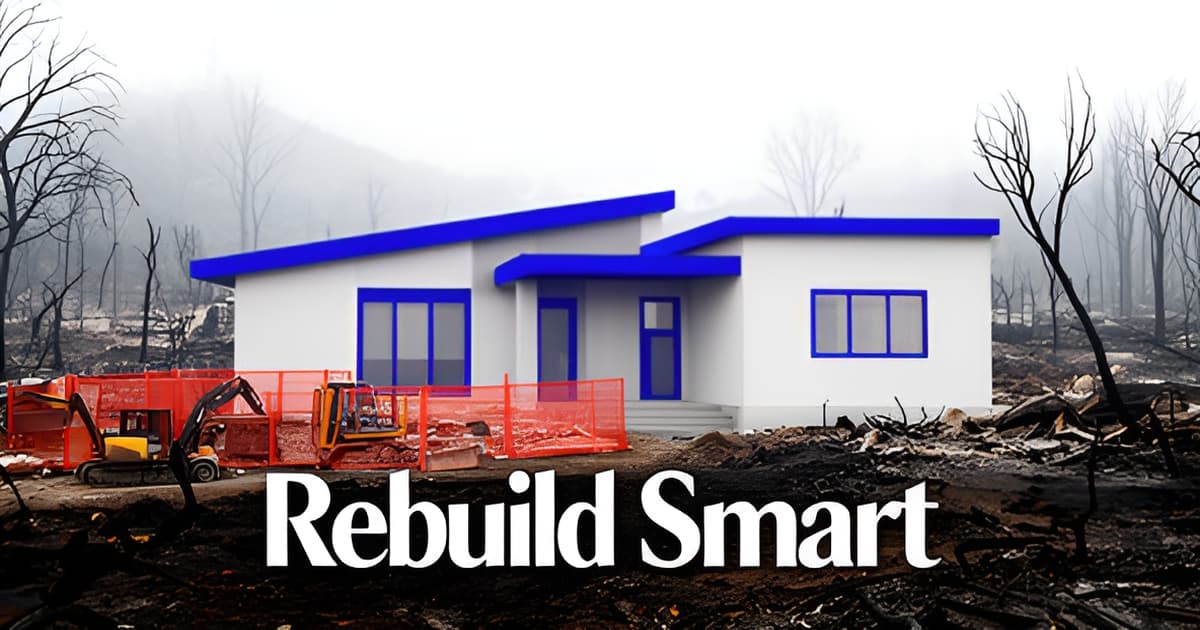
Fire Rebuild Cost in California: What Drives Post-Wildfire Construction Pricing
Key Facts
- A 2,000-square-foot Altadena rebuild runs $900,000–$1.5 million in hard costs at 2026 rates of $450–$750 per square foot, per Altadena rebuild guides.
- Pre-construction costs of $75,000–$200,000 hit before a single wall goes up, according to post-wildfire cost analysis.
- 62% of surveyed 2025 LA fire survivors reported being underinsured, with typical gaps of $200,000–$500,000 or more, a United Policyholders survey found.
- Demand surge — formally recognized by the California Department of Insurance — pushes post-fire contractor and materials costs up 20–40% for 12 months or more, per industry cost analyses.
- Wildfire-resistant construction adds only about $13,000, roughly 2.6%, to a 1,750-square-foot Altadena home, independent Headwaters Economics and IBHS research shows.
- Homeowners who bypassed the free state-managed Cal OES debris removal program averaged $100,000+ per property in cleanup costs, rebuild guides report.
- One year after the January 2025 fires destroyed 18,000+ structures, fewer than a dozen homes had been rebuilt across the region.
The Real Numbers: What an Altadena Rebuild Actually Costs
The number on your construction contract is not the number you need to budget. That distinction catches more Altadena rebuilders than any design decision ever will — and it's the single biggest reason insurance payouts run dry before roofs go on.
Start with hard construction costs. Current Altadena estimates run roughly $450–$750 per square foot once architecture, engineering, and permits are included, meaning a 2,000-square-foot home lands around $900,000–$1.5 million in hard costs. Broader LA-market figures for construction alone start near $350/SF and climb past $600.
But construction is only one line in the real budget. Rebuild cost is not construction cost — pre-construction, permits, temporary housing, and finishes typically add 40–60% on top of the base contract, according to post-wildfire cost analysis. The phases that arrive first are the ones nobody budgets for:
- Pre-construction costs of $75,000–$200,000 — debris removal, hazmat remediation, soil testing, engineering, and permits — spent before a single wall goes up
- Debris removal reaching ~$100,000 per parcel for homeowners who bypass the free state-managed Cal OES program
- Soft costs of $150,000–$350,000 covering permits, engineering, architecture, and landscaping
- Temporary housing adding $60,000–$120,000 out-of-pocket over a 24-month rebuild
The pattern is predictable. Most cost overruns happen because homeowners budget carefully for the construction phase while the earlier phases quietly drain the insurance payout first. By the time framing starts, the cushion is gone.
This is also why underinsurance is so damaging. A United Policyholders survey of 2025 LA fire survivors found 62% reported being underinsured, with typical gaps of $200,000–$500,000 or more. A policy sized to a construction contract simply cannot absorb $75,000–$200,000 in pre-construction spending plus $150,000–$350,000 in soft costs.
At Altadena Custom Home Builder, we walk Eaton Fire rebuild clients through a full-phase budget before anyone talks floor plans — because a hillside lot with slope engineering and LA County permitting needs every phase priced, not just the build. If you're weighing a rebuild, tear-down, or ground-up home in Altadena, a free build consultation is the place to start.
Three Forces Driving Post-Fire Pricing: Demand Surge, Labor Scarcity, and Code Escalation
The three biggest budget threats after a wildfire aren't the fire itself — they're what happens in the market and the codebook afterward. Understanding how demand surge, labor scarcity, and new building codes compound each other is the difference between a realistic rebuild budget and a painful one.
Demand surge is not a rumor; it's a formally recognized phenomenon. The California Department of Insurance defines it as the post-disaster spike in contractor and material prices, and costs routinely climb 20–40% within months of a major fire, staying elevated for 12 months or more according to industry cost analyses. Waiting doesn't protect you — homeowners who delay rebuilding face the same elevated pricing.
Labor scarcity compounds the surge. The January 2025 fires destroyed more than 16,000 structures, and rebuild crews are now split across simultaneous projects in Altadena, Pacific Palisades, and Malibu — all competing for the same licensed contractors, as Altadena rebuild guides note. Labor rates in active wildfire rebuild zones currently run above standard new-construction rates, with no near-term relief in sight.
Then there's the code. As of January 1, 2026, California's new Wildland-Urban Interface Code (Title 24, Part 7) took effect, mandating Class A roofing, ember-resistant vents, noncombustible cladding, and the AB 3074 ember-resistant "Zone 0" around structures. Most of the Altadena fire area sits in the Very High Fire Hazard Severity Zone, so these requirements apply to virtually every rebuild.
Here's the myth-busting part: the code itself is not the budget killer. Independent research from Headwaters Economics and IBHS, based on the RSMeans cost database, found that wildfire-resistant construction adds only about $13,000 — roughly 2.6% — to a representative 1,750 sq ft Altadena home. Even the enhanced IBHS "Wildfire Prepared Home Plus" standard runs about $15,000, under 10% of baseline construction cost.
The real threats are delay and scarcity:
- Demand-surge pricing of 20–40% that persists a year or longer
- Contractor capacity stretched across three simultaneous community rebuilds
- Pre-construction costs of $75,000–$200,000 before framing begins
- Material lead times on lumber, steel, windows, and roofing that force substitutions
For Altadena homeowners weighing a rebuild, the takeaway is clear: budget a 20–30% contingency for market conditions, not for the code. At Altadena Custom Home Builder, we walk fire-rebuild owners through these cost drivers in a free build consultation — including how lot conditions, hillside constraints, and current WUI requirements shape a realistic budget for your specific parcel. Locking in your design and builder early is the single most effective way to blunt the surge.
The Insurance Gap: Why 62% of Fire Survivors Come Up Short
Most fire survivors don't discover they're underinsured until the first contractor bid arrives. Six months after the 2025 LA fires, a United Policyholders survey found 62% of survivors reported being underinsured — and another 33% still didn't know either way.
The shortfalls are not trivial. Practitioners in the LA market report typical gaps of $200,000 to $500,000 or more between policy limits and actual rebuild costs, according to rebuild contractors. Against Altadena's 2026 all-in pricing of roughly $450–$750 per square foot, a modestly underinsured 2,000-square-foot home can fall short by half a million dollars or more.
Why the gap is so wide:
- Insurers' automated estimating tools systematically understate rebuild costs, especially in high-demand post-disaster markets — they miss demand surge pricing that the California Department of Insurance formally recognizes as pushing costs up 20–40%.
- Debris removal coverage is often capped at just 5% of the dwelling limit, while actual cleanup can run $100,000+ per parcel for homeowners who bypass the free state-managed Cal OES program.
- Missing or thin Ordinance or Law coverage leaves code-upgrade costs — WUI fire-hardening, sprinklers, Zone 0 compliance — outside the payout.
California law gives homeowners more leverage than most realize. Under Cal. Ins. Code 2051.5, the rebuild value insurers owe should include all trades, fees, materials, labor, and code-compliance work — and homeowners can even buy instead of rebuild at full rebuild value, per United Policyholders guidance. The catch: insurers have historically resisted paying full benefits under this law, and out-of-state adjusters handling wildfire claims are often not well trained on it.
The practical takeaway is to get an independent cost estimate before accepting any settlement figure. At Altadena Custom Home Builder, we encourage Eaton Fire households to have a licensed contractor price the actual rebuild — including the code upgrades the county will require — rather than relying on the insurer's software output. That number becomes your negotiating baseline under 2051.5.
If your settlement is still open, a free build consultation can help you compare your payout against real 2026 Altadena rebuild costs before you commit to a path.
Budgeting and Building Smart: A Phased Action Plan
A fire rebuild budget fails in phases, not all at once. Most cost overruns happen because homeowners budget for construction while pre-construction costs quietly drain the insurance payout first. The fix is a phased plan with honest buffers — and a few early decisions that lock in pricing before demand surge eats your margin.
Build the budget in phases, not as one number. Pre-construction alone — debris removal, hazmat remediation, soil testing, engineering, and permits — routinely runs $75,000–$200,000 before construction begins, per industry cost analysis. Add a contingency of 10–30% on top of the full budget; post-fire rebuilds in LA encounter surprises at a higher-than-normal rate, and contractor and materials costs spike 20–40% within months of a major fire.
- Use the state-managed Cal OES debris removal program if eligible — homeowners who bypassed it averaged $100,000+ per property, and insurance debris coverage is often capped at 5% of the dwelling limit.
- Verify your Ordinance or Law (Building Code Coverage) endorsement before designing — it pays for code-compliance work standard policies exclude, and 62% of surveyed 2025 LA fire survivors reported being underinsured.
- Engage a licensed contractor early. Regional crews are split across Altadena, Pacific Palisades, and Malibu, and delaying does not protect you from price increases that persist 12 months or more.
- Consider a like-for-like rebuild (≤10% footprint change) — it gets the fastest permitting path, while modifications trigger additional planning review that extends both timeline and cost.
Budget realistically for resilience, too. Independent Headwaters Economics and IBHS research found wildfire-resistant construction adds only 2–13% to total home cost, and the enhanced tier runs just ~$2,800 over the code baseline. A resilient build typically carries a $15,000–$50,000 premium but can reduce destruction risk by up to 43% — and in most 10-year comparisons, it pays for itself through insurance savings and avoided loss.
At Altadena Custom Home Builder, our field guide walks Eaton Fire rebuild owners through these decisions — from hillside and slope lots to LA County unincorporated permitting — without permit or timeline guarantees. If you want a second set of eyes on your phased budget or early contractor conversations, a free build consultation is a sensible next step.
Planning Your Altadena Rebuild: Timeline and Next Steps
If your Altadena lot was cleared after the Eaton Fire, you're at the start of a long road: most rebuilds take 18–36 months from debris clearance to occupancy. One year after the January 2025 fires destroyed more than 18,000 homes and structures across the region, fewer than a dozen homes had actually been rebuilt. That pace isn't a sign of failure — it reflects how slow, complex, and labor-constrained post-fire construction really is.
The permitting picture is improving, though. As of early 2026, more than 2,600 residential permits had been issued across the Palisades and Altadena rebuild zones, with roughly 3,340 more under review. State law helps here: under AB 2234, building departments must acknowledge complete residential permit applications within 15 business days and finish plan review within 30 business days for projects of 25 units or fewer. LA County has also set accelerated targets for fire rebuilds — 10 business days for initial review and 5 days for rechecks.
Your timeline will depend heavily on the path you choose:
- Like-for-like rebuilds (keeping footprint and floor area within about 10% of the original) move through permitting fastest.
- Modified designs trigger additional planning review, which extends both timeline and cost significantly.
- Contractor availability remains the primary scheduling variable, since crews are split across simultaneous rebuilds in Altadena, Pacific Palisades, and Malibu.
- Delaying doesn't protect you from price increases — demand surge costs of 20–40% can persist a year or more after a major fire.
Before construction starts, expect $75,000–$200,000 in pre-construction costs — debris removal, soil testing, engineering, architecture, and permits. If you haven't yet used the state-managed Cal OES debris removal program, confirm your eligibility; homeowners who bypassed it averaged $100,000+ per property in cleanup costs. It's also worth verifying your Ordinance or Law coverage before finalizing plans, since rebuilding means meeting current WUI code requirements, not restoring what stood before.
At Altadena Custom Home Builder, we publish this guide to help lot owners navigate ground-up rebuilds, hillside lots, and LA County permitting with realistic expectations — no guarantees on timelines or permits, just clear information. If you want a grounded read on your specific lot, budget, and rebuild options, our free build consultation is a good starting point.
A note on transparency: this article features JMB Builders LLC (CSLB #1103479), an Altadena-based licensed general contractor that builds custom homes, ADUs, and Eaton Fire rebuilds. This is a paid placement, disclosed so you can weigh the information accordingly.
Frequently Asked Questions
How much does it actually cost to rebuild a home after the Eaton Fire in Altadena?
Why is my insurance payout not enough to rebuild, even if I had full coverage?
Do new wildfire building codes really add that much to a rebuild budget?
What costs do I need to budget for before construction even starts?
Should I pay for debris removal myself or use the state program?
How long will my Altadena rebuild take, and should I wait for prices to come down?
The Bottom Line: Budget Every Phase, Move Early, Verify Everything
The math of an Altadena rebuild comes down to three realities: construction at $450–$750 per square foot is only part of the bill, pre-construction and soft costs quietly add 40–60% on top, and demand surge inflates pricing 20–40% for a year or more after a major fire. The code itself is affordable — wildfire-resistant construction adds only about 2–3% to total home cost per Headwaters Economics and IBHS research — but underinsurance is not, with 62% of surveyed 2025 LA fire survivors reporting shortfalls of $200,000–$500,000. Your next steps are concrete: confirm Cal OES debris removal eligibility, verify your Ordinance or Law coverage before finalizing plans, get an independent rebuild estimate before accepting any settlement, and lock in a licensed contractor early while crews remain stretched across three simultaneous rebuilds. A phased budget with a 20–30% contingency — built before anyone talks floor plans — is the single best protection against running dry mid-build. If you want a grounded read on your specific lot, budget, and rebuild path, Altadena Custom Home Builder offers a free build consultation — a sensible first move, with no permit or timeline promises attached.