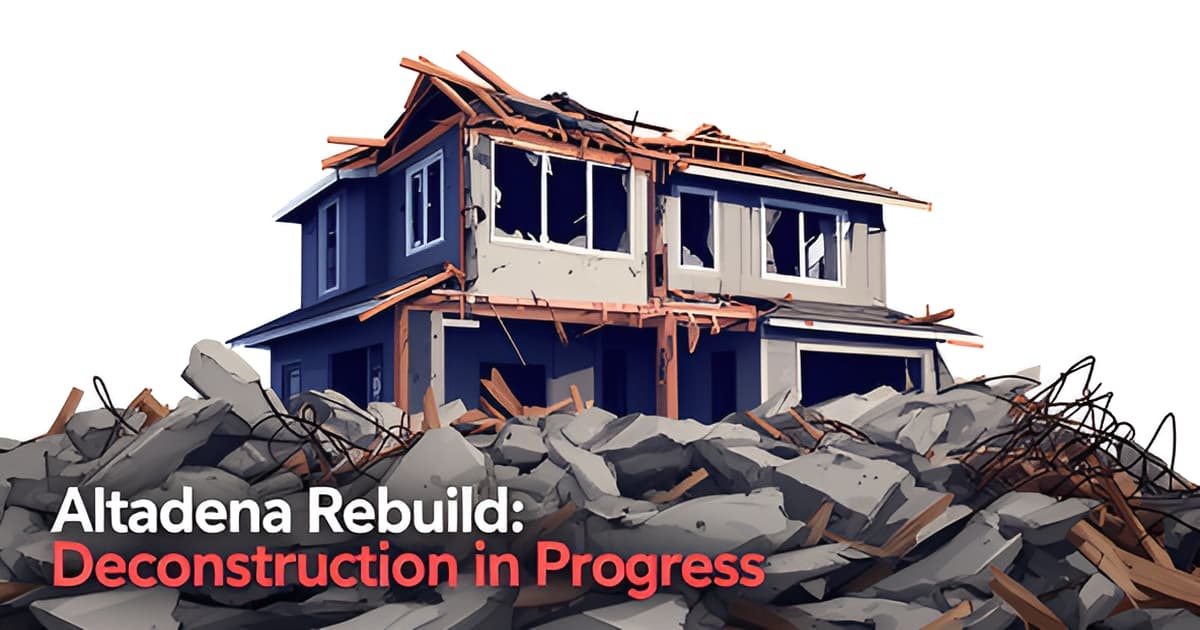
Demolish and Rebuild in Altadena: Tear-Down Costs and Timeline
Key Facts
- Real Southern California tear-downs cost $15,000–$95,000, roughly $23–$25 per square foot — not the $4–$8 online calculators claim, per contractor bid data.
- A house can be demolished in days, but SCAQMD Rule 1403 requires an asbestos survey plus a 10-working-day notice before any demolition begins, per regulatory requirements.
- LA County won't issue Eaton Fire rebuild permits until Phase 1 hazmat and Phase 2 debris removal are complete, per the County's guidance.
- Like-for-like Eaton Fire rebuilds are exempt from current zoning and may expand floor area by up to 10% or 200 square feet, per LA County.
- Standard Altadena rebuild permits average five months, but pre-approved plans have cut approval to 30–40 days, per Spectrum News.
- Hidden rebuild costs add $150,000–$350,000+ beyond the base bid, including up to $126,000 in temporary housing, per Bay Area teardown data.
- LA County has received ~2,700 rebuild permit applications and issued ~1,200, with 560 homes actively under construction, per CalMatters reporting.
The Real Cost of a Tear-Down (It's Not $4–$8/Sq Ft)
Type "demolition cost calculator" into a search engine and you'll walk away thinking a tear-down costs $4–$8 per square foot. That number is fiction for Southern California — it quietly excludes the slab, the trucking, and the disposal, which is where most of the money actually goes.
Real bids tell a different story. One Southern California demolition contractor reports whole-house tear-downs ranging from $15,000 to $95,000, or roughly $23–$25 per square foot all-in with slab removal and hauling. Recent examples include a 1,700 sq ft two-story in Manhattan Beach at $42,000, a 3,872 sq ft 1946 home in Newport Beach at $89,500, and a single-family tear-down in Ontario at $58,500.
Why such a wide range? Square footage matters less than you'd think. Lot access, neighbor proximity, foundation type, and local hauling rules can swing the price as much as the size of the house itself. Phone quotes are notoriously unreliable — a low bid that quietly leaves out the slab or hauling isn't a low bid.
The add-ons stack up fast:
- Asbestos abatement: $1,500–$8,000, and SCAQMD Rule 1403 requires an asbestos survey for any structure regardless of age, with a 10-working-day notice before demolition begins.
- Demolition permit fees: roughly $150–$600 in Orange County cities and often $400–$1,200 in Los Angeles jurisdictions.
- Debris boxes frequently carry ~8-ton weight caps, each overage a separate charge — and some cities require you to use their franchise hauler.
- Pre-1978 homes should also be checked for lead paint before work starts.
For Eaton Fire lots, the calculus shifts: LA County requires Phase 1 hazardous materials removal and Phase 2 fire debris removal to be complete before any rebuild permit is issued, per the County's recovery portal. Many fire-affected owners never pay a conventional demolition bill at all — government debris removal covered it.
Here at Altadena Custom Home Builder, we encourage clients to budget the tear-down at the $23–$25/sq ft benchmark and demand on-site bids, not phone estimates. Scrutinize every line item: slab removal, hauling, disposal destination, and permits. The tear-down itself takes days to weeks; getting these numbers right is what protects the rest of your rebuild budget.
Why the Demolition Is Fast but the Pre-Work Takes Months
The excavator shows up on Monday, and by Friday your house can be gone. The paperwork that made that possible? It started weeks or months earlier — and that's the part most Altadena homeowners underestimate.
According to Southern California demolition contractors, a single-story home with good access can be demolished and hauled in a few working days, while a two-story on a tight lot takes weeks. The long-lead items are all upstream: the demolition permit, utility disconnects, the asbestos survey, and the mandatory waiting periods that follow.
The regulatory clock you can't skip
SCAQMD Rule 1403 requires an asbestos survey before demolishing any structure — regardless of its age — plus a notice filed at least 10 working days before work begins. Practitioners advise planning on roughly two weeks between survey results and the first day of demolition, and pre-1978 homes should also be checked for lead paint. Asbestos abatement, if needed, runs $1,500–$8,000 as a separate line item.
Eaton Fire lots add a prerequisite step
For fire-affected properties, LA County requires both phases of debris removal — Phase 1 EPA hazardous materials removal and Phase 2 fire debris removal — to be complete before any rebuild permits can be issued, per the County's like-for-like rebuild guidance. Homeowners rebuilding after the Eaton Fire should also assume the foundation needs scrutiny: after a complete burn, structural engineers typically evaluate existing foundations against a soils report, and reuse often isn't possible.
The practical pre-work checklist looks like this:
- Demolition permit — several weeks in many jurisdictions
- Utility disconnects and early coordination with service providers
- SCAQMD Rule 1403 asbestos survey and 10-working-day notice
- Lead-paint inspection for pre-1978 homes
- Phase 1/Phase 2 debris removal sign-off (Eaton Fire lots, before permits)
Why sequencing matters more than speed
The contractors' advice is blunt: start these items early and the demolition won't hold up your new build. Standard permit approval in Altadena has averaged around five months, though pre-approved plan pathways have reportedly cut that to 30–40 days for some homeowners. Timelines vary by pathway and property, so treat these as ranges, not promises.
At Altadena Custom Home Builder, we walk homeowners through this sequencing during our free build consultations — mapping which tasks can run in parallel and which gate everything else. Getting the asbestos survey and utility disconnects moving while design work is still on the drafting table is the single easiest way to compress a rebuild calendar.
The tear-down is the short part. Respect the pre-work, and the short part stays short.
Two Permit Paths in Altadena: Like-for-Like vs. Full Custom
Before you swing a wrecking ball in Altadena, the most important decision isn't the contractor — it's which permit path your rebuild will follow. Choose wrong, and you could demolish a larger home only to get approval for a smaller one.
LA County's like-for-like rebuild pathway allows Eaton Fire survivors to rebuild the same size, location, and purpose as before — and critically, these structures are exempt from current Zoning Code requirements, though they must still comply with Building, Fire, and Health/Safety Codes. The County even permits modest expansion: like-for-like structures in the fire area may increase floor area by up to 10% or 200 square feet, whichever is greater.
The speed advantage is real. Standard Altadena rebuild permit approval averages roughly five months, while pre-approved plans through companies like Homebound have cut that to 30–40 days, according to Spectrum News reporting. The County also operates one-stop Permit Centers and an express lane for rebuilding, with information on fee waivers and refunds on its recovery portal.
If you want a different footprint, a second story, or a fully custom design, your rebuild falls under the Altadena Community Standards District rather than the fast lane. Some requirements are relaxed for fire rebuilds — the CSD's standard front-yard setback doesn't apply — but non-like-for-like rebuilds face a minimum front setback of 20 feet per the County's rebuild guidance. On typical Altadena lots, that geometry can quietly reduce what fits on your buildable pad.
The most expensive mistake in tear-down planning is demolishing before verifying what current code allows you to rebuild. Regional teardown data documents a homeowner who tore down a 2,800-square-foot home, only to discover zoning limited the rebuild to 2,400 square feet — a permanent 400-square-foot loss.
Before any demolition, confirm with the planning department:
- Your maximum buildable square footage under current zoning and the Altadena CSD
- Whether your lot qualifies for the like-for-like exemption and its 10%/200 sq ft expansion allowance
- That Phase 1 and Phase 2 debris removal are complete — permits can't be issued until then
At Altadena Custom Home Builder, we advise homeowners to map both permit paths before the first excavator arrives, because the pathway choice shapes your budget, your design freedom, and your timeline. If you're weighing a like-for-like rebuild against a full custom home on your lot, a free build consultation can help you pressure-test both options against your lot's zoning reality.
The Full Rebuild Timeline: What to Expect From Design to Move-In
The day the excavator arrives is not the start of your rebuild — it's closer to the middle. Homeowners who anchor their expectations to the full arc, from first sketch to move-in, plan better and panic less.
Here's the realistic shape of a ground-up rebuild in Altadena. Design and engineering come first, including soils and geology reports, foundation evaluation, and — for fire-zone lots — Chapter 7A fire-code assemblies. Then comes permitting, then construction. Practitioners who have worked Eaton Fire rebuilds report 12–20 months of construction alone for ground-up custom homes, before design and permitting are even counted (Bela Development's rebuild experience).
Permitting is the most variable phase. Standard Altadena rebuild approvals currently average about five months, though pre-approved plan programs have cut that to 30–40 days for some homeowners (Spectrum News reporting). Fire rebuilds also follow a distinct sequence: LA County will not issue permits until Phase 1 and Phase 2 debris removal are complete, per the County's like-for-like rebuild guidance.
Altadena's recovery pace puts these ranges in context. According to CalMatters reporting on LA County's dashboard, the County has received roughly 2,700 rebuild permit applications, issued about 1,200 permits, and has 560 homes actively under construction. Those numbers tell you two things: the pipeline is moving, and you are not waiting alone.
A typical end-to-end sequence looks like this:
- Design, documentation, soils/geology reports, and foundation evaluation
- Permit submission and plan check (weeks to months, depending on pathway)
- Site preparation, debris sign-off, and utility coordination
- Construction — typically 12–20 months for custom ground-up homes
- Final inspections and certificate of occupancy
Treat every figure here as a range, not a promise. Lot conditions, hillside geometry, design complexity, and plan-check volume all move the calendar. One Eaton Fire homeowner described managing architects and contractors as "basically (another) full-time job" — a fair warning that timeline stress is real, and that experienced guidance is worth its cost.
If you're weighing a tear-down and rebuild on your Altadena lot, Altadena Custom Home Builder offers a free build consultation to map your specific timeline, permitting pathway, and budget before you commit.
Hidden Costs and Your Action Plan Before the Excavator Arrives
If your demolition bid looks cheap, wait until you see everything it doesn't include. Across comparable California projects, costs beyond the base bid have added $150,000 to $350,000+ — and Altadena lots, with hillside soils and fire-recovery requirements, are no place to discover that after the excavator arrives.
The big-ticket items are predictable. Utility reconnections can run $15,000–$50,000, geotechnical and soils reports $5,000–$15,000, and temporary housing during a 12–20 month build $60,000–$126,000, according to Bay Area tear-down data. Tree protection or removal adds $5,000–$40,000, and Prop 13 reassessment on new construction can permanently add $15,000–$25,000 per year on a $3 million property. Foundation replacement alone — often unavoidable after a complete burn — can cost $100,000–$250,000.
Before you sign anything, work through this checklist:
- Get on-site bids, not phone quotes — practitioners note phone estimates are notoriously inaccurate, and lot access, neighbor proximity, and foundation type can swing the price as much as square footage.
- Verify the bid includes slab removal, hauling, and the disposal destination; a low bid that quietly leaves out the slab or the trucking isn't a low bid.
- For fire-damaged lots, confirm Phase 1 and Phase 2 debris removal are complete and you have sign-off — LA County won't issue permits until then.
- Check your contractor's license on the CSLB site, and remember California caps down payments at $1,000 or 10% of the contract price, whichever is less.
One more zoning trap: verify your maximum buildable square footage with the planning department before demolishing. One homeowner tore down a 2,800 sq ft home only to learn current rules limited the rebuild to 2,400 sq ft. Eaton Fire survivors should also weigh the like-for-like pathway, which is exempt from current Zoning Code requirements and allows up to a 10% or 200 sq ft expansion.
For official fee, waiver, and permitting help, use LA County's Eaton Fire recovery portal, or visit the Altadena Community Center recovery center at 730 E. Altadena Dr., open weekdays 9 AM–5 PM. And when you're ready to pressure-test your budget and sequencing, Altadena Custom Home Builder offers a free build consultation with featured builder JMB Builders LLC (CSLB #1103479), an Altadena-based licensed general contractor experienced in custom homes and Eaton Fire rebuilds. No timelines or costs are guaranteed — but walking in with the right questions is the closest thing to a guarantee you'll get.
Frequently Asked Questions
How much does it actually cost to demolish a house in Southern California?
How long does it take to demolish a house in Altadena?
What permits and approvals do I need before demolishing in Altadena?
Can I rebuild a bigger house than I had before the Eaton Fire?
How long does a full tear-down and rebuild take from start to move-in?
What hidden costs should I budget for beyond the demolition bid?
Before the Excavator Arrives: Your Next Move
A tear-down in Altadena is really two projects: a fast, visible demolition and a slow, invisible pre-work phase that determines whether the rest of your rebuild goes smoothly. Budget realistically at $23–$25 per square foot all-in, demand on-site bids that itemize slab removal and hauling, confirm Phase 1 and Phase 2 debris removal sign-off on fire-affected lots, and verify your buildable square footage before anything comes down. Then map your permit path — like-for-like or full custom — because that choice shapes your budget, design freedom, and timeline for the next 12–20 months of construction. None of these numbers are guarantees, but homeowners who sequence the asbestos survey, utility disconnects, and zoning checks early consistently compress their calendars and protect their budgets. If you're weighing a tear-down or an Eaton Fire rebuild on your lot, Altadena Custom Home Builder offers a free build consultation to pressure-test your numbers and sequencing. With roughly 1,200 rebuild permits already issued across the County, you're not rebuilding alone — and walking in with the right questions is the closest thing to a guarantee you'll get.