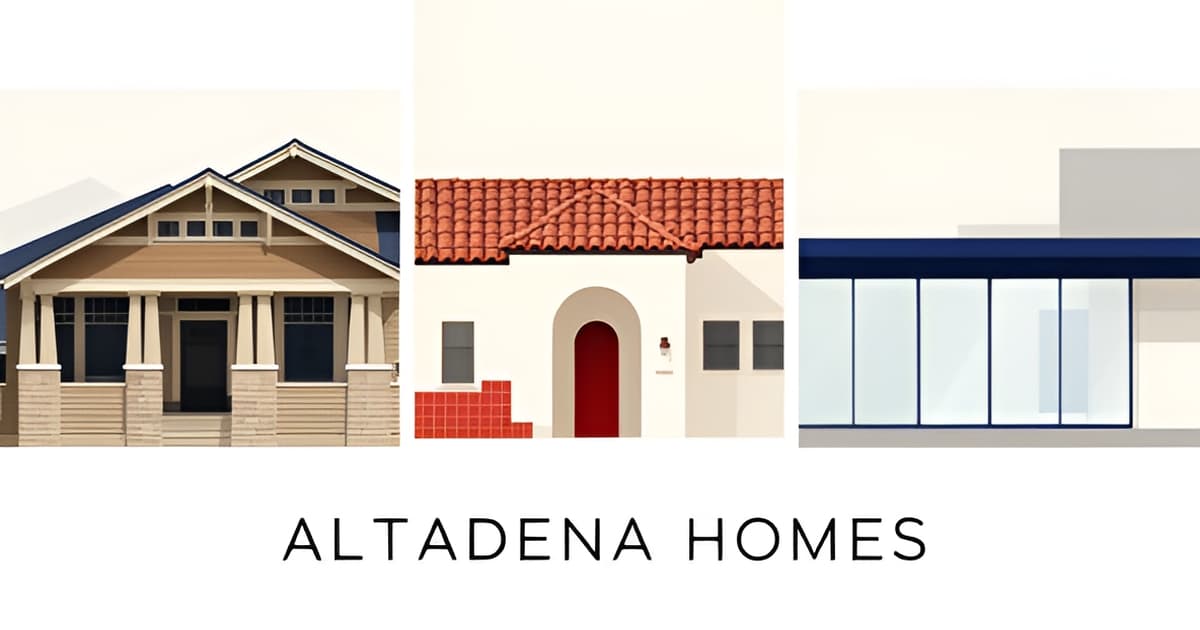
Craftsman vs Spanish Revival vs Mid-Century: Building in Altadena's Traditions
Key Facts
- The January 2025 Eaton Fire burned 14,000 acres and destroyed more than 6,000 Altadena homes, per Cal Fire figures reported by ABC News.
- LA County caps like-for-like rebuild modifications at 10% of floor area or footprint before triggering extra planning review, per the 2026 Altadena rebuild guide.
- A standard Altadena rebuild costs $450–$750 per square foot all-in, meaning a 2,000-square-foot home runs $900K–$1.5M, according to rebuild cost data.
- The Foothill Catalog's pre-approved designs cut permitting from 6–12 months to as few as 15 days, according to the Catalog.
- Six in ten Black-owned homes in Altadena were destroyed — the highest damage rate of any group — and 73% of Black homeowners showed no rebuild progress nine months later, per UCLA research cited in Architectural Record.
- Foothill Catalog homeowners report 8–12 months to move-in versus 2–3 years typical, with construction at $635K–$690K on a 1,500-square-foot example, per Catalog figures.
- Spanish Colonial Revival's Altadena rise traces to the 1915 Panama-California Exposition, according to preservation experts.
Altadena's Three Traditions — and Why Your Rebuild Style Matters Now
When the Eaton Fire burned 14,000 acres in January 2025, it destroyed more than 6,000 Altadena homes — and with them, thousands of examples of the architecture that defines this foothill community. Now, as families weigh their rebuild options, a question has emerged that goes beyond floor plans: what does it mean to rebuild "in the style of Altadena"?
That question isn't abstract. Organizations like Rebuild Altadena, Pasadena Heritage, and Altadena Heritage have launched lecture series dedicated to the three defining traditions, treating architectural character as something worth defending. And the stakes are real: with only a fraction of destroyed homes under permit so far, every rebuild decision shapes what the community looks like for the next century.
Three traditions, three design philosophies
Altadena's streetscapes are anchored by two dominant historic styles, with a third adding postwar diversity:
- Craftsman bungalows — low-pitched gabled roofs, exposed rafters, broad front porches with tapered columns, and interiors rich with built-in cabinetry and inglenooks. Altadena's local variant, the "airplane bungalow," adds a small second-story pop-up.
- Spanish Colonial Revival — a style that gained momentum after the 1915 Panama-California Exposition, defined by thick stucco walls, red clay tile roofs, arched openings, beamed ceilings, and open courtyards.
- Mid-century and Ranch homes — built in the 1940s–1960s postwar subdivisions, with simple horizontal lines, open-plan living, and a seamless indoor-outdoor connection.
The heritage community's central debate captures why this matters: is a Craftsman simply a set of recognizable elevations and details, or the result of a philosophy applied? Can a home built with modern technologies, to modern fire codes, from different materials, still be authentic?
At Altadena Custom Home Builder, we believe the answer lies in understanding each style's underlying principles — not just copying facades. A Craftsman is honest structure and craftsmanship; a Spanish Revival is shade, mass, and courtyard life; a Mid-century is openness to the landscape. Applied well, these philosophies survive even when materials must change to meet Chapter 7A fire-resistance requirements.
Why your choice matters now
Rebuild timelines run 15–26 months under standard pathways, and costs typically range from $450 to $750 per square foot including architecture, engineering, and permits. Style decisions made early — whether to pursue a like-for-like rebuild within the county's 10% modification limit, or a full custom design — determine which pathway, timeline, and budget a family faces. With contractor availability already stretched across Altadena, Pacific Palisades, and Malibu rebuilds, the families who move decisively are the ones who come home to a house that still belongs to Altadena.
The Rules That Shape a Traditional Rebuild: Like-for-Like, Chapter 7A, and Cost Reality
Every Altadena rebuild decision runs through three gates before a single design sketch matters: what the county allows, what the fire code demands, and what your budget can absorb. The romantic vision of recreating a 1920s bungalow collides quickly with paperwork and price tags.
Because Altadena is unincorporated, permits flow through LA County Public Works rather than LADBS, and the county's like-for-like rule is strict: a replacement home must match the original in size, location, and use, with modifications capped at 10% of floor area or footprint. Exceed that threshold and you trigger additional planning review, which stretches both your timeline and your cost. For homeowners hoping to shift styles — say, from a mid-century ranch to a Spanish Revival — this rule is often the first hard stop, a constraint detailed in a 2026 Altadena rebuild contractor guide.
Then comes Chapter 7A, California's Wildland-Urban Interface building code, which applies across most of the fire-affected area. Its requirements reshape the traditional palette:
- Class A roofing and ember-resistant vents
- Non-combustible siding in place of traditional wood
- Tempered dual-pane windows
- Fire-resistant decking
That last constraint cuts deepest for Craftsman devotees, since exposed wood details define the style. The good news: workarounds exist. Builders can preserve period character through dual-pane wood-clad windows, hand-troweled stucco, lime plaster, and terracotta tile — strategies that satisfy code without flattening the architecture, according to rebuilding guidance from GreatBuildz.
Budget is the third gate. A standard Altadena rebuild in 2026 runs $450–$750 per square foot all-in — architecture, engineering, permits, and construction combined — meaning a 2,000-square-foot home carries roughly $900K to $1.5M in hard costs. The full journey spans 15 to 26 months: one to three months of debris removal, one to three for design, four to five for permitting, and nine to sixteen for construction. And the single biggest variable? Contractor availability, as regional crews remain split across Altadena, Pacific Palisades, and Malibu.
This is the tension every rebuild lives inside: the heritage community's own question of whether a new home built to different codes and from different materials can still authentically be a Craftsman. Navigating that balance — like-for-like limits, 7A compliance, and period-true detailing on a realistic budget — is exactly the work we do every day at Altadena Custom Home Builder for Eaton Fire families planning their ground-up rebuild.
Planning a traditional rebuild in Altadena? Talk with our team about your lot, your style, and your like-for-like options — and lock in a builder slot before the 2026 schedule fills.
Three Paths to a Style-Faithful Home: Pre-Approved Catalog, Custom Build, or Hybrid
Once you've settled on a style — Craftsman, Spanish Revival, or Mid-century — the next decision shapes everything: how you get from concept to keys. Altadena homeowners now have three realistic paths, each trading between speed, cost, and design control.
The Foothill Catalog offers 50+ pre-approved designs tailored to local architectural traditions, including The Lexington, a 1,722-square-foot three-bedroom Craftsman, and La Solana, a 1,635-square-foot Spanish Revival. Because plans are already reviewed, permits arrive in 4–6 weeks — sometimes as few as 15 days — versus the 6–12 months typical of custom design.
The numbers are compelling: catalog homeowners report 8–12 months to move-in against a typical 2–3 years or more, with construction costs of $635K–$690K on a 1,500-square-foot example versus $850K–$1M+ through the conventional route. Architect fees run a flat $7,500 ($5/sq ft for fire survivors) instead of the $60K–$120K+ custom design commands. Nearly 100 families across Altadena and Pasadena are already working through the Catalog.
The catalog has limits. It offers no Mid-century model, and its designs answer a question some homeowners answer differently. As the heritage community's lecture series frames it: is a Craftsman "a set of recognizable elevations and details, or is it the result of a philosophy applied?" For homeowners who want a philosophy-driven home — or a Mid-century rebuild with true horizontal lines and indoor-outdoor connection — custom design is the only path. Expect 9–12 months of design work plus 6 or more months of permitting, and be mindful of LA County's like-for-like rebuild rules, which cap modifications at 10% of floor area or footprint before triggering additional planning review.
Most style-faithful rebuilds land between these poles. The hybrid strategy keeps defining period elements while meeting Chapter 7A fire code:
- Retain signature features — exposed ceiling beams, mantels, built-in cabinetry, symmetrical facades
- Use dual-pane wood-clad windows and tempered glass to satisfy fire-resistant glazing requirements
- Specify hand-troweled stucco, lime plaster, and terracotta tile for authentic texture in non-combustible assemblies
- Run ductless HVAC to avoid intrusive modern interventions in period interiors
As rebuilding experts note, the real work is balancing period character with modern code, energy efficiency, and budget. A builder fluent in both — like an Altadena custom home builder who navigates Chapter 7A daily while sourcing period-appropriate materials — closes the gap between catalog speed and custom authenticity. Whichever path you choose, contractor availability remains the single most critical factor controlling your timeline, with regional crews split across Altadena, Pacific Palisades, and Malibu rebuilds.
How to Build in Tradition Without Losing Your Timeline (or Your Shirt)
Every month spent deliberating is a month your neighbor's crew gets booked elsewhere. A standard Altadena rebuild runs 15–26 months from debris removal to move-in, and with regional contractors split across Altadena, Pacific Palisades, and Malibu, the single most critical factor controlling your timeline is contractor availability — not design, not permitting, not materials.
So make four decisions early, in this order.
First, decide your style philosophy. The heritage community's central debate — posed by the "Rebuilding in the Style of Altadena" lecture series — is whether a Craftsman is a set of recognizable elevations and details, or the result of a philosophy applied. A custom builder can pursue the philosophy: exposed rafters and built-ins for a Craftsman, beamed ceilings and courtyards for a Spanish Revival, horizontal lines and indoor-outdoor flow for a Mid-century. Decide whether you want faithful details or faithful principles before you draw anything.
Second, verify your like-for-like status. LA County defines a like-for-like rebuild as the same size, location, and use, with modifications not exceeding 10% of floor area or footprint. Exceed that limit — say, switching from a bungalow to a Mid-century ranch — and you trigger additional planning review that extends both timeline and cost. Confirm what your lot allows before falling in love with a plan.
Third, choose between catalog speed and custom flexibility. The Foothill Catalog offers pre-approved Craftsman and Spanish Revival designs with permits in as few as 15 days, versus a typical 4–5 months — and its 1,500-square-foot example reaches move-in in 8–12 months versus 2–3 years. But the catalog features no Mid-century model, and nearly 100 families are already in its pipeline. If your home was a postwar ranch or you want a truly custom interpretation, a ground-up custom build is the path that fits — and it's where an experienced Altadena custom home builder earns their keep, navigating Chapter 7A fire requirements (ember-resistant vents, non-combustible siding, Class A roofing) while preserving period character like hand-troweled stucco or dual-pane wood-clad windows.
Fourth, lock in your builder now. Budget $450–$750 per square foot all-in for a custom rebuild — a 2,000-square-foot home runs roughly $900K to $1.5M — and know that crews commit months out.
There's an equity dimension here, too. Six in ten Black-owned homes in Altadena were destroyed — the highest damage rate of any racial group — and 73% of Black homeowners showed no reconstruction progress nine months post-fire, per UCLA researchers. Rebuilding in tradition isn't nostalgia; it's how a historically Black community keeps its character and its people. As Architectural Record put it: the question is not just how to rebuild, but who will return, and on what terms.
Frequently Asked Questions
Can I rebuild my Altadena home in a different style than the one that burned down?
How can I keep the Craftsman look if Chapter 7A fire code bans traditional wood siding?
Is the Foothill Catalog faster than a custom rebuild, and what styles does it offer?
What does an Altadena rebuild actually cost per square foot in 2026?
What makes a home authentic to Altadena if it's built with modern materials and fire codes?
How long will my rebuild take, and what's the biggest factor in the timeline?
Building the Next Century of Altadena, One Faithful Rebuild at a Time
Altadena's character lives in its Craftsman bungalows, Spanish Revival courtyards, and Mid-century ranch homes — and the Eaton Fire put all three traditions at a crossroads. The path you choose matters: a like-for-like rebuild within LA County's 10% modification limit, a pre-approved Foothill Catalog design, or a custom build that applies each style's philosophy — honest craftsmanship, shaded mass, or openness to the landscape — under Chapter 7A fire code. With rebuilds running 15–26 months and only a fraction of destroyed homes permitted so far, the families who decide early on style, pathway, and builder are the ones who come home to a house that still belongs on its street. That's the work we do every day at Altadena Custom Home Builder: translating period character into code-compliant, budget-realistic homes for Eaton Fire families. If you're ready to move from questions to drawings, talk with our team about your lot, your style, and your rebuild pathway — and secure your place in the 2026 build schedule before contractor slots fill. The question isn't just how Altadena rebuilds, but who returns — and your answer starts with one decision made now.