Craftsman Style Home Builders: What to Look for in Period-True Work
Key Facts
- Craftsman homes appreciated 43.7% over six years, outpaced only by ranch homes, per Realtor.com market research.
- The median Craftsman price is $467,000 — roughly $42,000 above the national median, according to Realtor.com pricing data.
- Every traditional Craftsman home has a prominent low-pitched roof with exaggerated overhangs — steep pitches and perky dormers signal imitation, practicing architects warn.
- Only homes built from Gustav Stickley's roughly 240 published plans (1904–1916) are true 'Craftsman Homes'; everything else is 'Craftsman-style,' per Old House Journal's Patricia Poore.
- The national median build year for Craftsman-style homes is 2000, meaning much of the stock is recent construction, Realtor.com reports.
- Craftsman owners of about ten years see a nearly 50% sale price increase, Realtor.com pricing data shows.
- Fewer than half of Stickley's Craftsman Homes were bungalows — regional variation like the 1908 Gamble House is authentic, not deviation, per Arts & Homes editor Patricia Poore.
The Imitation Problem: Why Most New "Craftsman" Homes Miss the Mark
Craftsman is everywhere — and that's precisely the problem. According to Realtor.com's market research, the median build year for Craftsman-style homes nationally is 2000, meaning huge numbers of "Craftsman" houses are recent construction. Yet a practicing architecture firm that works on the style warns that contemporary spec houses claiming to be Craftsman "most have steeper roof pitches with perky dormers, and just don't have a true craftsman look about them."
That single detail — roof pitch — is the most reliable authenticity marker. CTA Design Builders put it bluntly: "Without fail, every traditional Craftsman home has a prominent low pitch roof with exaggerated overhangs." A steep roof with a jaunty dormer isn't a Craftsman house with modern updates; it's a costume. The imitation problem runs deeper than any one feature, though. It reflects a builder who copied the surface — gables, porch posts, a stone accent — without internalizing the philosophy that produced the style in the first place.
The stakes are real money, not just aesthetics. Craftsman homes have appreciated 43.7% over six years, and the median Craftsman price sits at $467,000 — roughly $42,000 above the national median, per Realtor.com pricing data. As Compass agent Jake Kennedy explains, buyers of authentic examples are "buying quality, history, and a kind of soul that new construction can't imitate." A well-executed period-true build captures that premium. A spec imitation captures none of it.
Even terminology matters more than most buyers realize. Old House Journal editor Patricia Poore notes that a true "Craftsman Home" is technically one built from Gustav Stickley's published plans — roughly 240 designs between 1904 and 1916. Everything else is more accurately "Craftsman-style." That distinction is worth raising with any builder, because it quickly reveals who has studied the tradition and who is working from a plan-book checklist.
For Altadena homeowners — especially those rebuilding after the Eaton Fire on lots that may have held genuine period bungalows — the challenge is finding a builder who understands the style, not just its features. When you evaluate candidates, listen for how they talk about the work:
- Do they explain why the roof pitch and overhang depth matter, rather than just listing gables and dormers?
- Can they discuss the Arts & Crafts philosophy — handcrafted simplicity, natural materials, structure put on display — as a design driver?
- Do they treat regional variation as authentic, not as deviation from a generic template?
- Can they show how they'd balance period detail with modern layouts and energy efficiency — deliberately, not by accident?
The builders who pass that conversation are rare, and they're the ones worth a call.
The Authenticity Checklist: Exterior and Interior Details That Separate Real Craftsman Work
The fastest way to spot a real Craftsman builder is to look at the roof before anything else. Practicing architects who design in the style are blunt about it: "Without fail, every traditional Craftsman home has a prominent low pitch roof with exaggerated overhangs," while contemporary spec houses claiming the Craftsman name tend to have "steeper roof pitches with perky dormers" and "just don't have a true craftsman look about them" (CTA Design Builders).
Start every plan review with the roof-pitch-first rule. A genuinely low-angle roof with wide, unenclosed eaves and exposed rafter tails is the single most reliable marker of period-true work. If a builder's portfolio shows steep pitches and perky dormers, the rest of the checklist rarely saves it.
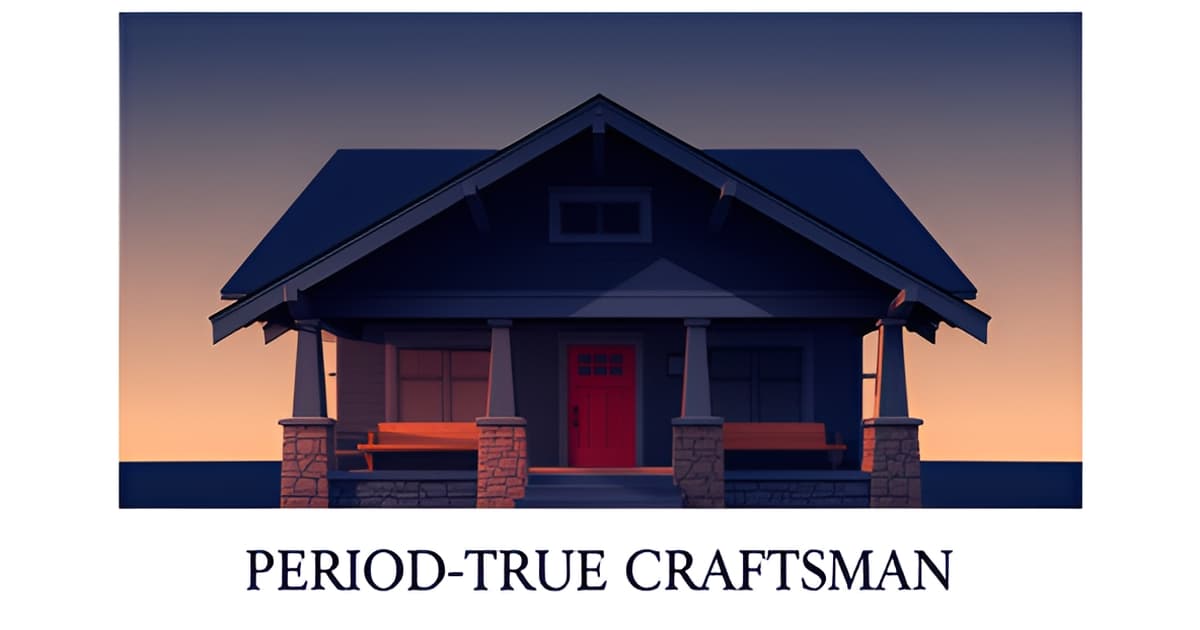
From there, evaluate exterior and interior details as a rubric rather than a wish list. As Old House Journal editor Patricia Poore summarizes, authentic Arts & Crafts houses share "a merger of indoors and out (porches, pergolas, overhanging eaves), the artful use of natural materials (stone chimneys, clinker bricks), and an exaggerated show of structure (battered column piers, eaves brackets)."
- Tapered, battered porch columns on piers — chunky and detailed, never thin or decorative-only
- Natural, local materials: wood shakes or narrow horizontal siding, stone, and brick rather than synthetic substitutes
- Divided-light windows in repetitive patterns, with stained or leaded glass at key focal points
- Interior built-ins — window seats, shelving, and cabinetry integrated into the walls themselves
- Exposed beams and a stone-chimney fireplace as the room's focal point
The interior matters as much as the facade. As one Los Angeles-based expert put it, period interiors were "exposed wood galore" and "often works of art in themselves, sporting expensive finished carpentry throughout" (Realtor.com). A builder who can't show finished-carpentry portfolio work at that level is quoting the style, not practicing it.
This detail work also carries financial weight. Craftsman homes have appreciated 43.7% over six years and carry a median price of $467,000 — roughly $42,000 above the national median — with experts attributing the premium to originality buyers "can't imitate" (Realtor.com market research). For Altadena homeowners planning a ground-up build or rebuild, that makes the checklist a value argument, not just an aesthetic one.
One caveat keeps the rubric honest: even original Craftsman Homes rarely included premium elements like hand-wrought copper hoods due to construction budgets, so absence of one feature doesn't condemn a design. What separates real work is the philosophy behind it — and Altadena Custom Home Builder recommends asking any candidate how they balance period authenticity with modern needs before signing anything.
Philosophy Over Features: How to Test a Builder's Real Understanding
Here's a simple test for any builder claiming Craftsman expertise: ask what the word actually means. A true "Craftsman home" is a dwelling built from plans Gustav Stickley published in The Craftsman magazine — roughly 240 plans between 1904 and 1916. Everything else, as Arts & Crafts Homes editor Patricia Poore notes, is more accurately "Craftsman-style" or, better yet, "Arts & Crafts." A builder who knows this distinction understands the tradition; one who doesn't is likely working from a stock plan and a sales pitch.
The philosophy matters as much as the vocabulary. The style originated as a reaction against mass production and dehumanizing factory life, favoring handcrafted, unpretentious design and simplicity over indulgence. Practitioners warn that builders who don't internalize this philosophy "risk missing the mark" — which is why the style is widely built but often built wrong. The national median build year for Craftsman-style homes is 2000, so plenty of new construction carries the label without the substance.
Regional variation is another tell. Fewer than half of Stickley's published homes were bungalows, and the movement deliberately embraced indigenous materials and vernacular traditions — producing brick Chicago bungalows, Prairie School work in the Midwest, and hacienda- and pagoda-influenced West Coast bungalows. In the Altadena–Pasadena area, the 1908 Gamble House remains the local benchmark, with custom-built cabinetry, window seats, intricate woodwork, and exposed beams designed down to the smallest detail.
When interviewing builders for a ground-up home or a rebuild, listen for how they frame modern adaptation. Open layouts and energy-efficient materials are legitimate — the best new work is a deliberate "mix of old and new" — but the choices should be explained, not assumed. A few questions that separate philosophy from imitation:
- How do you handle roof pitch and overhang depth? Every traditional Craftsman has a prominent low-pitched roof with exaggerated overhangs; steep pitches with "perky dormers" are the classic spec-house giveaway.
- Which regional tradition are you drawing on? A Southern California bungalow should reference local vernacular influences, not a generic catalog template.
- How will the house meet the landscape? Period work uses stepped roof forms, stepped-back upper walls, and rockeries so the home settles into its site — especially relevant on Altadena's hillside lots.
- Where are the built-ins? Window seats, integrated shelving, and cabinetry built into walls were central to the original vision, not optional upgrades.
This rigor has a financial payoff as well as an aesthetic one. Craftsman homes appreciated 43.7% over a six-year period, and their median price of $467,000 runs roughly $42,000 above the national median — premiums experts attribute directly to originality and craftsmanship. As one real estate agent put it, buyers are purchasing "quality, history, and a kind of soul that new construction can't imitate." For homeowners planning a custom build or Eaton Fire rebuild in Altadena, that's the standard worth holding a builder to. A free build consultation through Altadena Custom Home Builder is a practical place to start that conversation — and if you engage the featured builder, note that JMB Builders LLC (CSLB #1103479) is a paid placement whose work is documented at jmb-builders.com.
The Financial Case: Why Period-True Detail Pays at Resale
Period-true detail isn't just an aesthetic choice — it's one of the best-documented value plays in residential real estate. Craftsman homes have appreciated 43.7% over a six-year period, outpaced only by ranch homes, according to Realtor.com's market research. That's the kind of return that makes the extra millwork line item easier to defend.
The price premium is equally concrete. The median Craftsman home sells for $467,000 — roughly $42,000 above the national median — and owners of about ten years see a nearly 50% sale price increase, per Realtor.com pricing data. Real estate professionals attribute that premium directly to originality: as one Compass agent put it, buyers are "buying quality, history, and a kind of soul that new construction can't imitate."
Here's the catch for anyone building new: that premium attaches to authenticity, not to the label. A spec house with steep roof pitches and "perky dormers" may market itself as Craftsman, but practicing architects note it "just doesn't have a true craftsman look." Imitation work captures the trend; period-true work captures the premium.
For Altadena homeowners — especially those planning Eaton Fire rebuilds or hillside custom homes — this distinction has real financial weight. A rebuilt home that honors the town's Arts and Crafts traditions, with documented period-true features, positions itself closer to the authentic stock that commands top-of-market pricing.
What separates a premium-capturing build from an imitation? The market rewards:
- Original-feeling woodwork, built-ins, and exposed structure that buyers can't find in mass-market construction
- Low-pitched roofs with deep overhangs and exposed rafter tails — the signature buyers recognize instantly
- Natural, regionally appropriate materials that ground the home in its setting
- Documented design provenance: records showing deliberate, period-informed choices
That last point deserves emphasis. Design provenance is a resale asset. When your builder can document the philosophy behind every detail — why the roof pitch is low, why the columns taper, why the materials are local — future buyers and appraisers see a coherent story, not a collection of trendy features. In a market where Craftsman listings often trigger emotion-driven multiple-offer situations, that story translates directly into bids.
There's also a cultural tailwind. Designers describe a broader shift toward buying less but investing better — choosing craftsmanship and materials that age beautifully over whatever's trending. That shift favors homes built to period standards, because they're the ones that still look intentional in twenty years.
For Altadena rebuilds, the math is straightforward: the incremental cost of period-true detail is an investment in the premium tier of a proven appreciation class. Altadena Custom Home Builder covers this ground-up rebuild process — from hillside lots to design documentation — in our field guide, and a free build consultation can help you map which period-true details make sense for your lot, your budget, and your long-term resale position.
Your Next Step: Vetting a Craftsman Builder in Altadena
You've read the checklist — now put it to work. The questions you ask in a first conversation with a builder will tell you more than any brochure, because period-true Craftsman work lives or dies in decisions made before a single board is cut.
Start with the roof. Ask directly: what pitch do you design at, and how deep will the eaves overhang? Practicing architects note that every traditional Craftsman home has a prominent low-pitched roof with exaggerated overhangs, while imitation spec houses show steeper pitches and "perky dormers." A builder who can discuss rafter tails, brackets, and eave depth without hesitation understands the style; one who reaches for a standard plan package probably doesn't.
Then test the philosophy, not just the features. The best modern Craftsman work blends historic roots with deliberate updates — open layouts, energy-efficient materials — as plan designers describe it, a considered mix of old and new. Ask how the builder balances that equation, and how they'll document design decisions for resale. It matters financially: Craftsman homes have appreciated 43.7% over six years and carry a median price about $42,000 above the national median, with premiums driven by originality and craftsmanship.
For Eaton Fire rebuilds, add a third layer of questions: how the builder reconciles period-true detailing with current code and fire-resilient materials. Authenticity and resilience aren't opposed — natural materials, low profiles, and deep porches can be specified in compliant assemblies — but the builder should explain exactly how, not wave the question away.
When you review portfolios, score each project against the full checklist:
- Low-pitched roof with wide, unenclosed eaves and exposed rafter tails
- Tapered or battered porch columns with visible wooden brackets
- Natural, local siding materials and divided-light windows
- Built-ins — window seats, shelving, cabinetry integrated into walls
- A horizontal, low profile that steps with the terrain rather than fighting it
That last point matters more in Altadena than almost anywhere. Hillside and slope lots demand a builder who treats landscape integration as a design feature — stepped roof forms and rockeries that let a house settle into its site, in the tradition of the 1908 Gamble House just down the road.
Altadena Custom Home Builder covers ground-up custom homes, tear-downs, and Eaton Fire rebuilds throughout unincorporated LA County, including SB 9 lot splits and build-on-your-lot projects — with JMB Builders LLC (CSLB #1103479), an Altadena-based licensed general contractor, featured on this site as a paid placement. The right next step is a free build consultation: bring your plans — hillside, slope, or rebuild lot — and walk the site with a builder who can talk roof pitch and fire code in the same breath.
Frequently Asked Questions
How can I tell if a builder actually knows Craftsman style and isn't just building an imitation?
Is a new construction home really "Craftsman," or just Craftsman-style?
Does authentic Craftsman detail actually add resale value, or is it just aesthetics?
What details should I check when reviewing a builder's Craftsman portfolio?
Can a new Craftsman-style home include modern layouts and energy efficiency without losing authenticity?
I'm rebuilding after the Eaton Fire in Altadena — how do I balance period-true Craftsman design with fire code requirements?
Building a Home Worthy of the Name
The difference between a Craftsman home and a Craftsman costume comes down to understanding, not square footage. You now know the tells: a low-pitched roof with exaggerated overhangs and exposed rafter tails, tapered columns on battered piers, natural local materials, built-ins integrated into the walls, and a philosophy of handcrafted simplicity guiding every decision. You also know why it matters financially — Craftsman homes have appreciated 43.7% over six years and command a median price roughly $42,000 above the national median — but only when the work is genuinely period-true rather than a spec-house imitation. For Altadena homeowners planning a ground-up build, tear-down, or Eaton Fire rebuild, your next move is simple: put the checklist to work in a real conversation. Ask about roof pitch first, test the builder's grasp of the Arts and Crafts tradition, and score portfolios against the details that defined the era. When you're ready to walk your lot — hillside, slope, or rebuild site — with someone who can talk roof pitch and fire code in the same breath, schedule a free build consultation through Altadena Custom Home Builder.