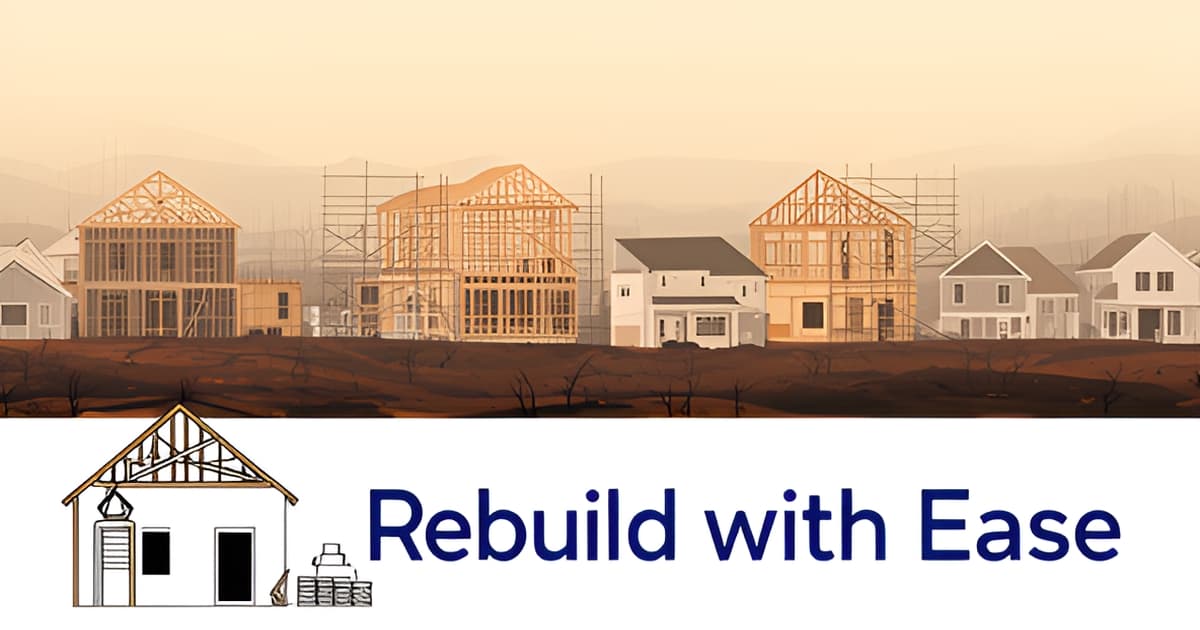
Altadena Rebuild Assistance Programs: Where Fire Survivors Turn First
Key Facts
- The Eaton Fire destroyed 9,413 structures and killed 19 people, making it California's second most destructive wildfire.
- Only 23 of nearly 6,000 significantly damaged Altadena properties had been fully rebuilt as of December 2025, per tracking data.
- Average Altadena insurance coverage of $607,000 falls more than $140,000 short of typical rebuild costs, research shows.
- 6 in 10 intact, remediated homes tested by Eaton Fire Residents United remained uninhabitable due to elevated lead or asbestos, according to Catalyst California.
- LA County's like-for-like rebuild pathway allows homes to grow by up to 10% or 200 square feet while staying exempt from current zoning, per the county FAQ.
- Qualifying fire survivors get fee waivers and 10-business-day initial permit reviews under the county's expedited pathway, the county confirms.
- Only 43% of significantly damaged property owners had applied for or received permits as of December 2025, tracking data shows.
The Rebuild Reality: Why So Few Altadena Homes Are Back
The numbers are sobering. The Eaton Fire destroyed 9,413 structures across 14,000 acres and killed 19 people, making it the second most destructive wildfire in California history — and more than 6,100 of those lost homes were in Altadena alone.
Nearly a year later, the rebuild math remains stark. As of December 2025, only 23 of nearly 6,000 significantly damaged residential properties had completed all rebuilding and repairs, and just 43% of owners had applied for or received permits, according to tracking data compiled by Catalyst California. A survivor advocacy group cited in May 2026 coverage put the rebuilt share at roughly 0.6% of damaged homes.
Three obstacles explain the gap.
Insurance is the biggest one. Average home insurance coverage in Altadena was $607,000, while rebuilding a 1,500-square-foot home at roughly $500 per square foot costs about $750,000 — a shortfall of $140,000 or more before temporary housing costs. A year after the fire, delays and denials at the insurance level remain the central frustration for survivors, even as mortgage forbearance and debris cleanup moved quickly.
Contamination is the second barrier. Debris removal must be completed before the county will issue a building permit, but clearing the lot is only the start. When Eaton Fire Residents United tested 50 intact, remediated homes, 6 in 10 remained uninhabitable due to elevated lead or asbestos — which is why county-run soil testing and professional site evaluation matter before anyone commits to a rebuild plan.
Permitting complexity is the third. LA County has built an expedited pathway — a like-for-like rebuild option, fee waivers approved in June 2025, and 10-business-day initial reviews — but navigating eligibility rules, foundation reuse testing, and zoning exemptions still requires careful sequencing. For hillside and slope lots in particular, understanding what the county requires before design begins can save months.
Knowing where to turn first changes the trajectory. The county's Altadena recovery portal consolidates the official starting points, and survivors who understand the sequence — insurance documentation, debris clearance, soil testing, permits — tend to move faster than those who improvise. At Altadena Custom Home Builder, we walk Eaton Fire survivors through that sequence in a free build consultation, so the first steps you take are the right ones.
- 9,413 structures destroyed; 19 lives lost across 14,000 acres
- Only 23 of nearly 6,000 significantly damaged properties fully rebuilt as of December 2025
- Average insurance coverage falls $140,000+ short of typical rebuild costs
- 6 in 10 tested, remediated homes still showed unsafe lead or asbestos levels
Start with the County: LA County's Altadena Recovery Portal and One-Stop Permit Centers
Rebuilding after the Eaton Fire starts with a phone number, a website, and a sequence most survivors learn the hard way. Before you pick a floor plan or a builder, LA County wants you at one of three doors — and the order you walk through them matters more than you'd expect.
The county's central hub is the Altadena Fire Recovery portal, which consolidates immediate and long-term recovery support in one place. It's the fastest way to reach the county's "express lane for rebuilding" and its step-by-step "Road to rebuilding" guide, plus state programs like the expanded CalAssist Mortgage Fund for mortgage payment relief.
The portal's physical counterpart is the One-Stop Permit Center, where the county consolidates its permitting agencies under one roof. Instead of driving between offices, you sit down with the LA County Fire Department, Regional Planning, Public Health, and Public Works Building and Safety in a single visit. Staff pull property-specific packets — permit records, assessor records, and property attributes — and Southern California Edison planners are available by appointment, per the county's recovery FAQ. Prefer face-to-face help? In-person assistance is available at the Altadena Community Center, 730 E. Altadena Dr., Monday through Friday, 9 AM to 5 PM.
The county has also built real incentives into the process: a "like-for-like" pathway that lets replacement structures exceed the original footprint by up to 10% or 200 square feet (whichever is greater), exempt from current zoning, with Regional Planning initial reviews promised in 10 business days and rechecks in 5.
The sequence that trips up most survivors:
- Debris removal must be complete before a building permit can be issued — no exceptions. Homeowners opting out of the government-assisted program need a Public Works debris removal permit (hotline: 844-347-3332).
- Applications for temporary housing and like-for-like rebuilds generally must be submitted within two years of the emergency declaration, though extensions are possible.
- Once issued, a building permit expires in 12 months if construction hasn't begun.
That last rule deserves attention. Only 43% of owners of significantly damaged properties had applied for or received permits as of December 2025, and just 23 of nearly 6,000 damaged residential properties had completed rebuilding, according to Catalyst California's tracking analysis. Permits that sit unused while designs stall are part of why.
The county is candid that no timeline fits everyone: weather, consultant availability, materials, and contractor capacity all stretch the process. At Altadena Custom Home Builder, we point every survivor to these official county resources first — the sequence above is the foundation any Eaton Fire rebuild, whether a like-for-like replacement or a ground-up custom home, must follow.
The Fast Track: Like-for-Like Rebuilds, Fee Waivers, and Expedited Review
For homeowners who qualify, LA County has built a genuinely fast lane through the permitting maze. The county's "like-for-like" rebuild pathway allows replacement structures to exceed the original floor area or footprint by up to 10% or 200 square feet (whichever is greater) while remaining exempt from the current Zoning Code — though the home must still meet current Building, Fire, and Health/Safety Codes, per the county's rebuild FAQ.
Speed is the second pillar. Regional Planning commits to an initial review of like-for-like projects within 10 business days, with rechecks in 5 business days — and every other permitting department follows the same 10/5 standard. The county's Altadena portal promotes this as an "express lane for rebuilding," and One-Stop Permit Centers put Regional Planning, Building and Safety, Fire, and Public Health under one roof.
The third pillar is money. On June 17, 2025, the Board of Supervisors unanimously approved a fee waiver for qualifying single-family rebuilds in unincorporated LA County. Eligibility is strict: the owner must have both owned AND lived in the property before January 7, 2025. Waived fees cover zoning review, building plan review and permits, Fire Department review, Public Health, addressing, and more — but not professional designer or builder costs, utilities, or school district fees.
- Building and Safety fees for non-qualifying owners run roughly $12,000 for a 1,500-sq-ft home and about $22,000 for a 3,000-sq-ft home
- Fire Department charges include $565 building plan review, $565 fire sprinkler plan review, and fuel modification reviews of $735–$845 depending on home size
- Regional Planning fees are $1,429 for like-for-like projects versus $1,623 for non-like-for-like rebuilds without a hearing
- Public Health onsite wastewater fees range from $447–$527 for like-for-like builds, jumping to $1,528–$1,986 otherwise
Two practical caveats shape the fast track. First, debris removal must be complete before a building permit can be issued, and permits expire after 12 months if construction hasn't begun. Second, foundation reuse is possible only after a licensed engineer or architect determines through testing that the foundation suffered minimal fire damage — and all under-slab electrical conductors must be replaced.
For many Eaton Fire survivors, the like-for-like pathway is the right starting point, but expansions beyond the 10%/200-sq-ft allowance, hillside lots, or foundation questions call for experienced design and construction guidance. At Altadena Custom Home Builder, we walk homeowners through these county programs during a free build consultation, and our featured builder, JMB Builders LLC (CSLB #1103479), brings documented Eaton Fire rebuild experience to projects across town.
ctaText: Planning an Eaton Fire rebuild? Get a free build consultation with an Altadena custom home specialist and map your like-for-like pathway, permits, and budget before you commit.
socialProofText: Our featured builder, JMB Builders LLC (CSLB #1103479), is an Altadena-based licensed general contractor with documented Eaton Fire rebuild work — see their projects at jmb-builders.com.
Closing the Money Gap: Insurance, State Assistance, and Nonprofit Support
For many Eaton Fire survivors, the hardest number isn't the fire's death toll — it's the gap between what insurance pays and what rebuilding actually costs. Average insurance coverage in Altadena was $607,000 in 2023, while rebuilding a 1,500-square-foot home at roughly $500 per square foot runs about $750,000 — a shortfall of more than $140,000 before temporary housing costs, according to research from Catalyst California.
That gap explains why insurance remains the central frustration a year after the fire. Assemblymember John Harabedian has acknowledged successes like mortgage forbearance and rapid debris cleanup, but notes that "we see delays and denials on the insurance level" and continued financial distress for survivors. LA County has responded on two fronts: it launched the L.A. Fire Survivor Insurance Survey at FireSurvey.org to document survivors' claims experiences, and it sued State Farm over its wildfire claims handling.
State assistance is expanding, though advocates say it doesn't go far enough. The expanded CalAssist Mortgage Fund provides mortgage payment relief, and the governor's office reports that 1,000 families have already received up to $100,000 in mortgage relief over 12 months. Gov. Newsom's latest budget proposes a $100 million fund for both mortgage help and "rebuilding assistance to unlock financing" — but survivors traveled to Sacramento asking for $300 million, and advocates like John Dobard criticize the proposal because it requires survivors to take on more debt.
Litigation may ultimately fund more rebuilds than any government program. While no official cause has been issued by state or county investigators, the U.S. Justice Department has blamed a Southern California Edison transmission line, and attorneys representing survivors are pressing for a settlement. "We are litigating to make sure that Edison comes up with a fair even-handed resolution," says Raffi Kassabian, an attorney and fire survivor.
One crucial point about nonprofit aid: most of it never flows directly to individuals. The Pasadena Community Foundation's Eaton Fire grants fund organizations — not households — across five areas including housing recovery, case management, and mental healthcare. Survivors access these services through community coalitions such as:
- Dena Rise UP!, a central recovery coalition partner
- The Eaton Fire Collaborative, coordinating survivor services
- Mutual aid networks within Altadena's Black, brown, and queer communities
If you're mapping how these funding sources fit together for your own rebuild, the team at Altadena Custom Home Builder offers a free build consultation to help you think through budget, financing gaps, and site conditions — no guarantees, just a clear-eyed look at what your lot and your numbers allow.
Your Rebuild Action Plan: Site Safety, Sequencing, and Next Steps
Rebuilding starts before the first blueprint. The county is blunt about sequencing: debris removal must be completed before a building permit can be issued, and once a permit is issued, it expires in 12 months if construction hasn't begun, according to the county's rebuild FAQ. Your action plan should follow that order.
Start with the ground itself. Even after debris removal, contamination can linger — Eaton Fire Residents United tested 50 intact, remediated homes and found that 6 in 10 remained uninhabitable due to elevated lead or asbestos. One survivor, Adrianna Bautista, tested her soil through a county program and found high lead levels, per May 2026 reporting. If you're keeping a foundation, remember it requires a licensed engineer or architect to confirm minimal fire damage through testing.
Your checklist, in order:
- Test soil for lead through the county's soil testing program before committing to a design.
- Confirm debris removal is complete — or secure a Public Works debris removal permit if you opted out of the government program.
- Pick up your property packet at the One-Stop Permit Center (permit records, assessor records, property attributes) at the Altadena Community Center, 730 E. Altadena Dr.
- Decide between a like-for-like rebuild — with its 10% or 200 sq ft expansion allowance and Zoning Code exemption — and a custom design that meets current Zoning Code.
- Evaluate financing before design work begins, given the documented gap between average coverage ($607,000) and rebuild cost (~$750,000 for 1,500 sq ft).
That last point matters most. Insurance shortfalls of $140,000 or more, plus temporary housing costs, mean financing decisions shape what you can build — not the other way around. The county also cautions that there's no one-size-fits-all timeline; weather, design consultant availability, materials, and contractor availability can all extend the process.
For survivors ready to scope a ground-up rebuild rather than a like-for-like replacement, Altadena Custom Home Builder offers a free build consultation to help you think through hillside lots, permits in LA County unincorporated areas, and sequencing — before you spend money on design work.
Frequently Asked Questions
How many Altadena homes have actually been rebuilt since the Eaton Fire?
What's the first step if I want to rebuild my burned Altadena home?
Will my insurance actually cover the cost of rebuilding?
What is the county's 'like-for-like' rebuild option and do I qualify for fee waivers?
Is my lot safe to rebuild on after debris removal?
Are there state or nonprofit programs that can help with rebuild costs?
The First Steps Matter Most: Turning Recovery Data Into a Rebuild Plan
Nearly a year after the Eaton Fire, the path back to Altadena runs through a clear sequence: start with LA County's recovery portal and One-Stop Permit Centers, confirm debris removal and soil safety, evaluate the like-for-like pathway and fee waivers, and confront the financing gap early — because with average coverage falling $140,000 or more short of rebuild costs, your budget shapes your design, not the other way around. The survivors who move fastest aren't the ones who improvise; they're the ones who understand what the county requires before spending a dollar on plans. Whether you're weighing a like-for-like replacement against a ground-up custom home, or facing a hillside lot with contamination questions, Altadena Custom Home Builder offers a free build consultation to help you sequence insurance documentation, testing, permits, and financing correctly from day one. No guarantees — just a clear-eyed look at what your lot and your numbers allow. Your first steps are the ones that set the pace for everything that follows. Take them with a plan.