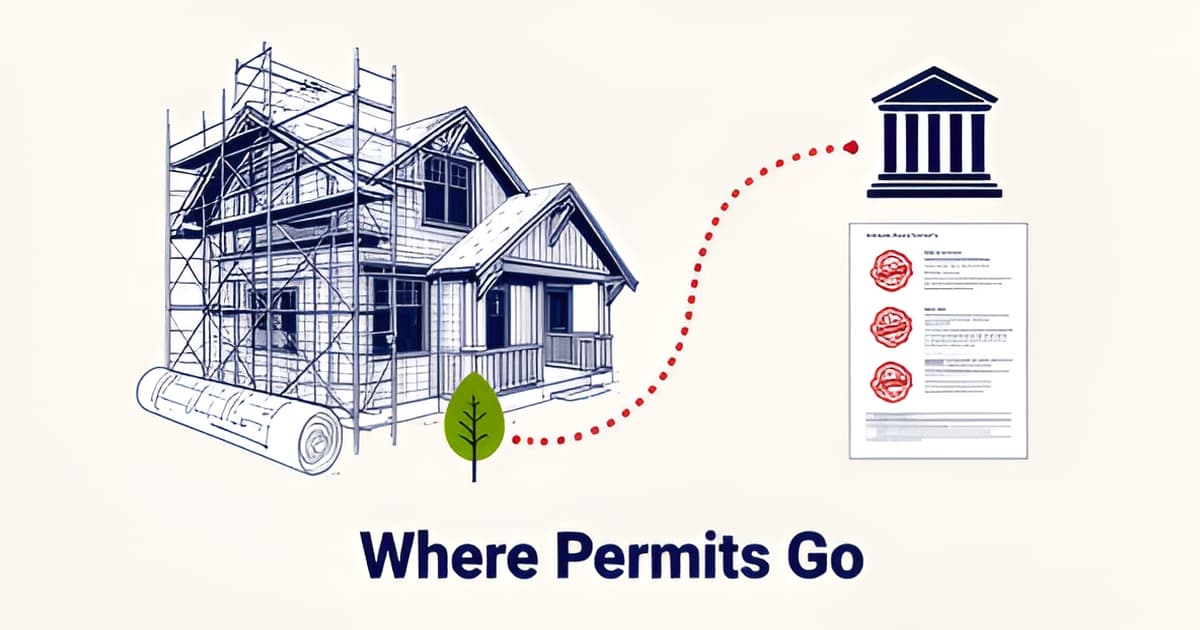
Altadena Building Department Guide: Where Altadena Permits Go
Key Facts
- Altadena is 100% unincorporated LA County territory, so every permit goes through County Public Works — never LADBS — according to practitioner guidance.
- Altadena permits follow County Code Title 22 (zoning) and Title 26 (building), so city-code plans get rejected at plan check, per permit research.
- Altadena uses EPIC-LA for all permit submissions; BSOP serves only Contract Cities, per LA County Public Works.
- Eaton Fire like-for-like rebuilds may grow floor area, height, or footprint by up to 10% or 200 square feet, whichever is greater, per County recovery guidance.
- Four County agencies — Planning, Building and Safety, Fire, and Public Health — review each Eaton Fire rebuild application, per official recovery guidance.
- Applications expire if no permit is issued within 12 months, and lapsed permits can cost up to 25% of the fee to extend, per County business services.
- Practitioner estimates put like-for-like Eaton Fire rebuilds at roughly 2–6 weeks with complete plans versus 10–20 weeks with changes, though the County publishes no official timelines.
Altadena Has No City Building Department — Why LADBS Assumptions Cost You
Every year, Altadena property owners lose weeks of design work to a single wrong assumption: that their building permits run through the Los Angeles Department of Building and Safety (LADBS). They don't. Altadena has never been an incorporated city — it is 100% unincorporated Los Angeles County territory, and every permit in town goes through LA County Public Works, Building and Safety Division, never a city agency.
The confusion is understandable. Altadena sits between Pasadena and Los Angeles proper, and most Angelenos deal with a city building department. But LA County contains 88 incorporated cities, and roughly 1 million County residents — including everyone in Altadena — live in unincorporated territory served by the County instead. If your architect prepares plans against city codes, the County plan checker will reject them, and the redesign starts the clock over.
Altadena permits follow County code, not city code. Zoning is governed by the LA County Department of Regional Planning under County Code Title 22, while building and safety falls under County Code Title 26. Altadena also has its own community standards district, which means Altadena-specific development standards get checked during zoning conformance review — standards a city-code plan set never accounts for.
The wrong-jurisdiction mistake shows up in several costly ways:
- Plans drafted to city requirements get redesigned to County Title 22 and Title 26 standards — wasted design fees and weeks of delay.
- Submittals go to the wrong portal. Altadena uses EPIC-LA, the County's system for unincorporated areas, while BSOP serves only Contract Cities, according to LA County Public Works.
- Permits must come from the Building and Safety District Office serving the project address — an LADBS approval carries no weight here.
- Altadena's Very High Fire Hazard Severity Zone triggers County Fire Department review with fire-resistive construction and defensible-space requirements that city-code plans often miss.
For Eaton Fire rebuilds, the stakes are higher. The County's expedited "like-for-like" pathway routes applications internally through LA County Planning, Building and Safety, Fire, and Public Health, per the official recovery guidance — a process that assumes County jurisdiction from the first submittal. City of LA, Pasadena, Malibu, and Sierra Madre fire survivors have separate recovery portals; Altadena residents must use the County process.
That's why confirming jurisdiction — city or unincorporated County — is the first verification step on any new rebuild or ground-up project, before design or plan-check work begins. At Altadena Custom Home Builder, we treat that check as non-negotiable, because a plan set that arrives complete and code-conforming on the first pass is what actually moves a project forward.
Who Actually Reviews Your Altadena Plans: The Four-Agency Stack
Getting a stamp from Building and Safety feels like the finish line, but in Altadena it's really just one lane in a four-agency relay. Because Altadena is entirely unincorporated LA County territory, your plans are routed through a stack of County departments — and each one reviews your project against a different body of law.
The stack breaks down like this:
- LA County Regional Planning — zoning conformance under County Code Title 22, including the Altadena Community Standards District's town-specific development standards
- Public Works Building and Safety — plan check under Title 26, plus the final Certificate of Occupancy issued by the Building Official
- LA County Fire — mandatory review, since Altadena sits in a Very High Fire Hazard Severity Zone with fire-resistive construction and defensible-space requirements
- Public Health — review applies whenever a septic system is part of the project
For Eaton Fire rebuilds, the County confirms this routing explicitly: applications are "internally routed for review with LA County Planning, Building and Safety, Fire, and Public Health," according to the County's official rebuild guidance. After the January 2025 fires, One-Stop Permit Centers physically co-located all four reviews into a single intake — but co-location doesn't mean fewer reviewers. It means four agencies still have to sign off, just under one roof.
This is where many rebuild and ground-up projects stall. A plan set that sails through Building and Safety can still bounce back over a Community Standards District setback, a Fire Department ignition-resistance detail, or a septic clearance. Practitioner reporting on the unincorporated County permit process puts it plainly: the determining factor in how fast a submittal moves isn't the office it walks into — it's whether the plan set arrives complete and code-conforming on the first pass, for every agency in the stack.
The practical takeaway: treat a Building and Safety approval as a milestone, not a permit. Your permit issues only when all four reviews clear, and even then the process continues through inspection to the Certificate of Occupancy. Anyone planning a custom home or rebuild in Altadena — our guide at Altadena Custom Home Builder covers this terrain in depth — should design to the full four-agency standard from day one, not discover the stack at plan check. If you're mapping out a project, a free build consultation is a good place to pressure-test your assumptions before they become correction cycles.
EPIC-LA: The Only Portal That Matters (and the 5-Step Process Behind It)
Once you've confirmed that Altadena's permits run through LA County rather than LADBS, everything funnels through one digital front door: EPIC-LA, the Electronic Permitting and Inspections portal for unincorporated areas. The County's process itself is straightforward on paper — five steps: Application, Plan Check, Permit, Inspection, and Completion, when the Building Official issues the Certificate of Occupancy (per County guidance). Navigating the portal is where most people need help.
Every EPIC-LA journey starts with a Base Application, which the system converts into the appropriate case type. Two details trip up newcomers:
- Your initial application receives an RPAP number — that's not your plan number. Once accepted, the case converts to an RPPL number, so searching by the wrong one returns nothing.
- Cases can be searched by project number, plan number, partial address, or Assessor's Parcel Number, and registration is required to submit, pay fees, and receive "plans filed" reports (LA County Planning).
- Technical support runs through [email protected], with planning staff available Monday–Thursday, 7:30am–5:30pm — no Friday service.
Speed depends heavily on how your project enters the system. Projects that can be plan-checked in 15 minutes or less may be reviewed over the counter during morning counter hours; everything else is "taken in" and reviewed in the order received, with turnaround varying by office volume. Not every permit needs plan check at all — a residential water heater replacement is issued upon application and fee payment.
Timing rules matter just as much as submission mechanics. An application expires if no permit is issued within 12 months, though the Building Official may grant two extensions upon written request. After issuance, a permit expires if work hasn't started within 12 months or lapses for more than 180 days — and expired permits require a new application and new fees, with an extension fee of up to 25% of the permit fee possible (County Business Services). Inspections must be requested at least 24 hours in advance, online via EPIC-LA for unincorporated areas.
One portal warning worth repeating: BSOP, the County's Building and Safety Online Plan Check System, serves Contract Cities only — don't burn time there. For Eaton Fire rebuilds, applications can be submitted at the County's dedicated rebuild link or in person at field offices, where they're internally routed to Planning, Building and Safety, Fire, and Public Health (LA County Recovery).
At Altadena Custom Home Builder, we manage EPIC-LA submissions for ground-up custom homes, tear-down rebuilds, and fire-rebuild projects — from Base Application through final inspection scheduling. If you'd rather not learn the RPAP-to-RPPL conversion the hard way, a free build consultation is a good place to start.
Eaton Fire Rebuilds: Like-for-Like vs. Full CSD Compliance
Rebuilding after the Eaton Fire starts with a single fork in the road: rebuild exactly what you had, or build something new. That choice determines which code regime applies, how many agencies review your plans, and how fast your permit moves.
LA County defines a like-for-like rebuild as a structure of the same size, location, and purpose as the fire-damaged structure — it may be smaller or have a different floor plan. The payoff: like-for-like rebuilds are exempt from current Zoning Code requirements, including the Altadena Community Standards District standards that would otherwise constrain your design.
That exemption has limits. Like-for-like structures must still comply with current Building, Fire, and Health and Safety Codes. And in the Eaton Fire area, modifications cannot increase floor area, size, height, or footprint by more than 10% or 200 square feet, whichever is greater — a slightly more generous cap than the Palisades Fire area's flat 10%.
Step outside like-for-like parameters — a bigger footprint, a second story that changes massing beyond the cap, a different use — and your rebuild falls under the Altadena Community Standards District. The County has softened some of these standards for fire rebuilds: CSD front-yard setback requirements don't apply, and the minimum front setback is 20 feet. Still, a non-like-for-like rebuild means fuller zoning conformance review on top of building, fire, and health review, which typically stretches timelines.
Practitioner estimates — not official County commitments — put like-for-like rebuilds through the One-Stop Permit Center at roughly 2–6 weeks with complete plans, versus 10–20 weeks for rebuilds with changes. The County publishes no official turnaround times, so treat these figures as directional only.
Before any rebuild permit is issued, site clearance must be complete: Phase 1 hazardous materials removal by the US EPA, and Phase 2 fire debris removal through the free US Army Corps of Engineers program or an approved contractor. Applications are accepted anytime, but permits wait on debris clearance.
Submission options for Eaton Fire rebuilds:
- Online via the County's rebuild-specific portal: https://bit.ly/RebuildEPIC
- In person at a field office via https://bit.ly/DRPRebuildApp
- Through the One-Stop Permit Centers, which co-locate Building and Safety, Regional Planning, Fire, and Public Health review in a single intake
Your application is internally routed to LA County Planning, Building and Safety, Fire, and Public Health — no separate agency visits required. Note that Altadena sits in a Very High Fire Hazard Severity Zone, so fire-resistive construction and defensible-space requirements apply regardless of pathway.
Deciding whether your design fits within the like-for-like envelope — or whether pushing past the 10%/200 sq ft cap is worth the added review — is a design and permitting tradeoff worth working through with a builder early. At Altadena Custom Home Builder, we help homeowners evaluate that fork before plans are drawn, and a free build consultation is the easiest way to start that conversation. JMB Builders LLC (CSLB #1103479), our featured Altadena-based builder, handles Eaton Fire rebuilds on both pathways. No timeline is guaranteed, but a complete, code-conforming first submittal remains the single biggest speed factor.
Getting to Yes Faster: Preparing a First-Pass-Complete Plan Set
Every week a plan set sits in correction cycles not because the project is difficult, but because it arrived incomplete or drawn against the wrong code. Permit expediters who work the County's One-Stop Permit Centers put it plainly: the determining factor in how fast a submittal moves is whether the plans arrive complete and code-conforming on the first pass.
That starts with jurisdiction. Confirming whether a property falls under a city or unincorporated County review is the first thing experienced teams verify — before any design work begins. In Altadena, that means preparing plans to County Code Title 22 (zoning) and Title 26 (building), submitting through EPIC-LA, and accounting for the Altadena Community Standards District plus Very High Fire Hazard Severity Zone requirements.
Once design is underway, your assigned land use planner becomes your most valuable contact. County guidance for fire rebuilds is explicit: check with your assigned land use planner for the most up-to-date information. Before finalizing a plan set, confirm:
- Whether your project qualifies as like-for-like — and if modifications stay within the 10% or 200-square-foot cap
- Which CSD requirements apply or are waived, including the 20-foot minimum front setback for non-like-for-like rebuilds
- That site clearance (Phase 1 and Phase 2 debris removal) is documented, since permits won't issue without it
- Which agencies your application will route through — Planning, Building and Safety, Fire, and Public Health if septic is involved
The payoff is real. Practitioner estimates suggest a like-for-like Eaton Fire rebuild with complete plans can move through the One-Stop process in roughly 2–6 weeks, while rebuilds with changes may take 10–20 weeks. These are general estimates, not County commitments — but the gap between them illustrates how much a clean first submittal matters.
At Altadena Custom Home Builder, we walk property owners through this preparation in a free build consultation — covering jurisdiction verification, like-for-like eligibility, and what a first-pass-complete plan set requires for your specific lot. For those who want professional execution, our featured builder is JMB Builders LLC (CSLB #1103479), an Altadena-based licensed general contractor whose custom home, ADU, and Eaton Fire rebuild work is documented at jmb-builders.com. This featured placement is paid and disclosed as such.
The fastest permit is the one that doesn't come back with corrections. Verify jurisdiction early, confirm the details with your planner, and submit once — completely.
Frequently Asked Questions
Does Altadena have its own building department, or do I use LADBS?
Which online portal do I use to submit plans for an Altadena project?
How long does an Eaton Fire rebuild permit take in Altadena?
Can I build something bigger than my original house under the like-for-like fire rebuild pathway?
Who actually reviews my plans — is Building and Safety approval enough?
What happens if my permit or application expires?
The Bottom Line for Altadena Permits: Get the Jurisdiction Right First
The single biggest lesson from this guide is simple: Altadena permits never touch LADBS. Every project in town runs through LA County Public Works, Building and Safety Division, under County Code Titles 22 and 26, submitted through EPIC-LA, and reviewed by a four-agency stack of Regional Planning, Building and Safety, Fire, and Public Health. For Eaton Fire rebuilds, the like-for-like pathway — with its 10% or 200-square-foot modification cap — offers the fastest route, with practitioner estimates of roughly 2–6 weeks for complete like-for-like submittals versus 10–20 weeks for rebuilds with changes. No timeline is guaranteed, but the pattern holds: the fastest permit is the one that doesn't come back with corrections. Before you spend a dollar on design, verify jurisdiction, confirm like-for-like eligibility with your assigned land use planner, and make sure site clearance is documented. At Altadena Custom Home Builder, we help homeowners pressure-test these decisions in a free build consultation — so your first submittal is your strongest one.