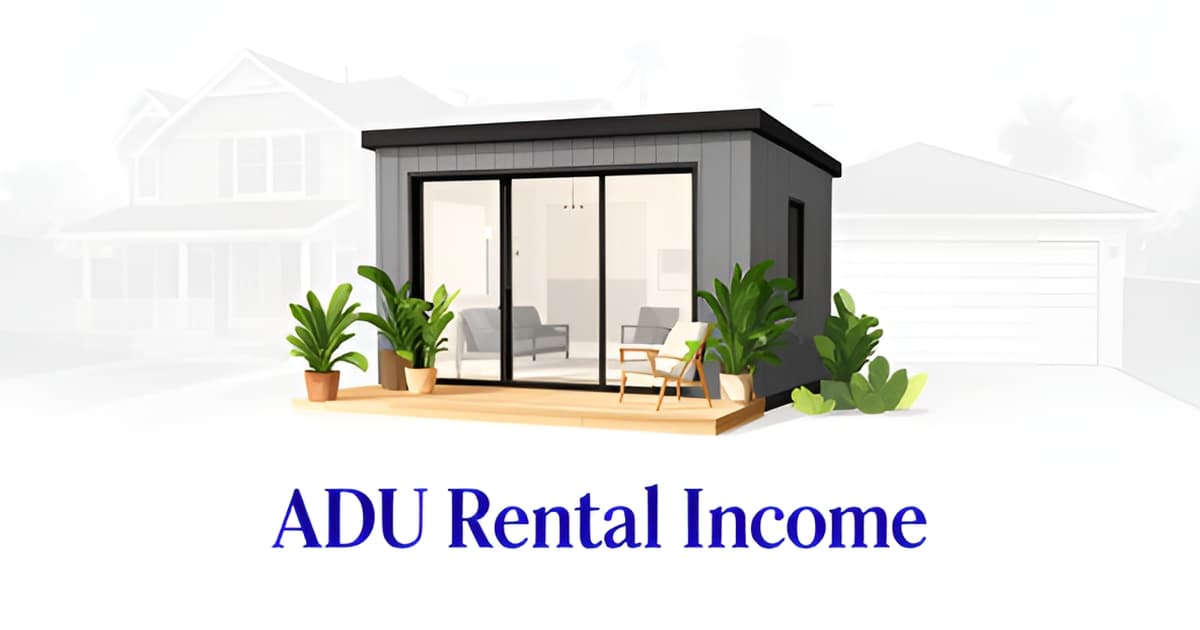
ADU Rental Income in Los Angeles: What an Altadena Backyard Unit Can Earn
Key Facts
- A well-designed 500 sq ft ADU can rent for nearly as much as a poorly designed 800 sq ft unit, per regional rental analysis.
- Furnished ADUs command 30–50% more rent than unfurnished units, according to ADU market research.
- Pasadena ADUs earn $1,900–$2,300 monthly for studios and $3,000–$3,800 for two-bedrooms, the closest benchmark to Altadena.
- California law requires ADU leases of 30 days or longer, making Airbnb-style income off-limits for most owners, per contractor analysis.
- Garage conversions pay back in 3.5–7 years, while new detached ADU builds take 7–12 years, per vendor ROI estimates.
- Illegal short-term rental advertising in LA draws fines of roughly $500 per day, CPI-indexed, per realtor guidance.
- Moving from a 500 sq ft one-bedroom to an 800 sq ft two-bedroom adds $575/month in rent but $45,000–$90,000 in build cost, per payback analysis.
The Realistic Income Picture for an Altadena ADU
Let's start with an honest caveat: no published rental dataset tracks Altadena ADUs specifically. Anyone quoting an exact "Altadena ADU rent" is guessing. The closest proxies are Pasadena — just down the hill, with similar character and demand — and LA County's HUD Fair Market Rent benchmarks.
Pasadena figures suggest a studio ADU earns roughly $1,900–$2,300 per month, while a two-bedroom can command $3,000–$3,800, according to a regional ADU rental guide. HUD's FY 2026 Fair Market Rents for LA County — which include utilities — sit at $2,079 for a studio, $2,328 for a one-bedroom, and $2,903 for a two-bedroom. One realtor blog advises treating those HUD numbers as floors-to-midpoints rather than ceilings, noting that a finished detached unit with a private entrance in a desirable pocket can out-earn the benchmark.
So what does that mean for a realistic Altadena income picture?
- Studio or converted garage space: roughly $1,800–$2,300 per month.
- One-bedroom detached unit: roughly $2,300–$3,000 per month.
- Two-bedroom unit: roughly $3,000–$3,800 per month, with premium finishes pushing higher.
Size isn't the whole story, though. Design quality moves the needle more than square footage — a well-designed 500 sq ft one-bedroom can rent for nearly as much as a poorly designed 800 sq ft unit. The amenities behind that premium are measurable: upgraded finishes add $200–$400 per month, in-unit laundry adds $150–$250, and a furnished unit commands 30–50% more than an unfurnished one. On a hillside lot where every build dollar counts — a reality Altadena homeowners know well, especially those working through Eaton Fire rebuild decisions — that design efficiency matters. It's a point we emphasize at Altadena Custom Home Builder when evaluating whether a larger footprint actually pays for itself.
One more expectation to set: don't count on Airbnb income. State law requires ADU leases of 30 days or longer, so these figures assume long-term tenancy, not short-term rental premiums. Budget for roughly 5% vacancy and $2,000–$4,000 in annual operating expenses as well.
If you're weighing an ADU as part of a rebuild or ground-up project, a free build consultation can help you model how these rent ranges stack against construction costs on your specific lot. Featured builder JMB Builders LLC (CSLB #1103479) builds ADUs and custom homes in Altadena, and its work is documented at jmb-builders.com.
The Airbnb Assumption You Need to Forget
Many backyard-unit calculators quietly assume Airbnb-style nightly rates in their income projections. That assumption falls apart the moment you read California's ADU rules — and building your Altadena budget around it is one of the fastest ways to break your pro forma.
State law requires ADU leases of 30 days or longer, which takes Airbnb-style income off the table for most owners entirely, according to contractor analysis of LA's ADU market. Los Angeles goes further: it allows short-term rentals only of a homeowner's primary residence, capped at 120 days per year, and ADUs permitted after 2020 may carry deed restrictions prohibiting short-term rentals outright, per a breakdown of California's ADU STR rules.
The exceptions are narrow enough to plan around:
- The ADU itself is your registered primary residence — meaning you live in the backyard unit and rent the main house, or vice versa, but never both at once.
- Your ADU permit was filed before January 1, 2017, predating the current restrictions, per realtor guidance on LA rental rules.
- You register for home-sharing and stay within the 120-day annual cap — an option that costs $89 per year in registration fees.
For most homeowners, none of those apply. And the enforcement math is ugly: advertising an illegal short-term rental in LA draws fines of roughly $500 per day, CPI-indexed. A single bad month can erase a year of premium pricing.
Here's the part that surprises people: long-term rental often wins on the numbers anyway. LA County ADU rents run roughly $1,800 to $4,800 per month depending on size, with Pasadena — the closest benchmark to Altadena — showing studios at $1,900–$2,300 and two-bedrooms at $3,000–$3,800. A steady tenant paying $2,328 (the HUD FY 2026 one-bedroom fair market rent) with a ~5% vacancy rate beats nightly-rate roulette after cleaning fees, platform commissions, and turnover costs.
The consistency argument matters even more on Altadena's hillside lots, where new detached builds sit at the top of the $180K–$420K cost range and pay back over 7–12 years. A 30-plus-day lease protects that timeline. As one contractor puts it: can you Airbnb your ADU? Maybe. Should you? In most cases, long-term rental provides better, more consistent returns with fewer headaches.
If you're planning a backyard unit as part of an Eaton Fire rebuild or a custom-home project, Altadena Custom Home Builder can help you model the income scenario that actually survives a permit review — book a free build consultation to run the numbers on your lot.
Payback Math: Garage Conversion vs. New Detached Build
Two homeowners on the same Altadena street can build nearly identical ADUs and end up with payback periods five years apart. The difference isn't the floor plan — it's the build path they choose and how they finance it.
Garage conversions are the fast lane. Converting an existing garage typically runs $100,000–$200,000, and because the slab, walls, and roof already exist, the unit reaches gross-rent payback in roughly 3.5–7 years against the HUD one-bedroom Fair Market Rent of $2,328/month. That's the fastest route to positive cash flow on an Altadena lot, and for many hillside properties it's the only route that avoids expensive new grading and foundation work.
New detached construction tells a different story. Vendor estimates put all-in costs at $180K–$420K — or $380–$550 per square foot — with permit and utility fees adding $8,000–$18,000 on top. Payback stretches to 7–12 years, with cash-on-cash returns of 5–10%. The trade-off: a purpose-built detached unit can command higher rent through design choices that conversions can't always accommodate.
Where your lot sits on that cost spectrum matters enormously in Altadena. Hillside and slope lots — a defining feature of the town's architecture — and fire-zone parcels sit at the top of the range, since access, grading, and fire-hardening requirements all add cost. A flat-lot garage conversion and a canyon detached build are not playing the same financial game.
Bigger isn't automatically better, either. Moving from a 500 sq ft one-bedroom to an 800 sq ft two-bedroom adds roughly $575/month in rent but $45,000–$90,000 in build cost. Contractors note that two-bedrooms make sense when the layout suits the household or the lot, not as a pure income play.
The single biggest swing factor, though, is financing. As one contractor analysis puts it, "interest changes the picture more than any other line." A cash build at $150,000 and a financed build of the same unit produce completely different timelines to breakeven.
Quick comparison of the two paths:
- Garage conversion: $100K–$200K, 3.5–7 year payback — fastest return, existing structure does the heavy lifting
- New detached build: $180K–$420K, 7–12 year payback — more design freedom, higher ceiling on rent
- Altadena hillside/fire-zone lots: expect the top of either range once grading and fire-hardening enter the picture
Figuring out which path your specific lot supports — and what it will actually cost — is exactly the kind of question Altadena Custom Home Builder walks homeowners through in a free build consultation, whether you're adding a rental unit or planning an Eaton Fire rebuild.
Design and Amenity Choices That Raise the Rent
The same 500-square-foot footprint can earn wildly different rents depending on the choices you make before the first nail is driven. Design quality is one of the biggest levers in ADU income — a well-designed 500 sq ft one-bedroom can rent for nearly as much as a poorly designed 800 sq ft unit, according to ADU rental market analysis.
The upgrades that consistently pay for themselves are the ones tenants can see and use every day:
- In-unit laundry: adds roughly $150–$250/month in rent
- Upgraded finishes: adds $200–$400/month
- Dedicated parking: adds $100–$200/month
- Furnishing the unit: commands 30–50% more than unfurnished
Stack those together and the math shifts fast. A unit that would rent at $2,300 unfurnished and basic can plausibly clear $3,000 or more with laundry, quality finishes, and furniture — all without adding a single square foot of construction cost.
The size decision is where most Altadena homeowners overreach. Jumping from a 500 sq ft one-bedroom to an 800 sq ft two-bedroom adds roughly $575/month in rent but $45,000–$90,000 in build cost, per contractor payback analysis. As one analysis puts it, two-bedrooms make sense when they suit the household or the lot — not as a pure income play. On Altadena's hillside lots, where site work already pushes costs toward the top of the range, that premium is even harder to justify.
Tenant targeting matters as much as square footage. Market the unit around proximity to demand drivers — traveling nurses near hospitals, graduate students and faculty near universities, and remote workers who want a private entrance and real laundry. Furnished units in particular attract these flexible, higher-income renters who arrive without a moving truck and pay a premium for turnkey.
This is also where design-build guidance earns its keep. Altadena Custom Home Builder sees the biggest yield differences come not from size but from layout discipline: a private entrance, generous natural light, and storage that makes a small unit live large. JMB Builders LLC (CSLB #1103479), the featured builder behind this guide, designs ADUs with these rent-driving details from day one — and a free build consultation is the simplest way to pressure-test which upgrades fit your lot and budget before you commit to a floor plan.
Renting Legally in Unincorporated LA County
A backyard unit only earns money if it rents legally — and in unincorporated Altadena, the rules that apply are not always the ones Los Angeles bloggers describe. Here is what the compliance picture actually looks like.
Four gates govern legal ADU rentals in the LA area, according to realtor guidance: a permitted unit with a certificate of occupancy, a rent-cap status determination, annual registration, and leases of 30 days or longer. State law requires ADU leases longer than 30 days, which takes Airbnb-style income off the table for most owners, as contractor analysis confirms.
The rent-cap question matters most for long-term yield. Under AB 1482, annual increases are capped at 8.7% starting August 1, 2026, while properties under LA's Rent Stabilization Ordinance face a flat 3% cap. There is also a trap worth knowing: adding a second unit to a pre-1978 parcel can pull the main house into rent stabilization if it is ever rented, since the single-family exemption dies with two units on the lot.
One caution for Altadena specifically: most published guidance describes City of LA ordinances — LAHD registration fees, RSO caps, home-sharing rules — and Altadena sits in unincorporated LA County, where those city ordinances may not apply directly. Verify current rental and registration requirements with LA County before listing the unit.
Before you pour a foundation, run this quick gate-check:
- Confirm the unit will be fully permitted with a certificate of occupancy issued by LA County
- Determine rent-cap status — AB 1482, rent stabilization, or exempt — before setting the initial rent
- Budget for annual registration and understand 30+ day lease requirements
- Check whether a deed restriction or recorded agreement affects short-term use
- Price against Pasadena benchmarks — roughly $1,900–$2,300 for studios and $3,000–$3,800 for two-bedrooms — since no Altadena-specific data exists
The stakes are real: rent overcharges can trigger full repayment plus attorney's fees and up to triple damages if willful. Getting the compliance picture right before construction is far cheaper than untangling it after a tenant moves in.
If you are weighing an ADU alongside a custom home or Eaton Fire rebuild on an Altadena lot, a free build consultation with Altadena Custom Home Builder can help you map permits, rent-cap exposure, and realistic income in one conversation.
Frequently Asked Questions
How much rent can an ADU in Altadena actually earn per month?
Can I list my Altadena ADU on Airbnb to make more money?
Is it better to convert my garage or build a new detached ADU?
Which upgrades actually increase ADU rent the most?
Is building a bigger two-bedroom ADU worth the extra cost?
What legal requirements apply to renting out an ADU in Altadena?
The Numbers Are Yours to Run
An Altadena backyard unit can realistically earn $1,800–$3,800 a month depending on size and design — but only if you build the right unit for your lot, rent it long-term, and stay clear of the compliance traps. The biggest takeaways: skip the Airbnb fantasy, favor design quality over square footage, weigh a garage conversion's 3.5–7 year payback against a detached build's 7–12, and verify rent-cap status before setting your asking rent. Every one of those decisions depends on what your specific parcel allows — a hillside slope, a fire-zone rebuild, or a flat lot with an existing garage will each point to a different answer. That's exactly the kind of question a free build consultation with Altadena Custom Home Builder is designed to resolve: mapping permits, realistic rent scenarios, and construction costs in one conversation. Featured builder JMB Builders LLC (CSLB #1103479) brings the same lot-specific thinking to ADU design, with rent-driving details like private entrances and in-unit laundry planned from day one. Before you commit to a floor plan, pressure-test the income math against your actual lot — the vendor ROI estimates are a starting point, but your property deserves better than a generic calculator.