ADU Permit Process in California: From Plans to Final Inspection
Key Facts
- California ADU permitting surged 15,334% between 2016 and 2022 after by-right reforms took effect.
- LA County has approved more than 126,000 ADUs since 2018, making it the state's ADU epicenter.
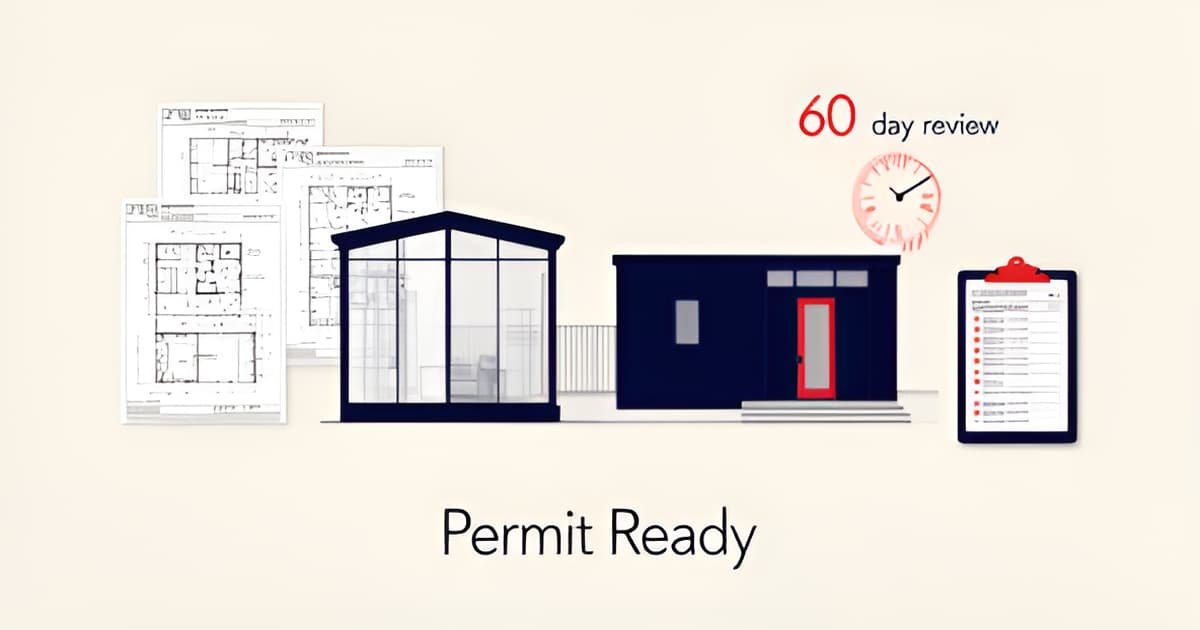
- The 60-day ADU review clock only starts once your application is deemed complete, per practitioner guidance.
- Realistic ADU timelines run 3–12 months from design to approval, not the statutory 60 days.
- Preapproved ADU plans, mandated since 2025, can cut review time in half.
- California properties with ADUs hit a median value of $1,064,000 in 2023 versus $715,000 without one.
- Modular ADUs hold a 57% market share and finish in 3–4 months versus 7–15 for traditional builds.
Why ADU Permitting Changed — and What It Means for Altadena Homeowners
If you're planning an ADU on a property in Altadena or anywhere in LA County's unincorporated areas, you've likely discovered that "easy permitting" and "confusing process" can both be true at once. The law is now firmly on your side — but translating that law into an approved permit still takes real work.
The turning point came with a wave of state legislation. Bills including SB 1069, AB 68, AB 881, and SB 13 made ADU approvals ministerial, or "by-right" — meaning local agencies must approve qualifying projects rather than leaving them to discretionary review — while capping parking requirements and fees, according to permit-data analysis. Later legislation eliminated minimum lot sizes, removed impact fees for smaller ADUs, and rolled back owner-occupancy mandates.
The result was explosive growth. Los Angeles saw ADU permits surge by a factor of 30 after the reforms, with ADUs reaching one-fifth of all housing permits by 2018. Statewide, ADU permitting rose 15,334% between 2016 and 2022, per a California YIMBY retrospective — and by 2022, nearly one in five new housing units in California was an ADU.
LA County sits at the center of it all, with more than 126,000 ADUs approved since 2018, according to industry market data. That volume matters for Altadena homeowners in a practical way: county reviewers handle these applications constantly, and the rules they apply are heavily standardized by state law.
But standardized doesn't mean simple — especially on hillside and slope lots like many in Altadena. Here's where the gap between law and practice shows up:
- State law requires a 60-day review of complete ADU applications — but the clock only starts once the county deems your application complete.
- Incomplete applications are the number-one cause of permit delays, triggering correction cycles that push timelines back significantly.
- Realistic end-to-end timelines run 3–12 months from design to approval, depending on complexity.
- Hillside lots, grading, and utility trenching are among the factors that extend timelines beyond the statutory minimum.
The takeaway for Altadena homeowners: the law guarantees a faster path than existed before 2017, but it doesn't guarantee speed if your submittal isn't airtight. Assembling the full document package — site plans, floor plans, elevations, structural calculations, and energy compliance forms — before you submit is the single most effective way to keep the 60-day clock running from day one. At Altadena Custom Home Builder, we walk homeowners through this landscape regularly, particularly on hillside lots where standard ADU rules meet additional slope and grading considerations.
One more shift worth knowing: California has required jurisdictions to offer preapproved ADU plans since 2025. These plans eliminate discretionary review components and can cut review time substantially — some jurisdictions target 30-day approvals. For homeowners who want speed over customization, that's a meaningful option.
If you're weighing an ADU alongside a ground-up rebuild, a tear-down, or an Eaton Fire rebuild project, a free build consultation with Altadena Custom Home Builder can help you map how the ADU fits your broader plans. Our featured builder, JMB Builders LLC (CSLB #1103479), builds custom homes, ADUs, and whole-home remodels in Altadena, including fire rebuilds. We can't promise timelines — no one honestly can — but we can help you understand what your specific lot will demand.
The Real Timeline: The 60-Day Rule and the 'Complete Application' Trap
Sixty days sounds like a promise. In practice, it's a starting gun that only fires when the planning department says it fires — and for Altadena homeowners, that distinction can cost months.
California law requires local agencies to review ADU applications within 60 days, but practitioner guidance is blunt about the catch: the clock starts only once your application is deemed "complete." Submit a package with missing structural calculations or incomplete energy forms, and the jurisdiction can return it, you revise, resubmit — and the 60 days begin again from zero. Incomplete applications are the single leading cause of permit delays nationwide.
That's why realistic expectations matter more than statutory language. The same timeline research puts the true end-to-end process — from initial design to approval — at 3 to 12 months, depending on location and project complexity. Anyone planning around a two-month approval is budgeting for a timeline that essentially never materializes.
The complete-application package is the single biggest lever you control. Before submitting to LA County for an unincorporated Altadena parcel, assemble everything at once:
- Site plans showing setbacks, access, and utility connections
- Floor plans and exterior elevations
- Structural calculations, stamped by a licensed engineer
- Energy compliance (Title 24) forms
- Any grading or drainage documentation the lot requires
That last item is where Altadena diverges from the flat-lot suburbs. Hillside and slope lots add complexity drivers — grading, retaining structures, and utility trenching — that extend plan check well beyond what a standard infill ADU requires. A Pew study found that heavily regulated jurisdictions take roughly 2½ times longer to approve projects than less regulated ones, and hillside review is where that friction concentrates. Preapproved ADU plans, which California has mandated since 2025, can cut review time in half — though a slope lot's grading and foundation conditions still get case-by-case scrutiny.
One honest caveat: the procedural specifics for unincorporated LA County — departmental routing, correction cycles, inspection scheduling — aren't documented in the statewide sources above. Confirm current requirements directly with official LA County planning and building sources before submitting. Altadena Custom Home Builder advises homeowners to treat the 60-day rule as a floor, not a forecast, and a free build consultation can help you map which complexity drivers apply to your lot before you spend a dollar on plans.
The Fastest Path: Preapproved Plans and Smart Sequencing
If the standard ADU permit path feels like a maze, California has quietly built an express lane. Since 2025, state law has required local jurisdictions to offer preapproved ADU plans — designs that clear plan review before you ever apply, like "TSA PreCheck for 'frequent flyer' buildings," as one researcher put it.
The payoff is measurable. Because preapproved plans eliminate the case-by-case and discretionary components of plan review, using one can cut review time in half, with some jurisdictions targeting 30-day approval. And because these plans undergo the same safety scrutiny as custom designs, you're not trading quality for speed. A Pew report also notes preapproved plans can trim builder development costs by roughly 1%–2%.
Even with a preapproved plan, though, the 60-day statutory review clock only starts once your application is deemed "complete" — and incomplete applications are the single biggest cause of permit delays. The fix is sequencing, not luck:
- Assemble the full document package upfront: site plans, floor plans, elevations, structural calculations, and energy compliance forms.
- Consult planning officials early to clarify setbacks, height limits, and utility connections before finalizing drawings.
- Hire a contractor with local experience who knows your jurisdiction's correction cycles and inspection expectations.
- Account for complexity drivers — hillside lots, grading, and utility trenching all extend timelines beyond the statutory minimum.
That last point matters in Altadena, where hillside and slope lots are common and LA County unincorporated requirements can differ from neighboring cities. Realistic end-to-end timelines still run 3–12 months from design to approval, so treat the 60-day rule as a floor, not a promise — and verify specifics directly with LA County Building and Safety.
Your construction method can also reshape the back end of the process. Modular ADUs, which hold a reported 57% market share and finish in 3–4 months versus 7–15 for traditional builds, often arrive with factory-integrated MEP systems that eliminate rough-in inspections in many jurisdictions, according to industry data — collapsing several site visits into fewer, faster milestones.
For Altadena homeowners weighing a preapproved plan against a fully custom design, the right choice depends on your lot, your goals, and the architectural character of the neighborhood. Altadena Custom Home Builder offers a free build consultation to walk through those trade-offs — from SB 9 lot splits to Eaton Fire rebuild considerations — with no permit or timeline guarantees, just a clear-eyed look at your options. Featured builder JMB Builders LLC (CSLB #1103479), an Altadena-based licensed general contractor, brings local ADU and rebuild experience to those conversations.
From Permit to Final Inspection: What Happens After Approval
Getting the permit in hand is a milestone, but the real test of your ADU project is what happens next: a sequence of construction-phase inspections that ends only when the building official signs off on final. Here's how that sequence typically unfolds.
Once plans are approved, the jurisdiction issues the permit and your contractor can begin scheduling inspections at each construction milestone. The standard sequence for a site-built ADU looks like this:
- Foundation inspection — verifying footings, reinforcement, and grading before concrete is poured
- Framing inspection — confirming structural elements match the approved plans
- Rough-in MEP inspection — checking mechanical, electrical, and plumbing before walls close
- Insulation inspection — verifying energy compliance before drywall
- Final inspection — the sign-off that authorizes occupancy
Each inspection must generally pass before work proceeds, and failed inspections trigger re-inspection cycles that extend the timeline. That's one reason realistic end-to-end timelines run 3–12 months from design to approval, with construction on top of that. Complexity drivers like hillside lots, grading, and utility trenching — common on Altadena's slope properties — stretch schedules further.
Construction method can change the sequence itself. Modular ADUs, which now hold a 57% market share and build in 3–4 months versus 7–15 months for traditional construction, often arrive with factory-integrated MEP systems. In many jurisdictions, that eliminates the rough-in inspection entirely, since the electrical and plumbing were completed and vetted under factory conditions before delivery.
The payoff for navigating all of this is substantial. According to FHFA appraisal data, California properties with ADUs reached a median appraised value of $1,064,000 in 2023, versus $715,000 for properties without — and they appreciated faster, at 9.34% annually compared to 7.65%. In a county that has approved more than 126,000 ADUs since 2018, that final inspection sign-off is more than paperwork; it's the moment your property joins a demonstrably stronger tier of the market.
For Altadena homeowners weighing an ADU alongside a custom home or rebuild project, a free build consultation with Altadena Custom Home Builder can help you map the inspection sequence to your lot and construction method before you commit to a timeline.
Planning Your Altadena ADU: Next Steps
Permits follow rules, but your lot follows gravity — and in Altadena, the hillside usually wins the argument about your ADU timeline. If you're planning a unit on a slope lot, expect the process to run longer than the flat-lot average, because grading, foundation engineering, and utility trenching all add review complexity that practitioner guidance identifies as primary timeline drivers.
Altadena sits in unincorporated Los Angeles County, which means your ADU application routes through the LA County Department of Regional Planning and Public Works rather than a city building department. That matters because no statewide source documents the exact unincorporated-area sequence — departmental routing, plan-check correction cycles, and inspection scheduling are all jurisdiction-specific. Confirm current requirements directly with LA County before you commit to a design.
The stakes are real either way. LA County has approved more than 126,000 ADUs since 2018, making it the state's ADU epicenter, according to market data on ADU permitting. And the payoff is measurable: FHFA appraisal data shows California properties with ADUs reached a median appraised value of $1,064,000 in 2023, versus $715,000 without.
For Eaton Fire rebuild households, a few planning priorities stand out:
- Confirm whether your rebuild and ADU can be reviewed together, or whether sequencing them separately changes your timeline.
- Verify hillside and slope-lot requirements — grading, drainage, and foundation standards — with LA County before finalizing plans.
- Ask the county about preapproved ADU plans, which California has mandated since 2025 and which can cut review time in half, per Pew research on preapproved plans.
- Assemble the complete document package — site plans, elevations, structural calculations, energy forms — before submitting, since incomplete applications are the leading cause of delay.
Altadena Custom Home Builder helps homeowners think through these decisions — hillside constraints, rebuild sequencing, and what LA County unincorporated permitting realistically demands. We don't guarantee permit outcomes or timelines, and no honest guide should. What we do offer is a free build consultation: an expert-guided planning conversation about your lot, your goals, and the path that fits your property. If you'd like a grounded second opinion before you file anything, that's a good place to start.
Frequently Asked Questions
How long does it really take to get an ADU permit in California?
What documents do I need to submit with my ADU permit application?
Do preapproved ADU plans actually speed up permitting?
Will my hillside lot in Altadena make ADU permitting take longer?
What inspections happen after my ADU permit is approved?
Is adding an ADU actually worth it for my property value?
From Stamp to Sign-Off: Your ADU Journey Starts With a Complete Package
The ADU permit process in California is now firmly on your side — but the law guarantees a path, not a pace. The 60-day review clock only starts when LA County deems your application complete, and incomplete packages are the number-one cause of delay. Assemble everything upfront: site plans, elevations, stamped structural calculations, and Title 24 forms. Consider a preapproved plan, which can cut review time in half, and remember that Altadena's hillside lots add grading and trenching complexity that extends realistic timelines to 3–12 months. The payoff is real: California properties with ADUs reached a median appraised value of $1,064,000 in 2023 versus $715,000 without, per FHFA appraisal data. Your next steps: confirm current requirements with LA County Building and Safety, evaluate whether your lot demands a custom design or a preapproved plan, and sequence any rebuild decisions carefully. Altadena Custom Home Builder offers a free build consultation to map what your specific lot — hillside or flat — will realistically demand before you spend a dollar on plans.