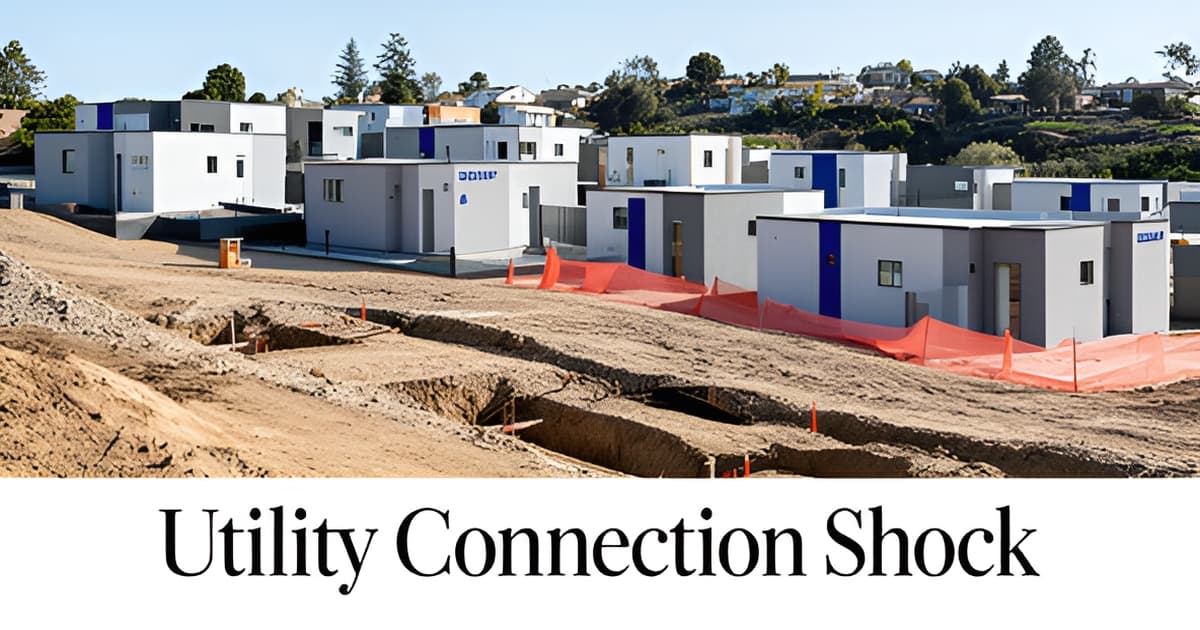
ADU Construction in Altadena: Utility Connections That Blow Up Budgets
Key Facts
- Utility trenching to a detached ADU can add $15,000–$30,000, and many homeowners don't discover it until permitting, according to industry cost analysis.
- A 500 sq ft ADU can hit $350/sq ft versus $275/sq ft for an 800 sq ft unit because fixed utility and infrastructure costs punish smaller builds, per detailed cost research.
- Slope and access challenges on hillside lots like Altadena's add $5,000–$15,000 to a typical ADU project before a single pipe is laid, per regional benchmarks.
- One builder's 'basic utility hookup' became an $8,500 electrical overhaul, and another project required a full septic replacement at roughly $20,000, according to builder case reports.
- Under California's SB 1117, ADUs of 750 square feet or less carry no impact fee at all, and JADUs of 500 square feet or less are likewise exempt, per the bill text.
- SB 1117 bars agencies from treating most ADUs as new residential uses for water and sewer connection fees, blocking separate-meter demands that can run $10,500–$30,000 elsewhere, under the statute.
- Sizing an ADU at 740 versus 800 square feet could save or cost you $10,000 or more in fees, per cost analyses.
The Hidden Utility Costs That Wreck ADU Budgets
The per-square-foot number your ADU calculator quoted is real — it just isn't the whole story. According to detailed cost analyses, utility trenching to a detached unit at the far end of a property can add $15,000–$30,000 on its own, and many homeowners don't discover the requirement until the permitting phase.
Site work is the least predictable expense category in ADU construction. Trenching distance is a major driver: an 80-foot run to the main sewer line versus a 20-foot run multiplies trenching, pipe, and labor costs. On Altadena's hillside lots, slope and access issues alone can add $5,000–$15,000 before a single pipe is laid.
Separate meters are another trap. Some utilities increasingly require them for new-construction ADUs — San Diego's SDG&E charges roughly $10,500 for a separate electric meter, while Austin Water's separate water meter can hit $30,000. Panel upgrades to power the new unit run $4,000–$12,000, per builder case reports.
Here's what the benchmark numbers look like:
- Utility trenching to a detached ADU: $15,000–$30,000
- Electrical panel upgrade: $4,000–$12,000
- Water service upgrade: $3,000–$8,000
- Gas line extension: $2,500–$7,000
These are fixed costs, and fixed costs punish smaller units. A 500 sq ft ADU can hit $350/sq ft versus $275/sq ft for an 800 sq ft unit, because every ADU needs a kitchen, bathroom, utility connections, foundation, and permits regardless of size. One builder's client watched a "basic utility hookup" become an $8,500 electrical overhaul — the kind of surprise that a utility survey before design is finalized would have caught.
The good news for Altadena homeowners: California law is shifting this risk. Under SB 1117, most ADUs can no longer be treated as new residential uses for water and sewer connection fees, and any permitted fee is capped at the reasonable cost of providing the service. We'll cover those protections — and how to use them — further in this guide.
Why Altadena Hillside Lots Make It Worse
Altadena's terrain doesn't just shape what your ADU looks like — it shapes what it costs to connect. On a flat lot, a straightforward trench to the main house might be a minor line item. On a hillside lot above Lake Avenue or up in the Chaney Trail area, the same connection becomes a major construction project.
Site conditions are, according to industry research on ADU costs, the least predictable expense category in ADU construction — and Altadena's slope lots stack several of those unpredictable categories at once:
- Slope and access challenges add $5,000–$15,000 to a typical project, driven by equipment access, grading, and staging constraints.
- Specialized foundations for expansive clay soils or seismic zones add another $5,000–$15,000 or more.
- Large specimen tree removal runs $2,000–$4,000 per tree — a real consideration on Altadena's mature, oak-dotted lots.
These numbers compound rather than add neatly. A sloped lot often requires the deeper foundation, which triggers more excavation, which may bring the tree removal question into play. Builders report how quickly surprises escalate: one client's "basic utility hookup" turned into an $8,500 electrical overhaul, and another required a full septic replacement at roughly $20,000, according to builder reporting on ADU infrastructure. On a hillside lot, where trenching runs are longer and access is harder, those same discoveries tend to cost more to fix.
One honest caveat: no published Altadena-specific or LADWP-specific utility connection fee data exists in our research. The figures above are regional benchmarks drawn from broader studies, not local quotes. Your actual costs will depend on your lot's specific slope, soil, distance to existing lines, and whether your property is served by municipal sewer or an on-site system.
That uncertainty is exactly why our guide at Altadena Custom Home Builder emphasizes front-loading the investigation. The most effective step a hillside homeowner can take is a comprehensive utility survey before design is finalized — one builder caught a major water line running under a planned ADU foundation before construction began, simply by looking underground first. On slope lots, where every surprise costs more to unwind, knowing what's buried before you dig is worth more than any other dollar you'll spend on the project. If you're weighing an ADU on a hillside or fire-rebuild lot, a free build consultation can help you map those unknowns early.
New California Laws That Shift the Risk Off Homeowners
For years, the utility connection was the part of an ADU budget no law protected. Two new California statutes have changed that, and Altadena homeowners planning a detached unit — whether alongside a custom build or an Eaton Fire rebuild — now have statutory leverage they didn't have before.
SB 1117, chaptered September 29, 2026, is the bigger of the two. Under the bill text, an ADU or JADU "shall not be considered by a local agency, special district, or water corporation to be a new residential use" for calculating water and sewer connection fees or capacity charges — unless the ADU was built alongside a new single-family dwelling. That single provision removes the legal basis agencies used to charge ADUs as if they were brand-new houses.
The statute goes further in three ways:
- Any permitted connection fee must be based on square footage or drainage fixture unit (DFU) values per the Uniform Plumbing Code, and "shall not exceed the reasonable cost of providing this service."
- ADUs of 750 square feet or less carry no impact fee at all, and JADUs of 500 square feet or less are likewise exempt.
- Agencies cannot require a new or separate utility connection for many ADUs — closing off the separate-meter demands that elsewhere can run $10,500 for a second electric meter in San Diego or roughly $30,000 for a water meter in Austin.
The second change eliminates what advocates called the 750-square-foot fee cliff. Previously, an ADU over 750 square feet could be hit with full impact fees on its entire square footage — including the first 750 feet that were supposed to be exempt. SB 1117 replaces that with a marginal structure: for up to two ADUs per lot, fees are charged proportionally only on the area above 750 square feet. Brian Hanlon, CEO of California YIMBY, said in a press release that Governor Newsom "has eliminated an arbitrary fee cliff – a substantive change that will help create more family-sized ADUs."
Timeline risk is the other half. SB 1196, signed September 30, 2026 and effective January 1, 2027, lets applicants file for utility hookups simultaneously with their building permit application, according to ADU Geeks. It also directs the CPUC to set clear processing timelines — with penalties — for small energization projects including ADUs, and prohibits utilities from canceling an application without the applicant's consent.
For Altadena homeowners, the practical takeaway is straightforward: verify any connection-fee demand against SB 1117's provisions before paying, and file utility applications in parallel with your permit submittal to LA County. At Altadena Custom Home Builder, we flag these statutory protections during early planning on hillside lots and rebuild projects, where every avoided fee and shortened queue compounds across a six-figure budget. A free build consultation can help you map which protections apply to your specific property.
Five Moves to Keep Utility Costs Contained
Utility surprises rarely announce themselves at the design stage — they surface mid-construction, when changing course is most expensive. The good news: every major cost driver in this guide has a countermove, and most of them cost far less to execute before a shovel hits the ground than after.
Move 1: Survey the utilities before finalizing the design. One builder's early survey caught a major water line running directly under a planned ADU foundation — a discovery that would have been catastrophic mid-build. That builder now treats utility planning as "step one" of every project, under the philosophy of figuring out "what's underground before we start building above" (Goshen Tiny Homes). On Altadena's hillside and slope lots — where site conditions alone can add $5,000–$15,000 to a project — this is the single highest-leverage step.
Move 2: Place the ADU close to existing lines. Trenching water, sewer, gas, and electrical to a detached unit at the far end of a property can easily add $15,000–$30,000; an 80-foot sewer run versus a 20-foot run multiplies trenching, pipe, and labor costs (Block Renovation). Shifting the footprint 30 feet closer to the main can be worth more than any finish-level upgrade.
Move 3: Size at or under 750 square feet. SB 1117 exempts ADUs of 750 square feet or less from impact fees entirely, and the 740 vs. 800 square foot decision "could save or cost you $10,000 or more" in fees. When budget margins are this tight, square footage is a financial decision, not just a design one.
Move 4: Verify connection-fee demands against SB 1117. The statute bars treating most ADUs as new residential uses for water and sewer connection fees, prohibits forced separate connections for many ADUs, and caps any permitted fee at "the reasonable cost of providing this service." Before paying any utility or agency demand, check it against these provisions.
Move 5: Bundle and offset. Combine electrical panel upgrades with EV charging and solar-ready wiring so you pay for one upgrade instead of three, and check CalHFA grants of up to $40,000 toward predevelopment costs.
- Utility survey before design lock-in — catch buried lines early
- Site the ADU near existing mains to avoid the $15,000–$30,000 trenching penalty
- Stay at or under 750 sq ft to sidestep impact fees
- Challenge fee demands against SB 1117's caps and prohibitions
- Bundle panel upgrades and pursue CalHFA predevelopment funding
At Altadena Custom Home Builder, our free build consultation walks through your lot's utility realities — sewer lateral locations, panel capacity, hillside access — before you commit to a design. JMB Builders LLC (CSLB #1103479), our featured licensed contractor, applies this same survey-first approach to ADUs and Eaton Fire rebuild projects across Altadena.
When to Bring in a Builder — and What to Ask First
The most expensive ADU surprises rarely come from the building itself — they come from what's already underground. One builder describes a "basic utility hookup" that became an $8,500 electrical overhaul, and another project required a full septic replacement at roughly $20,000, according to field reports from ADU contractors. That's why experienced builders now treat utility planning as step one — "figure out what's underground before we start building above."
For Altadena homeowners, this matters most on hillside lots and Eaton Fire rebuild sites, where slope and access conditions alone can add $5,000–$15,000, and trenching to a detached unit at the far end of a property can add $15,000–$30,000, per industry cost analysis. The right builder surfaces these numbers before design is finalized — not during permitting.
Before you sign a contract, ask any contractor these four questions:
- What's your utility survey process? A pre-design survey should locate water, sewer, and gas lines before the footprint is set — one survey caught a major water line under a planned foundation before construction started.
- What trenching assumptions are in your estimate? Ask for the assumed distance from mains to the ADU, and what happens to the price if that run doubles.
- How do you verify connection fees? Under SB 1117, most ADUs can't be treated as new residential uses for water and sewer connection fees, and any permitted fee can't exceed the reasonable cost of service. Your contractor should know this and challenge improper charges.
- Have you checked panel capacity? Electrical panel upgrades run $4,000–$12,000, so confirm whether your existing service can support the ADU before design locks in an all-electric kitchen.
A contractor who can't answer these fluently hasn't budgeted for the least predictable expense category in ADU construction. One who can will likely also recommend placing the unit near existing utility lines and sizing it at or under 750 square feet, where SB 1117 eliminates impact fees entirely.
If you're planning an ADU in Altadena — hillside build, SB 9 lot split, or Eaton Fire rebuild — Altadena Custom Home Builder offers a free build consultation to map your site's utility picture before you commit to a design. Disclosure: our featured builder, JMB Builders LLC (CSLB #1103479), is a paid placement; the Altadena-based licensed contractor builds custom homes, ADUs, and remodels, documented at jmb-builders.com. Readers rebuilding after the Eaton Fire should also consult official Los Angeles County recovery resources for current permit and utility-rebuild guidance.
Frequently Asked Questions
How much does it cost to connect utilities to a detached ADU in Altadena?
Why is my 500 sq ft ADU costing more per square foot than a bigger one?
Can a utility company force me to install a separate meter for my ADU?
Does building my ADU over 750 square feet trigger extra fees?
What can I do to avoid surprise utility costs on my hillside Altadena lot?
How long will it take the utility company to hook up my ADU's power?
Know What's Underground Before You Build Above It
The lesson running through every example in this guide is simple: utility connections — not the ADU itself — are where Altadena budgets go sideways. Trenching to a detached unit can add $15,000–$30,000, panel upgrades run $4,000–$12,000, and hillside slope conditions can tack on another $5,000–$15,000 before a single pipe is laid, according to industry cost analysis. But you now hold levers most homeowners don't know exist: survey utilities before locking in a design, site the unit near existing mains, size it at or under 750 square feet, and challenge any connection-fee demand against SB 1117's caps. For hillside lots and Eaton Fire rebuild sites, where every surprise costs more to unwind, front-loading that investigation matters most. A free build consultation with Altadena Custom Home Builder walks through your lot's utility picture — sewer laterals, panel capacity, slope access — before you commit to a design, and our featured builder, JMB Builders LLC (CSLB #1103479), applies the same survey-first approach to ADUs and rebuilds across Altadena. The cheapest time to know what's buried is before you dig.